Viper Energy (VNOM): Royalty Cashflow, Strategic Divestiture, and Operator Exposure
Viper Energy Partners is a mineral and royalty owner that monetizes acreage through royalties and selective asset sales, collecting production-based cashflow from operators running wells on its acreage while returning cash to holders via a high-yield base dividend and buybacks. Recent asset sales and the concentration of production with a primary operator have reshaped the company’s cashflow profile and balance sheet, creating a clearer dividend funding pathway but increasing sensitivity to operator activity.
Explore the full coverage at NullExposure.
Quick financial snapshot and what matters to investors
Viper is a large-cap energy royalty vehicle with market capitalization around $19.1 billion, trailing revenue of about $1.325 billion and EBITDA near $1.279 billion. The company distributes cash to shareholders — dividend yield ~4.41% and a recent dividend per share of $2.20 — while reporting negative EPS on a GAAP basis driven by non-cash items. Institutional ownership is high at over 90%, indicating the stock is largely held by professional investors and funds. Analyst coverage is constructive: consensus target price sits near $56.56 with the majority of ratings at buy/strong buy.
The divestiture that changed the footprint
Viper executed a targeted divestiture on February 9, 2026 that substantially reshaped its non-Permian footprint. The transaction generated approximately $617 million in net proceeds, tightening the company’s geographic exposure and providing cash to support the dividend and buyback program.
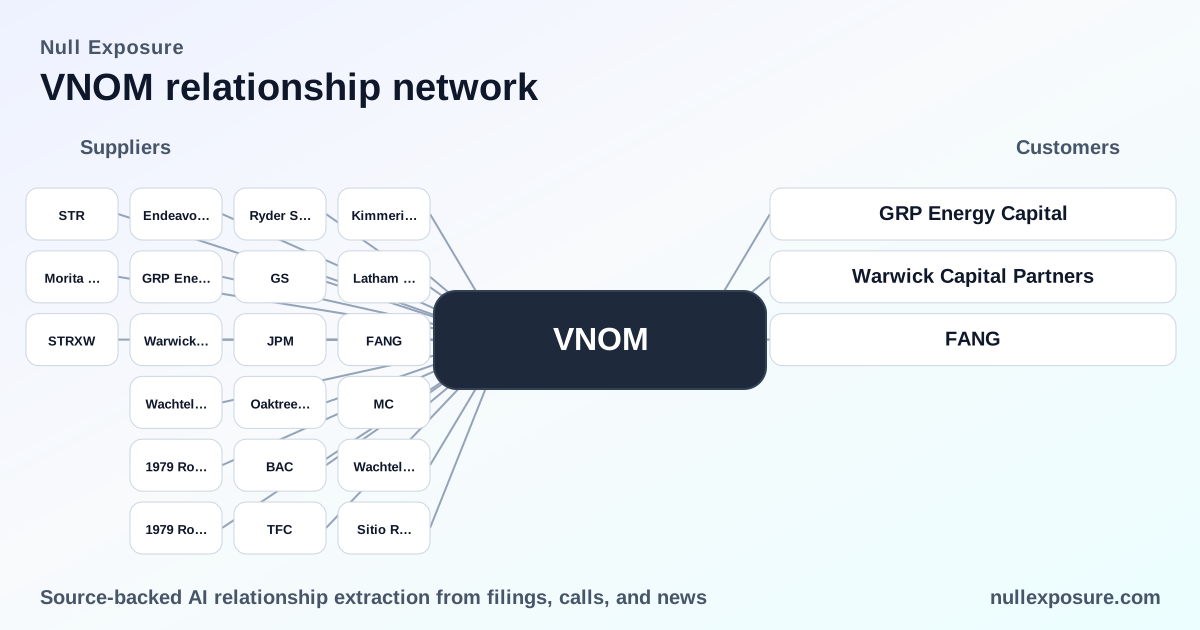
- GRP Energy Capital — Viper closed the sale of its non-Permian assets to an affiliate of GRP Energy Capital, a private energy investor, for roughly $617 million in net proceeds after customary adjustments. Source: GlobeNewswire coverage reported via ManilaTimes and StockTitan (Feb 2026).
- Warwick Capital Partners — The buyer group also included an affiliate of Warwick Capital Partners sharing in the purchase of the non-Permian assets, taking those legacy holdings out of Viper’s portfolio on February 9, 2026. Source: GlobeNewswire coverage reported via EnergyDigital and StockTitan (Feb 2026).
Those two entries reflect the same transaction executed with a buyer consortium; the sale reduces non-core exposure and converts legacy mineral acreage into liquid capital for shareholder returns.
Diamondback relationship: the operating engine under the royalty model
Diamondback Energy remains a central operating partner for Viper’s royalty receipts. Viper’s business model is centered on collecting royalties from production operated by Diamondback and by third parties on acreage where Viper owns mineral and royalty interests, so Diamondback’s drilling and production cadence directly drives a large portion of Viper’s revenue. Source: Company overview and market coverage summarized in StockTitan (FY2025).
How the operating model looks after the sale
The asset sale and the underlying royalty business imply a specific operating posture:
- Contracting posture — passive royalty owner. Viper does not operate wells; it depends on third-party operators to develop acreage and produce hydrocarbons, which lowers capital intensity but transfers execution risk to operators.
- Concentration — operator concentration is material. Revenue concentration with Diamondback and other active operators increases sensitivity to their investment decisions and production results.
- Criticality — royalties are the core revenue engine. Cashflow is directly tied to third-party production volumes and commodity prices, making the company’s dividend and buyback capacity a function of operator performance and realized oil & gas prices.
- Maturity — established cash-return machine. Viper has a mature, distributable-yield profile supported by past divestitures, a history of incremental buybacks, and strong institutional ownership that treats the vehicle as a yield and cashflow play.
No explicit relationship-level constraints were provided in the source results; treat that absence as a company-level signal rather than an omission of risk — the public record for FY2026 emphasizes the divestiture and operator reliance rather than contractual restrictions.
Relationship-by-relationship view (concise)
- GRP Energy Capital: Acquired Viper’s non-Permian assets as part of the February 9, 2026 divestiture, delivering about $617 million in net proceeds to Viper. This was a cash-conversion event that strengthens Viper’s balance sheet and buyback capacity. Source: GlobeNewswire reporting carried by ManilaTimes and StockTitan (Feb 2026).
- Warwick Capital Partners: Participated alongside GRP in the purchase of the non-Permian assets on February 9, 2026, removing a tranche of non-core acreage from Viper’s portfolio. The deal increased liquidity for shareholder returns. Source: EnergyDigital and StockTitan coverage (Feb 2026).
- Diamondback Energy, Inc. (FANG): The operating relationship is integral — a large share of Viper’s royalty revenue derives from production operated by Diamondback on acreage where Viper owns interests, making Diamondback’s drilling activity a primary revenue driver. Source: StockTitan company overview and FY2025 summaries.
Investment implications — why this transaction matters now
The divestiture to GRP and Warwick is accretive to liquidity and capital return optionality, enabling Viper to fund dividends and buybacks without adding operational risk. However, the sale also concentrates the portfolio toward core Permian holdings and increases reliance on a small group of operators, raising cyclicality tied to those operators’ capex cycles and Permian basin activity.
Key investor takeaways:
- Positive: Strong cash generation structure, high institutional ownership, and a clear use of proceeds to support the dividend and buybacks.
- Watch: Operator concentration risk, commodity-price sensitivity, and continued dependence on third-party capex decisions.
- Valuation context: The company trades with relatively elevated multiples for a royalty vehicle (EV/EBITDA and EV/Revenue reflect expectations for durable cash returns), and analyst coverage skews bullish.
Read deeper company signals and structured relationship data at NullExposure.
Bottom line
Viper Energy is a mature royalty owner that just converted non-core assets into meaningful cash, strengthening near-term capital return capacity while intensifying its operator and Permian concentration. For yield-oriented investors, the company offers a high-yield, low-operational-intensity play, but exposure to operator activity and commodity cycles requires active monitoring of Diamondback and other major producers on Viper acreage. Sources for the relationship and transaction details include GlobeNewswire press materials reported through ManilaTimes and EnergyDigital, StockTitan summaries, and market press in February 2026.