Vontier’s customer profile: durable hardware sales plus growing SaaS annuity
Vontier (VNT) manufactures and sells hardware, software and services into the mobility infrastructure market and monetizes through a mix of product sales, aftermarket parts and recurring software/subscription revenues—notably via its Driivz EV charging platform. The company captures durable margins from installed equipment and is layering higher-margin, contract-backed software and service revenue to shift economics toward predictable annuity streams. For a deeper look at customer relationships and commercial exposures, visit https://nullexposure.com/.
How Vontier actually earns revenue — a concise operating thesis
Vontier operates across three end markets—convenience retail, fleet solutions and auto repair—selling hardware (fueling and environmental equipment, Matco Tools), distributing parts and operating software platforms. Revenue drivers are split between capital goods (one-time sales), aftermarket parts/service (recurring but volatile) and subscription-style software (SaaS) that ramps recurring margins). The corporate disclosure highlights an installed base that seeds aftermarket revenue while the Mobility Technologies segment sells point-of-sale, telematics and EV charging network software that is recognized ratably over contract terms.
- Capital intensity: hardware and manufacturing sales drive near-term cash flow and backlog.
- Annuitization: software and maintenance are recognized over time and are increasingly material to revenue mix.
- Distribution reach: a mixed direct/distributor/reseller go-to-market model extends geographic coverage.
Customer relationships: the specific partners on record
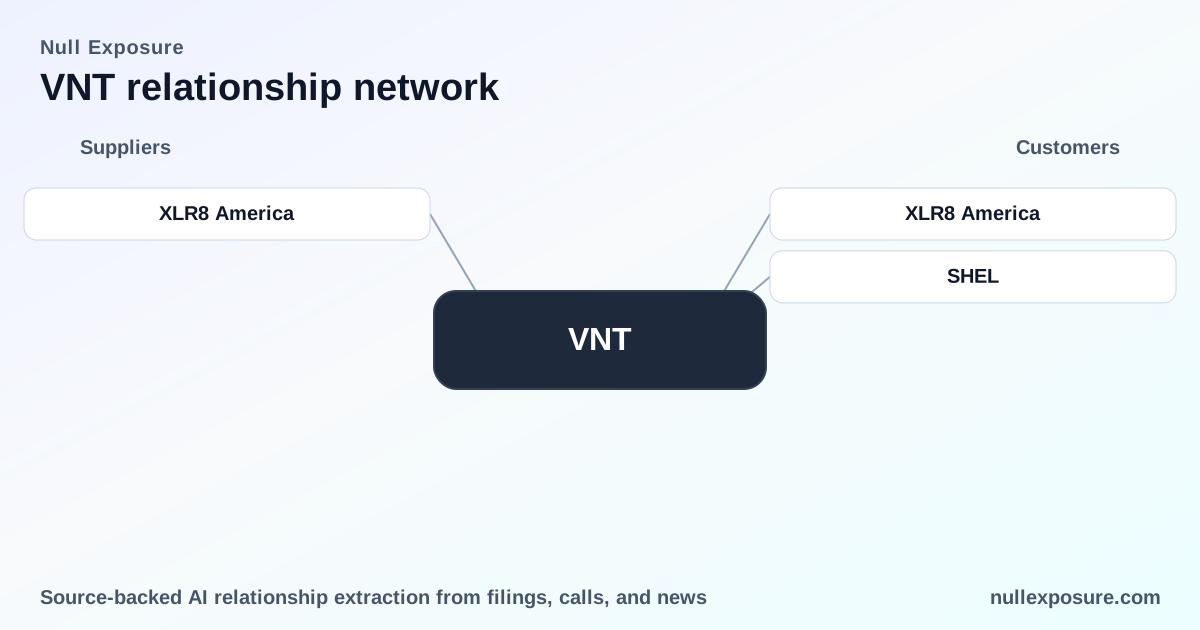
The dataset returned three distinct relationship entries tied to Vontier’s customer universe. Each capture is summarized below with source context and timing.
XLR8 America — large-scale EV charging operations agreement
Vontier’s Driivz platform was selected to manage and optimize over 5,000 EV charging sites for XLR8 America, extending Vontier’s reach in charging network software and services and reinforcing its hardware-agnostic positioning. This placement was reported in a Simply Wall St article covering investor reaction to the Driivz tie-up (March 10, 2026). (Source: SimplyWallSt, March 10, 2026)
XLR8 America — deal framing and corporate context (duplicate coverage)
A follow-up/amp version of the same story reiterated the Driivz–XLR8 America relationship and noted it concurrent with corporate actions such as a quarterly cash dividend declaration (reporting referenced March 2026). This duplicate confirms market visibility and public attention around the deployment. (Source: SimplyWallSt, March 10, 2026)
SHEL — deployed payment/regulatory capabilities with customers
Executives referenced customers like SHEL in the Q4 2025 earnings call, noting that integrating NFX (payment/regulatory tooling) delivers material advantages for customers that require robust payment compliance and transaction throughput improvements. This was discussed during the Q4 2025 earnings call transcript published on March 10, 2026. (Source: InsiderMonkey Q4 2025 earnings call transcript, March 10, 2026)
Shell — global energy retailer using Vontier’s payment and transaction stack
Shell was explicitly cited by management in the same Q4 2025 earnings call as a customer that benefits from Vontier’s layered software (NFX plus other offerings) to manage payment regulation and increase transaction speed and throughput, demonstrating traction with large, global fuel retailers. (Source: InsiderMonkey Q4 2025 earnings call transcript, March 10, 2026)
What that relationship map implies for investors
Collectively these relationships illustrate a deliberate strategy: win marquee, large-site operators for the software platform (Driivz/NFX), then leverage those placements to scale recurring, subscription-like revenue. The XLR8 America engagement signals scaling deployments on a hardware-agnostic platform; the Shell/SHEL citations show enterprise-level validation in payment and transaction infrastructure.
For more detailed customer coverage and to track how these commercial wins evolve into recurring revenue, see https://nullexposure.com/.
Operational constraints and business-model signals investors should treat as firm inputs
Below are company-level signals pulled from Vontier’s disclosures and related excerpts that shape contract economics, concentration and operational risk.
- Contracting posture — long-term and subscription bias. The company discloses backlog and explicit long-term contract value, with SaaS revenue recognized ratably and many SaaS contracts described as non-cancellable; PSA payment terms can extend up to five years, and some franchise notes up to ten years. This indicates a meaningful tilt toward durable contractual commitments rather than purely transactional sales.
- Revenue mix — movement toward subscription/maintenance. Management states an increasing portion of revenue comes from software maintenance and subscription services, a deliberate shift away from pure hardware cyclical exposure toward recurring revenue that supports valuation rerating dynamics.
- Geographic concentration and global reach. Reported U.S. sales were $2,112.4 million in the referenced period, while the company maintains principal markets in Europe and Asia Pacific—domestic-heavy but with international distribution, implying regional revenue concentration risk offset by global market access.
- Customer criticality and maturity. Vontier’s large installed base and long-standing relationships in car wash and fueling networks create recurring aftermarket and service demand; many relationships are described as mature and active, supporting consistent aftermarket flows.
- Channel complexity. Sales occur directly and through independent distributors and franchisee networks (reseller/franchise models such as Matco Tools), adding layers to revenue recognition, margin capture and receivables management.
- Segmented portfolio. The business spans hardware, manufacturing, services and software—diversified product categories that reduce single-point exposure but create operational complexity in execution and integration.
Investment implications and risks — what to monitor next
- Upside: Continued enterprise wins (Shell-like deployments and large site management deals such as XLR8 America) convert capital sales into higher-margin, recurring software revenue and improve cash flow visibility. If Driivz scales across tens of thousands of ports, margin leverage and multiple expansion are credible.
- Execution risk: Integrating software platforms with legacy hardware and reseller channels imposes execution and customer success demands; failure to convert pilots into multi-year contracts would pressure guidance.
- Concentration risk: U.S.-weighted revenue and a mix of large enterprise customers imply that a small number of contract renewals or pricing disputes could move near-term results.
- Financial health: Current trailing metrics show operational profitability (EBITDA and operating margin positive) and a valuation consistent with a company in transition to higher recurring revenue.
Conclusion — the thesis distilled for investors
Vontier combines durable hardware economics with a deliberate push into subscription software, and recent customer citations (XLR8 America, SHEL/Shell) provide public evidence of enterprise traction in EV charging and payment/regulatory tooling. Investors should value the company on a blended basis: hardware cyclical cash generation plus the optionality and margin improvement delivered by scalable SaaS contracts. Monitor contract renewals, SaaS ARR growth and the pace at which large-site software deployments convert to multi-year revenue streams.
For ongoing customer intelligence and relationship tracking, visit https://nullexposure.com/.