VNTG: Customer Footprint and Contract Signals for Investors
Vantage Corp (VNTG) operates as a niche shipbroker with headquarters in Singapore and Dubai, monetizing through transaction fees and agency arrangements in the oil tanker market. The company converts cargo flow and chartering activity into recurring commission revenue, supported by a compact cost base and concentrated client workflows. For investors, the key focus is how customer relationships and contract exposure translate into predictable fee income and whether reported relationships extend VNTG’s addressable market beyond shipbroking. For further company-wide intelligence and relationship mapping, visit https://nullexposure.com/.
Executive thesis: narrow franchise, transaction-driven cash flow
VNTG’s financial profile shows a small-market-cap specialist: market capitalization roughly $26 million, TTM revenue of $16.8 million, and EBITDA of about $836k. The business model converts shipping market activity into commission revenue, producing a high operating margin (23.3%) on a thin net profit margin (3.75%), which signals operational leverage but sensitivity to non-operational items. Concentration is a structural feature — the company’s size and industry focus create reliance on a limited number of counterparties and route flows rather than diversified product sales.
What the customer relationship data reveals
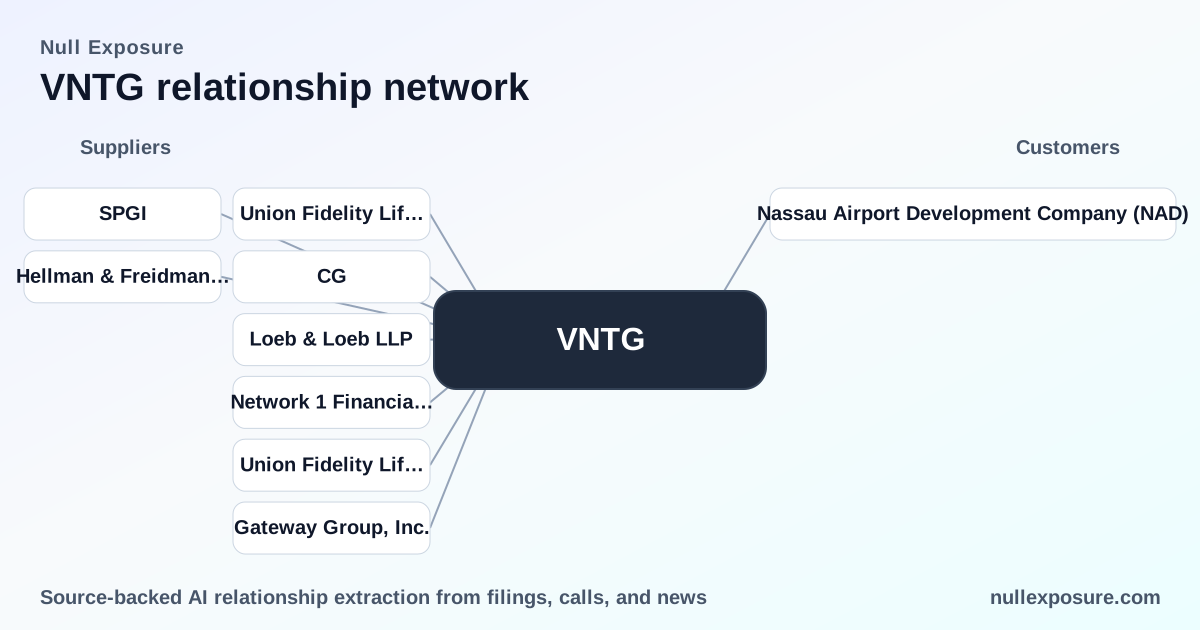
The relationship records for VNTG include a single documented customer linkage in our coverage window. Below I summarize that relationship and what it implies for investors evaluating revenue quality and strategic footprint.
Nassau Airport Development Company (NAD) — reported operational link in FY2019 coverage, surfaced 2026
A March 10, 2026 news report in The Bahamas Weekly states that Nassau Airport Development Company (NAD) is owned by the government of The Bahamas and operated by Vantage, integrating Lynden Pindling International Airport (LPIA) into Vantage’s worldwide network of airports. The record ties NAD to VNTG’s customer set and indicates an operational relationship in airport management under the Vantage brand (The Bahamas Weekly, March 2026). This item is notable because VNTG’s core corporate description identifies it as a shipbroking firm; the customer link suggests either brand extension, affiliated operations under the Vantage name, or reporting that connects VNTG to other Vantage businesses. Source: The Bahamas Weekly, “Nassau Airport Development Company, Vantage Airport Group Host Successful Operations Workshop in Nassau,” first seen March 10, 2026.
How to interpret this listed relationship
- Brand and business-line ambiguity: The public record connects the Vantage name to airport operations in Nassau while VNTG is described as a shipbroker; investors should interpret the NAD entry as a signal that the Vantage group name operates across multiple transport verticals, which can introduce both diversification and corporate governance complexity.
- Revenue criticality and concentration: With only one customer-level item disclosed in our results, the available relationship data is sparse. The reported NAD relationship is not sufficient to materially alter revenue concentration conclusions derived from VNTG’s financials, but it does flag potential non-shipping revenue streams or affiliated business activities that warrant further diligence.
- Source and timing: The NAD reference is sourced to a 2026 operations workshop report and refers to FY2019 context for NAD’s ownership; treat the link as a long-lived operational arrangement rather than a short-term commercial contract.
Company-level operating signals and contracting posture
Because explicit contract-level constraints are absent in the record, present signals should be read as company-level characteristics rather than relationship-specific facts:
- Contracting posture: VNTG operates as a transaction-oriented intermediary rather than a long-term service contractor; its cash flow profile is therefore tied to market volume and volatility rather than fixed-term contracted revenue.
- Concentration: The firm’s small revenue base and limited public customer disclosures signal high customer and revenue concentration risk, making performance sensitive to a handful of client relationships or trade lanes.
- Criticality: For counterparties that rely on VNTG’s market access and chartering expertise, the firm can be a critical intermediary, but from a buyer side, VNTG’s services are replaceable in a competitive broking market. This reduces counterparty leverage but increases commercial pressure on margins.
- Maturity: Financial ratios and corporate scale indicate a mature small-cap operator in a specialized niche, not an early-stage growth franchise; capital allocation and margin management are primary value levers.
Financial context that matters to relationship valuation
Investors should weigh customer signals against the company’s financial metrics: Price-to-Sales ~1.55, EV/EBITDA ~11.8, and Return on Equity ~56.7%. Those numbers reflect a compact but potentially profitable operation with operational efficiency (high operating margin) offset by low net margins and modest absolute EBITDA, consistent with transactional broking that scales profitably when volumes are steady. These metrics justify targeted due diligence into any non-core relationships (like airport operations references) that could diversify revenue or introduce new capital requirements.
Risks and catalysts driven by customer relationships
- Risk — Reputation and brand alignment: Any conflation between different Vantage-branded operations could create governance and disclosure risks if investors cannot clearly map revenue and obligations across entities.
- Risk — Concentration: Sparse customer disclosures and low institutional ownership (~2.4%) increase the likelihood that single relationships materially affect quarters.
- Catalyst — Clarification of scope: Public confirmation of cross-vertical operations (airports vs. shipbroking) or formalization of long-term contracts would be a positive re-rating event because it would either broaden revenue sources or demonstrate strategic expansion.
- Catalyst — Renewals in core shipping clients: Given the transactional model, sustained charter volumes and retained client mandates produce immediate earnings leverage.
What investors should do next
- Request or review corporate disclosures that reconcile the Vantage brand family and delineate revenue by business line and legal entity to assess whether the NAD relationship represents a direct customer, an affiliate arrangement, or a separate Vantage group business.
- Monitor operating volume metrics and quarterly commentary for signs of diversification into airport or non-shipping contracts that would change capital needs and revenue predictability.
For an integrated view of relationship mappings and contract-level signals, visit https://nullexposure.com/ for deeper analysis and primary-source linkages.
Bottom line
VNTG is a compact, transaction-driven shipbroking franchise with limited public customer disclosure; a 2026 news report ties the Vantage name to airport operations in Nassau, introducing a potential cross-vertical exposure that requires clarification. Investors should prioritize confirming legal entity boundaries and revenue attribution before revising concentration and credit assessments.