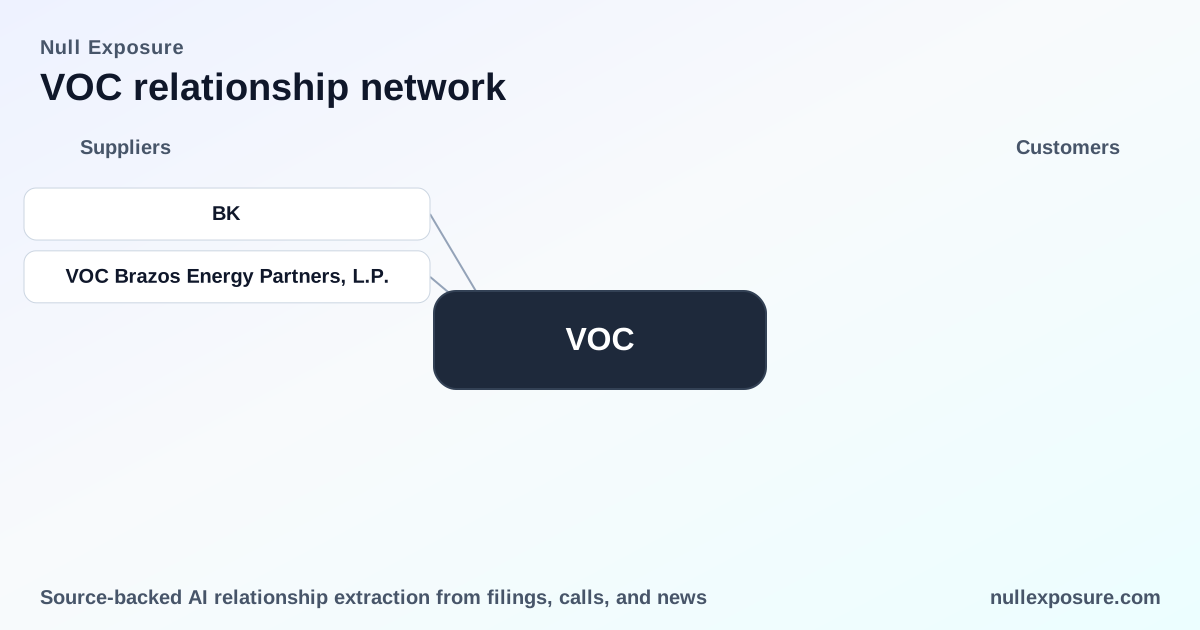
VOC Energy Trust: The customer map and what it means for investors
VOC Energy Trust acquires forward interests in the net proceeds from oil and gas production in Kansas and Texas and monetizes through net-profits-interest receipts and downstream sales of produced hydrocarbons. The Trust’s cash yield is driven by production volumes from underlying properties and the pricing realized when those barrels are sold—often to a small set of purchasers under short-term, market-sensitive arrangements. For a quick look at VOC’s investor materials, visit https://nullexposure.com/.
One-line operating thesis for shareholders
VOC functions like a narrowly focused royalty instrument: the Trust collects net proceeds from operators and related entities rather than operating wells directly, then distributes a large portion of that cash as dividends. That structure delivers high payout ratios and commodity-price sensitivity, with counterparty and contracting posture shaping near-term cash volatility.
How the business actually runs: short-term sales, concentrated buyers, high payout mechanics
VOC’s operating model combines three structural traits that matter for valuation and risk:
- Short-term, market-sensitive sales: Company disclosures indicate that purchasers of production—most materially MV Purchasing—buy under terms ranging from one to six months and at market-sensitive prices. That creates immediate price exposure on every lift rather than a long-term hedged revenue stream.
- Concentration of purchasers: Historical filings show a small number of buyers purchase substantially all production, and one affiliate has purchased as much as 35% of production in recent years, making counterparty performance a material factor for cash receipts.
- Cash-distribution orientation: As a trust that holds forward interests, VOC’s economics are linked to gross production and realized prices after operating and marketing costs; the Trust’s dividend profile therefore tracks commodity cycles and purchaser behavior closely.
These are not neutral operating details: short-term contracts increase revenue volatility, and concentrated counterparties increase single-point counterparty risk.
Contracting posture and revenue sensitivity (what contracts imply for cash flow)
VOC’s counterparty arrangements are fundamentally spot-like. Company-language in regulatory filings states there are no firm commitment contracts or payment guarantees for production sold, and purchasers transact under short-term arrangements. That yields straightforward implications for investors: when oil prices rise, the Trust benefits quickly; when prices fall or a major purchaser reduces lifts, the Trust’s distributions compress quickly as well.
Customer relationships: the universe investors need to evaluate
VOC Brazos Energy Partners, LP
VOC Brazos is the entity that actually remits the Trust’s quarterly net-profits-interest payments and therefore functions as the primary conduit for the Trust’s cash receipts. According to an EDGAR-derived report aggregated on ADVFN, VOC Brazos makes quarterly net-profits-interest payments to the Trust (document reported 2016). Source: ADVFN report of EDGAR filing (2016) — https://br.advfn.com/noticias/EDGAR/2016/artigo/72876261.
MV Purchasing, LLC
MV Purchasing, an affiliate of VOC Brazos, purchases a significant portion of production from the underlying properties under short-term, market-sensitive arrangements, historically buying roughly 35% of production in reported years. Filings and filings-summaries indicate MV Purchasing’s purchases run from one to six months and account for a material share of volumes, so MV Purchasing is both a major buyer and a price-taking channel for produced oil. Sources: ADVFN/EDGAR filings summarized in 2016 and 2019 (discussing purchases and contract terms) — https://br.advfn.com/noticias/EDGAR/2016/artigo/72876261 and https://br.advfn.com/noticias/EDGAR/2019/artigo/81139163.
(Note: the dataset returns multiple mentions of MV Purchasing across years; the commercial relationship is consistent — short-term purchases of a material share of production.)
What the disclosed constraints tell investors about VOC’s business model
The disclosure excerpts collectively deliver several company-level signals investors must price:
- Contract type: short-term / spot-oriented — Multiple filings indicate sales are under one- to six-month arrangements and there are no firm commitments or payment guarantees. That is a fundamental driver of cashflow variability.
- Relationship role and concentration — The Trust’s arrangements show both buyer and seller dynamics: the Trust’s upstream affiliates buy production and the Trust receives net-profit proceeds; one purchaser historically accounted for ~35% of production, signaling concentration risk.
- Materiality and activity — Purchases by MV Purchasing are described as material and ongoing, so counterparty performance is a current, not hypothetical, risk.
- Core product exposure — The relationships are tied directly to the Trust’s core product—crude oil from the underlying properties—so customer behavior directly affects distributable cash.
Where constraints explicitly name counterparties (for example, MV Purchasing and VOC Brazos in the filings), those specifics support the relationship-level summaries above. Where the constraints are more general—references to “several purchasers” or lack of guarantees—treat those as company-level characteristics that raise revenue cyclicality.
Key risk/reward implications for investors
- Reward: The Trust structure leverages production to deliver high dividends and strong profit margins when pricing is supportive; VOC’s recent metrics show high profitability ratios and a meaningful dividend yield (DividendYield ~13.3% per last reported figures), making it attractive for yield-seeking allocations.
- Risk: Short-term, spot-priced sales and purchaser concentration are the dominant risks. A material reduction in lifts by MV Purchasing or significant price declines flow directly to distributions with minimal contractual dampening.
- Counterparty governance: Several purchasers are affiliates or related entities; that alignment can be stabilizing but increases dependency on intra-group commercial arrangements. Monitor related-party disclosures and quarterly remittance timing.
Practical monitoring checklist for active investors
- Watch monthly/quarterly production volumes and whether MV Purchasing’s share of lifts changes.
- Track lift-to-payment timing from VOC Brazos to the Trust, which directly affects dividend coverage.
- Monitor commodity prices and any movement toward longer-term marketing arrangements; any shift away from one- to six-month terms would materially reduce bilateral price exposure.
If you want a concise, investor-focused pack on VOC’s counterparty map and how it feeds distributable cash, visit our homepage for downloadable summaries: https://nullexposure.com/.
Bottom line: thesis refined
VOC is a concentrated, yield-oriented vehicle whose near-term cash profile is highly sensitive to spot pricing and a small set of purchasers, especially MV Purchasing and payments routed through VOC Brazos. That structure creates a clear trade-off: attractive yields and upside in a rising market, paired with elevated counterparty and price risk on the downside. Investors evaluating VOC must combine macro commodity outlooks with careful monitoring of these named counterparties and the short-term contracting posture disclosed in company filings.