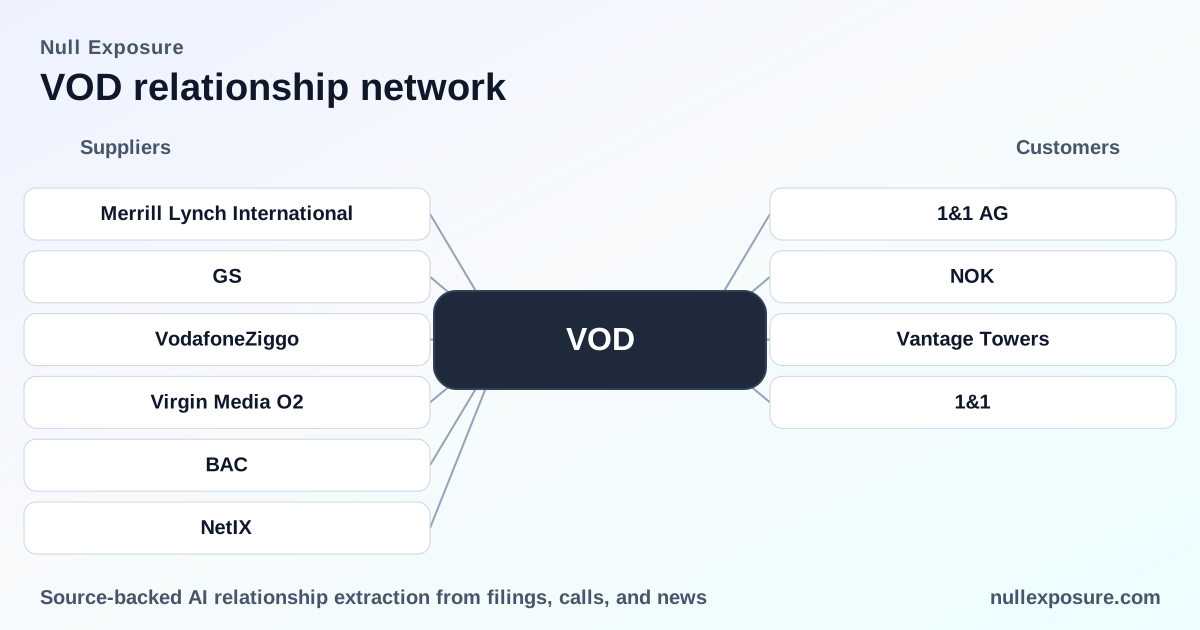
Vodafone (VOD) — Customer relationships and where the revenue really comes from
Vodafone is a diversified European telecom operator that monetizes through consumer mobile and fixed subscriptions, wholesale network services, tower asset monetization and long-term service contracts with corporate and carrier customers. The firm's cash generation is driven by core subscriber ARPU and scale in Germany and the UK, while strategic transactions—tower sales and joint-venture reorganizations—are being used to de-lever and fund selective growth. For investors, the balance between stable subscriber cash flow and one-off monetizations (towers, stake sales) defines the stock’s risk-reward profile. For further context on the platform and relationship signals, visit https://nullexposure.com/.
Why customer and partner relationships determine Vodafone’s optionality
Vodafone operates as an incumbent wholesaler and retail operator simultaneously, which shapes its contracting posture: long-term service agreements are common, and commercial deals often lock in multi-year revenue streams. The business shows market concentration (Germany repeatedly noted as its largest market) and high criticality in relationships with network vendors and wholesale customers—those partners affect network performance and go-to-market capability. The company’s maturity is characteristic of a large telco: steady core EBITDA with episodic capital recycling to manage leverage and invest in next-generation services. There are no explicit contractual constraints recorded in the available relationship records that would limit Vodafone’s ability to restructure these commercial arrangements in the near term.
Customer map: what the recent sources reveal about Vodafone’s relationships
1&1 AG (FY2026)
Vodafone added 1&1 AG as a wholesale customer in Germany, a win that helped migrate 12 million 1&1 customers onto Vodafone’s 5G network but did not prevent competitive pressure from softening growth in the market. According to TradingView’s March 2026 coverage, the addition is material for wholesale volumes in Vodafone’s largest market (https://www.tradingview.com/news/gurufocus:6136df26f094b:0-vodafone-shares-slide-5-as-germany-growth-misses-expectations/).
LBTYA — Liberty Global (FY2025)
On the spectrum and M&A front, Liberty Global reported that VMO2 (Virgin Media O2) closed a purchase of 80 MHz of spectrum from Vodafone, indicating asset transfers and coordination between the groups. The transaction reflects cross-operator asset reallocation in European markets (Investing.com transcript, May 2026: https://ca.investing.com/news/transcripts/earnings-call-transcript-liberty-global-q2-2025-focuses-on-innovation-and-asset-sales-93CH-4246226).
ERIC — Ericsson (FY2025)
Vodafone signed a five-year strategic agreement with Ericsson for programmable networks in Europe, with Ericsson remaining Vodafone’s primary vendor, reinforcing vendor continuity and operational stability for network upgrades. This was disclosed in an Ericsson earnings call transcript reported March 2026 (Insidermonkey: https://www.insidermonkey.com/blog/telefonaktiebolaget-lm-ericsson-publ-nasdaqeric-q3-2025-earnings-call-transcript-1628259/).
NOK — Nokia (FY2026)
Vodafone is deepening its anti-fraud capability by integrating Vodafone’s network APIs into Nokia’s anti-fraud products across Europe starting April 2026, signaling tighter vendor integration on security and fraud mitigation. TradingView summarized the partnership in March 2026 (https://www.tradingview.com/news/tradingview:3c364974d992e:0-key-facts-vodafone-buys-shares-from-goldman-partners-with-nokia-on-fraud/).
Nokia — Nokia (FY2026)
A duplicate reporting entry reiterates the same strategic integration between Vodafone and Nokia on Europe-wide anti-fraud solutions, underscoring the operational importance Vodafone places on vendor-led security products (TradingView, March 2026: https://www.tradingview.com/news/tradingview:3c364974d992e:0-key-facts-vodafone-buys-shares-from-goldman-partners-with-nokia-on-fraud/).
Vantage Towers (FY2026)
Vodafone continues monetising tower assets via Vantage Towers and related structures, using proceeds to de-lever and fund targeted growth—an explicit element of Vodafone’s capital strategy to improve the balance sheet. This asset-monetization strategy was covered in an ad-hoc news overview in March 2026 (Ad-hoc-news: https://www.ad-hoc-news.de/boerse/ueberblick/vodafone-s-stock-wakes-up-can-a-high-yield-turnaround-story-finally/68530470).
LBYAV — Liberty Global / VodafoneZiggo (FY2026)
Liberty Global and Vodafone entered long-term service agreements related to VodafoneZiggo, ensuring continuity of operations during the transition of asset ownership and preserving integrated service delivery in the Benelux market. A Shearman advisory note referenced this commercial continuity in May 2026 (A&O Shearman news, May 2026: https://www.aoshearman.com/en/news/ao-shearman-is-advising-liberty-global-on-the-commercial-aspects-of-its-acquisition-of-vodafoneziggo).
1&1 (FY2026)
Separately reported coverage confirms that the migration of 12 million 1&1 customers onto Vodafone’s 5G network completed successfully, which is a significant wholesale revenue and utilization event for Vodafone’s German network. Telecom Review Africa reported this operational milestone in March 2026 (https://www.telecomreviewafrica.com/articles/telecom-operators/28239-vodafone-posts-strong-q3-fy26-performance-in-africa-and-europe/).
LBYAV — Liberty Global (FY2026, coverage)
SimplyWall and other market reports flagged the planned acquisition of Vodafone’s 50% stake in VodafoneZiggo as central to Vodafone’s FY2026 agenda, highlighting strategic portfolio reshaping and the resulting need for transitional service agreements. SimplyWall coverage in May 2026 emphasized the deal context and implications for cash generation (SimplyWall, May 2026: https://simplywall.st/stocks/us/telecom/nasdaq-lbty.a/liberty-global/news/liberty-globals-q1-profit-rebound-and-vodafoneziggo-deal-mig).
LBYAV — Liberty Global (FY2026, media follow-up)
Market outlets including TipRanks and industry press reported that Liberty Global’s purchase of Vodafone’s Benelux stake included long-term service arrangements to maintain operational alignment, supporting continuity of revenue while ownership shifts. TipRanks and related coverage in May 2026 reinforced the same operational detail (TipRanks: https://www.tipranks.com/news/the-fly/liberty-global-to-buy-vodafones-vodafoneziggo-stake-transfer-benelux-assets-thefly-news).
LBYAV — Liberty Global (FY2026, earlier reporting)
Earlier reporting noted Liberty’s interest in buying out Vodafone’s stake in local ventures, providing context for the later formal agreements and transactional timeline. Silicon Republic covered the market movement and strategic intent in March 2026 (https://www.siliconrepublic.com/comms/three-ireland-ck-hutchison-mobile-operator-liberty-global-sale).
IRDM — Iridium Communications (FY2026)
Iridium’s partnership with Vodafone IoT for non-terrestrial network (NTN) NB‑IoT connectivity positions Vodafone in the direct-to-device satellite-enabled IoT market, expanding Vodafone’s enterprise and IoT service addressable market. The integration and strategic push were noted in an Iridium earnings/industry report in May 2026 (IBTimes/Australia coverage, May 2026: https://www.ibtimes.com.au/iridium-communications-stock-surges-11-q1-earnings-call-announcement-amid-satellite-growth-1865233).
What these relationships mean for investors
- Revenue diversification: Wholesale deals (1&1), IoT partnerships (Iridium) and vendor integrations (Ericsson, Nokia) expand recurring service lines beyond the retail subscriber base.
- Balance-sheet mechanics: Vantage Towers monetization and the VodafoneZiggo stake sale illustrate an explicit strategy of harvesting asset value to reduce leverage and fund selective capex.
- Operational risk concentration: Germany’s market softness and the reliance on a small set of large wholesale or JV arrangements create concentration risk; vendor continuity with Ericsson and Nokia is strategically critical.
- Contracting posture: The prevalence of long-term service agreements (e.g., with Liberty Global on VodafoneZiggo) underpins revenue visibility through transitions and reduces near-term churn risk.
Key takeaway: Vodafone’s customer relationships are a blend of traditional retail cash flow and large, high-impact commercial agreements that materially affect leverage and growth optionality. Investors should weigh steady EBITDA from subscribers against the one-off volatility of asset sales and the strategic importance of vendor partners for network performance.
For a deeper read on how these customer and partner dynamics translate to financial exposure and counterparty risk, explore our platform at https://nullexposure.com/.