VOLT: What the Vega Acquisition Means for Customers and Investors
Volt Information Sciences operates as a workforce solutions and professional staffing business, monetizing through placement fees, time-and-materials billings for contract employees, and managed-services arrangements that convert headcount into recurring revenue streams. The company’s value accrues from contract scale, customer concentration, and the operational efficiency of converting bench and recruiting costs into billable hours. For investors evaluating customer relationships, the recent change of control is the defining event that resets counterparties, contract terms, and integration risk profiles. For continuing analysis and tracking, see ongoing coverage at https://nullexposure.com/.
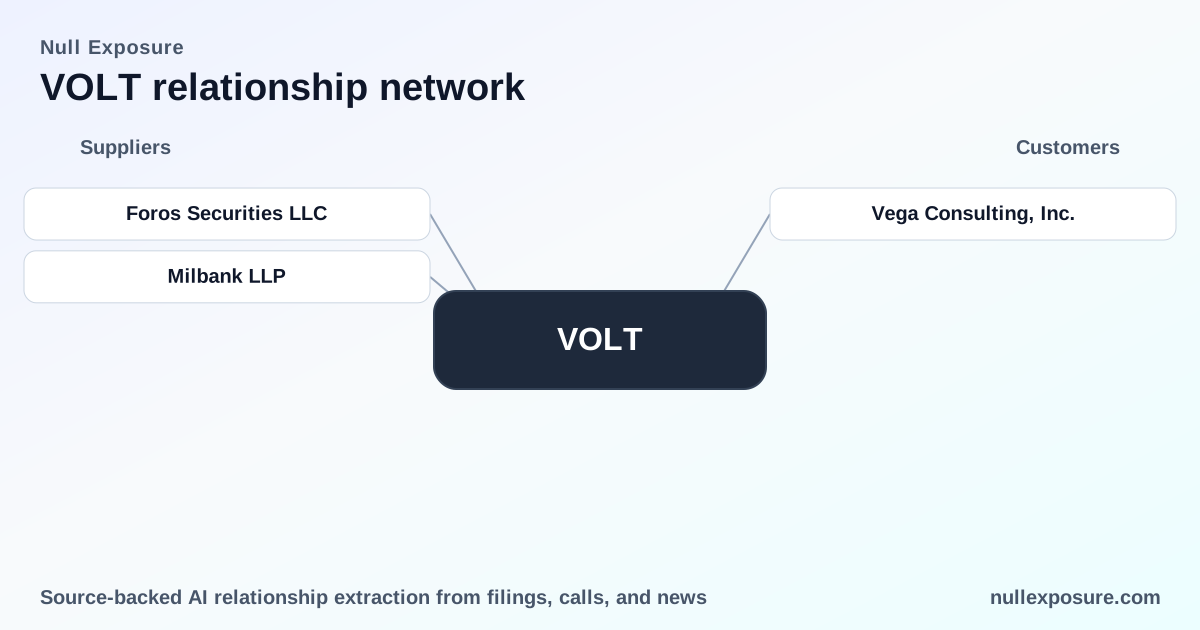
The headline relationship: Vega Consulting purchased Volt for $6.00 per share
A FinancialContent/Press-Telegram release (BusinessWire) reported that Vega Consulting, Inc. agreed to acquire Volt Information Sciences for $6.00 per share in cash, a transaction disclosed in relation to Volt’s FY2022 filings and press coverage. The same coverage noted that shareholder counsel (Halper Sadeh LLP) initiated an inquiry into the fairness of the cash sale, signaling active investor scrutiny around deal pricing and process. (Press-Telegram/BizWire via FinancialContent, March 2022; first-seen in the feed March 2026.)
How the Vega transaction reframes customer risk and contracting posture
The acquisition fundamentally changes the counterparty landscape for Volt customers and suppliers. Under new ownership, expect:
- Repricing and re-contracting risk: Vega will control negotiation levers for renewals and new placements, with timing and approach driven by integration priorities and margin targets rather than Volt’s prior commercial cadence.
- Operational continuity as a performance factor: Customers that rely on Volt for critical contingent labor or managed solutions will evaluate continuity guarantees, SLAs, and transition plans — these are the levers that determine whether revenue remains sticky.
- Regulatory and shareholder pressure: Public reporting of an investigation into the deal’s fairness increases the probability of follow-on litigation or deal adjustments that can distract management and affect post-close integration speed.
These are not theoretical: a cash sale at a fixed per-share price concentrates downside risk for sellers and concentrates negotiation power with the acquirer immediately after closing.
Relationship detail (complete coverage of results)
- Vega Consulting, Inc.: The press release in the FinancialContent feed states that Vega Consulting offered $6.00 per share in cash to acquire Volt Information Sciences, Inc., reflecting a full-company transaction disclosed in fiscal year 2022 reporting and covered in March 2022 media; press reports also flagged an investigation by Halper Sadeh LLP into the fairness of the sale process. (FinancialContent/Press-Telegram, BusinessWire, March 2022.)
Business-model implications and company-level signals
The data feed for customer relationships contains no formal constraint excerpts, which itself is a company-level signal: there are no listed third-party limits, regulatory flags, or contract-specific constraints surfaced in this relationship extract. From a commercial and operational vantage, the acquisition provides several clear signals about Volt’s business posture:
- Contracting posture: Historically transactional with pockets of longer managed-service agreements; ownership change signals an imminent phase of contract re-evaluation and consolidation. Expect aggressive renegotiation where margins can be improved.
- Concentration: Staffing and managed services businesses characteristically show client concentration risk — a handful of large enterprise accounts frequently drive a disproportionate share of revenue. The change in ownership elevates the importance of understanding who the top customers are and how sticky those engagements are.
- Criticality: For clients that treat Volt as a primary source of contingent labor or critical IT staff, switching costs are material — transitions create operational risk and cost. Vega’s approach to integration will determine whether Volt’s customer relationships remain strategic or become commoditized.
- Maturity: The sale at a fixed cash price denotes a liquidity event consistent with a mature lifecycle transition: an exit for equity holders and a strategic reset for the business under new stewardship.
These characteristics should guide diligence priorities: contract durations and termination clauses, customer concentration metrics, and integration milestones are the highest-value items to verify.
Risks and upside from a customer-relationship perspective
- Integration and execution risk is the primary near-term exposure. Customers should demand clear transition plans, personnel continuity commitments, and explicit SLAs to prevent service disruption during ownership handover.
- Contract renegotiation is a parallel risk and opportunity. Vega will want to extract margin improvements; customers that want to preserve terms must prepare to demonstrate vendor lock-in or competitive alternatives.
- Shareholder litigation can slow strategic change. The reported inquiry by plaintiff counsel increases the chance of delays or even deal amendments that affect management bandwidth.
- Upside arises from operational improvements. If Vega achieves cost synergies while maintaining delivery quality, customers could benefit from stabilized pricing and an expanded service offering over time.
Practical takeaways for investors and operators
- For investors: Re-rate Volt’s post-close revenue visibility based on the probability of contract churn among large customers and on Vega’s integration plan. The transaction price sets a near-term ceiling on public equity value absent a revised buyer or new disclosure.
- For corporate operators and procurement teams: Use the change of control as leverage to clarify continuity terms and to benchmark alternative suppliers; insist on written transition milestones and maintain contingency staffing plans to mitigate any short-term service degradation.
For deeper coverage and ongoing signals related to Volt’s customers and deal evolution, visit https://nullexposure.com/ for continuing updates and primary-source tracking.
Bottom line
The Vega acquisition is the single, material customer-related development surfaced in the available feed: a cash sale at $6.00 per share that resets Volt’s counterparty dynamics and places integration execution at the center of near-term value creation or erosion. Investors and enterprise buyers must treat contract renegotiation risk and continuity assurance as the two most actionable items when assessing post-transaction exposure.