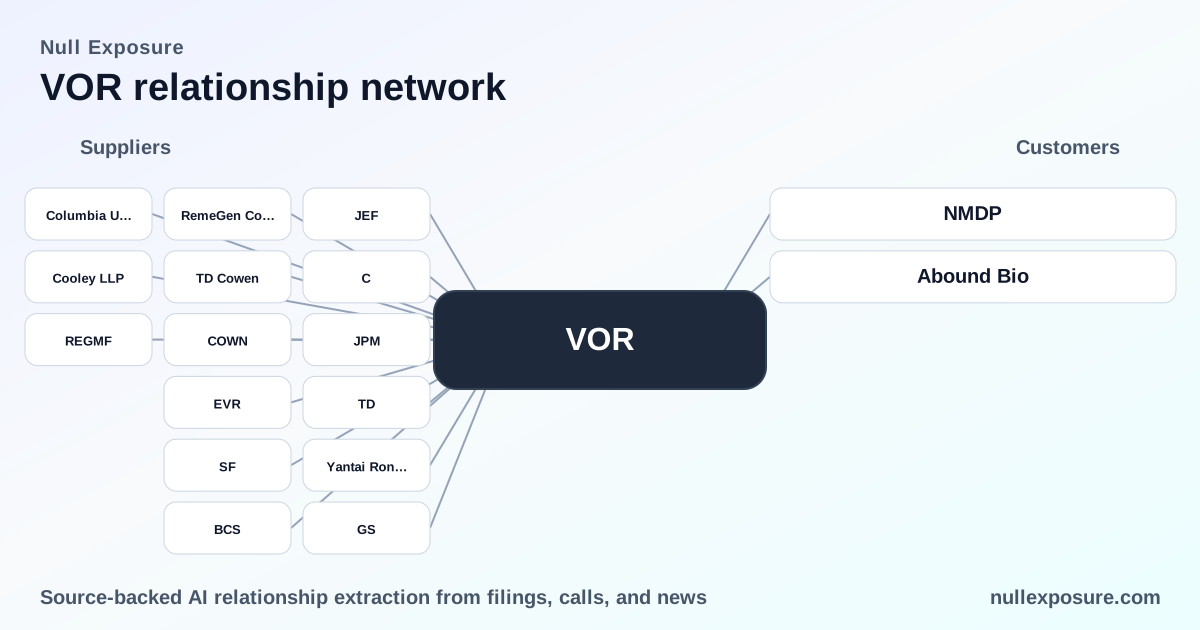
Vor Biopharma’s partner map: where value and risk sit for investors
Vor Biopharma develops engineered hematopoietic stem cell (eHSC) therapies designed to enable safer allogeneic transplants and to unlock targeted cell therapies for blood cancers. The company monetizes through clinical-stage product programs, strategic collaborations and license arrangements, and capital markets transactions that fund development until commercial launch; revenue is currently zero while value is driven by clinical progress, partner-sponsored programs, and milestone/licensing optionality. For a consolidated view of customer and partner signaling, NullExposure tracks the relationships below — more context at https://nullexposure.com/.
Why partner and customer relationships determine Vor’s valuation trajectory
Vor is an early-stage biotech with no product revenue and negative operating results, so progress is funded and de‑risked through three channels that show up in the relationship list: clinical collaborations that enable pivotal studies, research licenses that expand product scope, and strategic financing that extends runway. Clinical sponsors and research partners are operationally critical because trial outcomes and co‑development arrangements drive regulatory timing, future commercial economics, and licensing leverage.
Vor’s current market capitalization and earnings profile reflect these dynamics: the company is capital‑intensive, dependent on external funding, and value will be realized only as clinical readouts and partner milestones convert into regulatory and commercial optionality.
What the disclosed constraints tell investors about operating posture
Vor’s public disclosures and model statements collectively convey a clear commercial and strategic posture:
- Geographic focus is primarily U.S. for commercialization. Vor states it will build focused U.S. capabilities and a targeted sales force to address concentrated specialist populations; this is a deliberate go‑to‑market choice that limits early commercialization cost and concentrates regulatory focus in the U.S. (company filing language).
- Global market opportunity remains part of the long‑term plan. Vor quantifies the global allogeneic HCT market and states an intention to maximize reach for transplant patients worldwide, signaling a staged international expansion after U.S. commercialization is established.
- Contracting posture is seller‑oriented for future commercialization. Vor frames itself as building commercial capabilities to sell shielded transplants and targeted therapies, which implies standard biopharma commercialization contracts rather than pure services or toll‑manufacturing relationships.
- Product focus is core product commercialization rather than ancillary services. Public language positions the company’s eHSC platform and shielded transplant programs as core assets that will drive future revenue.
Taken together, these signals describe an early‑stage biotech that is commercially focused but operationally immature, reliant on partner funding and trial outcomes to bridge to a seller role. Investors should treat Vor’s partner list as a direct proxy for near‑term runway, regulatory exposure, and program diversification.
Customer and partner relationships investors must track
NMDP — clinical sponsorship that affects regulatory outcomes
Vor discloses that the NMDP sponsors the VCAR33 AUTO trial, and that results or developments in that sponsored trial can negatively impact regulatory approval and demand for Vor’s products if the trial outcome is adverse. According to Vor’s FY2024 10‑K filing, the NMDP relationship is directly tied to trial sponsorship and therefore regulatory risk for the program.
TCGX — strategic financing that materially extends runway
In May 2026 Vor completed a $75.0 million private placement with entities affiliated with TCGX, issuing 5,338,078 common shares at $14.05 per share and obtaining registration rights, providing substantive near‑term liquidity and investor alignment with TCGX interests. This financing was reported in a TradingView news item covering the private placement (FY2026).
Abound Bio — research collaboration to expand therapeutic combinations
Vor and Abound Bio entered a multi‑year collaboration and license agreement to research single‑ and multi‑targeted CAR‑T treatments for use in combination with Vor’s eHSC platform, aiming to generate combined systems for AML and other blood cancers; the agreement is positioned to broaden Vor’s product architecture beyond single‑agent programs. The collaboration was announced via a GlobeNewswire release in June 2021 (FY2021).
How each relationship affects commercial concentration, criticality and maturity
Vor’s relationship slate spans research, clinical sponsorship and financing — a useful functional diversification for an early‑stage company — but concentration is still meaningfully high because only a handful of counterparties carry outsized operational impact:
- Criticality: The NMDP sponsorship is operationally critical for clinical validation and regulatory timelines; negative developments there directly affect product approval probability. Abound Bio influences product breadth and combination strategies that affect future market size and licensing potential. TCGX materially influences capitalization and near‑term dilution/ownership dynamics.
- Concentration: With just a few named partners, Vor’s exposure to counterparties is concentrated; adverse outcomes with any one of these partners would have an outsized effect on development and financing options.
- Maturity: These relationships are consistent with an early‑stage, development‑focused company: discovery and preclinical research agreements (Abound), sponsor‑driven clinical programs (NMDP), and equity financing (TCGX) rather than recurring commercial customers.
Investment implications — what to watch next
For investors evaluating Vor’s trajectory, the following items are priority monitors:
-
Clinical readouts and sponsor announcements from NMDP. Trial outcomes and study design updates determine regulatory path and commercial timing.
-
Use of proceeds and dilution profile from the TCGX financing. Monitor filings for registration rights execution, equity issuance, and how the capital extends the company’s runway.
-
Progress and milestone triggers in the Abound collaboration. Research milestones that enable INDs or combination studies increase optionality and licensing leverage.
-
Commercial strategy execution in the U.S. vs. global rollout. The stated U.S. commercialization focus implies a sequenced global expansion that affects near‑term addressable market and cost structure.
-
Cash runway and additional financing needs.
-
Counterparty concentration risk and sponsor dependence.
-
Regulatory dependencies tied to partner‑sponsored trials.
If you want the full partner signal package tracked across filings and market news, see the NullExposure coverage at https://nullexposure.com/ for ongoing updates and linkable source references.
Bottom line
Vor Biopharma is a capital‑intensive, early‑stage biotech whose value is driven by a small set of high‑impact relationships: a clinical sponsor (NMDP) that controls program outcomes, a strategic investor (TCGX) that extends runway through a material private placement, and a research partner (Abound Bio) that broadens therapeutic scope. Investor returns will be binary and event‑driven, hinging on clinical milestones, partner deliverables, and successful capitalization. Track those counterparties closely — they are the operational levers that convert Vor’s scientific platform into commercial value.