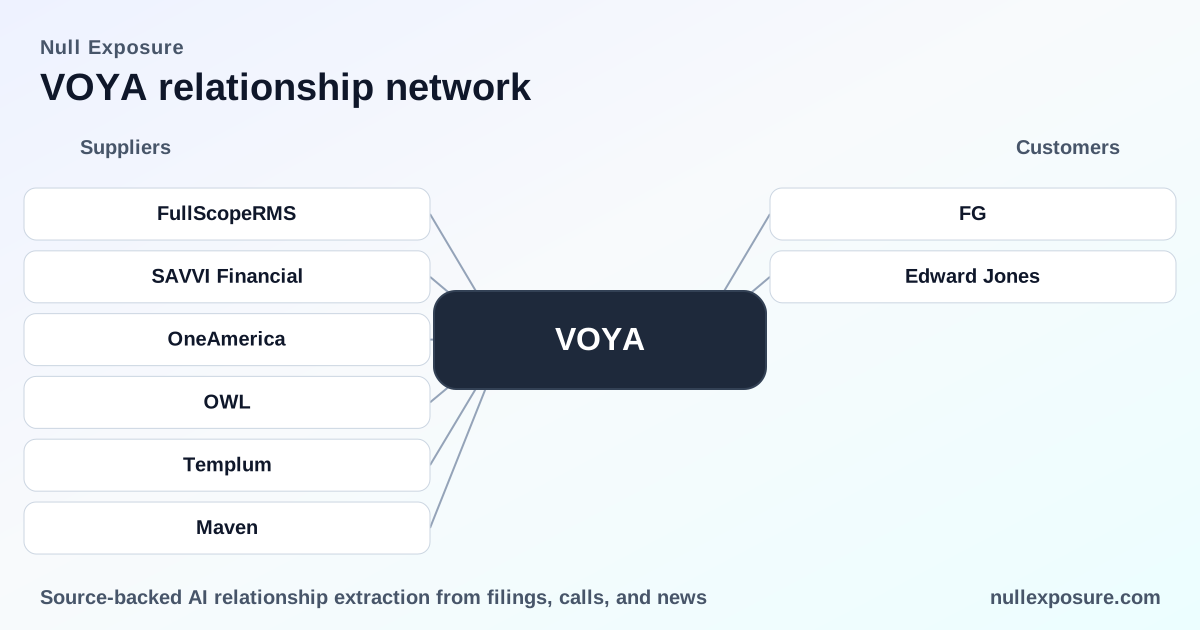
Voya Financial: customer relationships that drive a retirement-anchored franchise
Voya Financial monetizes through a three-legged model: fee-bearing retirement recordkeeping and advisory services, investment management and distribution fees, and software/subscription services for benefits administration. The company captures recurring revenue from plan sponsors and individual investors, collects asset-based and transaction fees from institutional and retail clients, and sells cloud-based benefits software and administration services to employers; these streams combine sticky, recurring economics with periodic transactional uplifts from annuity distribution and investment performance. For investors, the critical read-through is that Voya’s revenue base is diversified across product types and counterparty segments but structurally tied to retirement plan participation and asset levels, making distribution partnerships and subadvisory arrangements strategically important. For more relationship-level intelligence, see https://nullexposure.com/.
H2: Why relationship mapping matters for Voya investors
Relationship signals show how Voya embeds itself in the retirement and wealth ecosystem. Subadvisory mandates, platform integrations, and annuity distribution partnerships create both revenue synergies and operational dependencies. These links explain where growth will come from (platform expansion, distribution partnerships) and where downside concentrates (stop‑loss repricing, client churn, or lost distribution agreements).
H2: Relationship-by-relationship rundown — who Voya works with and why it matters
H3: AIO (Virtus Artificial Intelligence & Technology Opportunities Fund) Voya Investment Management serves as a subadviser to Virtus on this closed-end fund, positioning Voya as a portfolio manager on specialty strategies that extend its investment management reach beyond core retirement channels. Source: Virtus fund notices and media reporting (StockTitan / Marketscreener, filings referenced March 2026 and Aug 2023 — https://www.stocktitan.net/news/AIO/virtus-artificial-intelligence-amp-technology-opportunities-fund-uxr0mqgzzx1j.html).
H3: NCZ-P-A (Virtus Convertible & Income Fund II — preferred shares) Voya Investment Management is listed as a subadviser on Virtus’s convertible-income vehicle, reinforcing Voya’s role as a third-party asset manager on closed-end and income-oriented funds that generate advisory revenue. Source: Yahoo Finance / Marketscreener notices (Dec 2025 / Mar 2026 — https://finance.yahoo.com/news/virtus-convertible-income-fund-ii-224500833.html).
H3: VRTS (Virtus Dividend & Income / diversified strategies) Voya acts as a subadviser on select Virtus strategies, signaling repeatable subadvisory revenue and distribution exposure through affiliate relationships that broaden Voya’s institutional client footprint. Source: Virtus press releases and distributor notices (news pieces March–May 2026 — https://sg.finance.yahoo.com/news/virtus-dividend-interest-premium-strategy-170300568.html).
H3: BRW (Saba Capital Income & Opportunities Fund / formerly Voya Prime Rate Trust) Historical filings show Voya previously served as investment adviser to the predecessor trust before the adviser role transferred to Saba Capital in 2021; this underscores that Voya has trimmed or restructured some adviser relationships, which can reduce legacy recurring fees but also free capacity for new mandates. Source: Saba/Voya transition notices (StockTitan filings March 2026 referencing the 2021 adviser change — https://www.stocktitan.net/news/BRW/brw-announces-notification-of-sources-of-9xu5p7llizu9.html).
H3: TNET (TriNet integration for retirement administration) TriNet announced pre-built connector integrations beginning with Voya and Vestwell, indicating a platform-level distribution channel for Voya’s retirement administration and recordkeeping services to small and midsize employers. That integration accelerates enrollment and distribution scale for Voya’s workplace retirement business. Source: TriNet press release / Seeking Alpha (March–May 2026 — https://www.sahmcapital.com/news/content/trinet-unveils-platform-innovations-purpose-built-for-todays-small-and-medium-size-businesses-2026-03-24).
H3: FG / F&G Annuities & Life F&G joined Voya’s annuity platform, giving F&G distribution access to Voya’s wealth channels and expanding Voya’s annuity product set available through partner carriers — a distribution partnership that supports annuity sales without Voya bearing full product risk. Source: Market reporting and company announcements (Finviz / MarketScreener / SahmCapital coverage, March–May 2026 — https://finviz.com/news/270999/voya-financial-voya-stock-is-up-what-you-need-to-know).
H3: Edward Jones Company commentary referenced distribution through an Edward Jones relationship, which points to traditional broker-dealer distribution as a channel for Voya’s wealth and retirement products and supports incremental retail asset flows. Source: Voya investor communications reported in financial press (March 2026 — https://finance.yahoo.com/news/voya-financial-touts-775m-2025-090424966.html).
H3: ATH-P-A (Athene / reinsurance of Voya annuity block) Historical disclosures reference the acquisition/reinsurance of Voya’s individual fixed and fixed indexed annuity business by Athene in a prior transaction, illustrating Voya’s strategic use of reinsurers and carve-outs to manage capital and risk on annuity liabilities. Source: A.M. Best and historical press coverage (reported in industry press, archived April 2018 notice referenced in databases — https://bernews.com/2018/04/a-m-best-affirms-ratings-of-athene-holdings/).
H2: What the constraints tell investors about Voya’s operating model
- Contracting posture: Voya mixes subscription-style software agreements (1–3 year terms) with short-term, renewable financial services contracts (many under one year) for advisory, R&A and stop‑loss products, producing a balance of recurring and variable revenue. The company also runs programmatic mutual fund frameworks (Voya Framework) for plan sponsors. Evidence drawn from company revenue-recognition descriptions in regulatory filings points clearly to these contract types.
- Customer concentration and counterparty mix: Voya serves a broad counterparty set — government/public, large enterprise, mid-market, non-profits, and individuals — reducing single‑counterparty concentration but making the business sensitive to macro employment and retirement-plan participation trends.
- Geographic and segment reach: While predominantly North America-focused for workplace and benefits solutions, Voya’s investment management operations are global, with EMEA and APAC exposure via subadvisory and distribution agreements.
- Relationship criticality and maturity: Many relationships are service-provider and vendor-style (recordkeeping, subadvisory, platform integrations) and often mature and active, particularly in retirement plan services where Voya leverages long-term participant relationships to sell wealth products.
H2: Investment implications and risk signals
- Growth levers: Platform integrations (TriNet), broker-dealer distribution (Edward Jones), and third-party annuity arrangements (F&G) are the primary drivers for asset inflows and annuity distribution — each partnership expands distribution without proportionate capital strain.
- Operational risks: Short-term contract elements (annual repricing of stop-loss and some admin contracts) create earnings variability, and the company’s exposure to annuity product transfers or reinsurance deals can shift capital needs and margins.
- Earnings quality: The mix of subscription software revenue plus recurring advisory fees improves predictability, but fee revenue remains tied to asset levels and participant behavior; asset-management subadvisory roles add scalable, fee-accretive income.
H2: Bottom line and next steps
Voya’s customer map shows a deliberate balance of advisory, subadvisory, platform and distribution relationships that extend its reach while managing capital intensity. For sector-focused investors, the critical questions are whether distribution partnerships accelerate asset gather and whether short-term contract exposure compresses near-term margins. For deeper relationship analytics and to track changes in real time, visit https://nullexposure.com/.
Bold takeaway: Voya is a distribution-anchored financial services company that uses platform integrations and subadvisory mandates to scale fee revenues while selectively offloading product risk through partnerships and reinsurance.