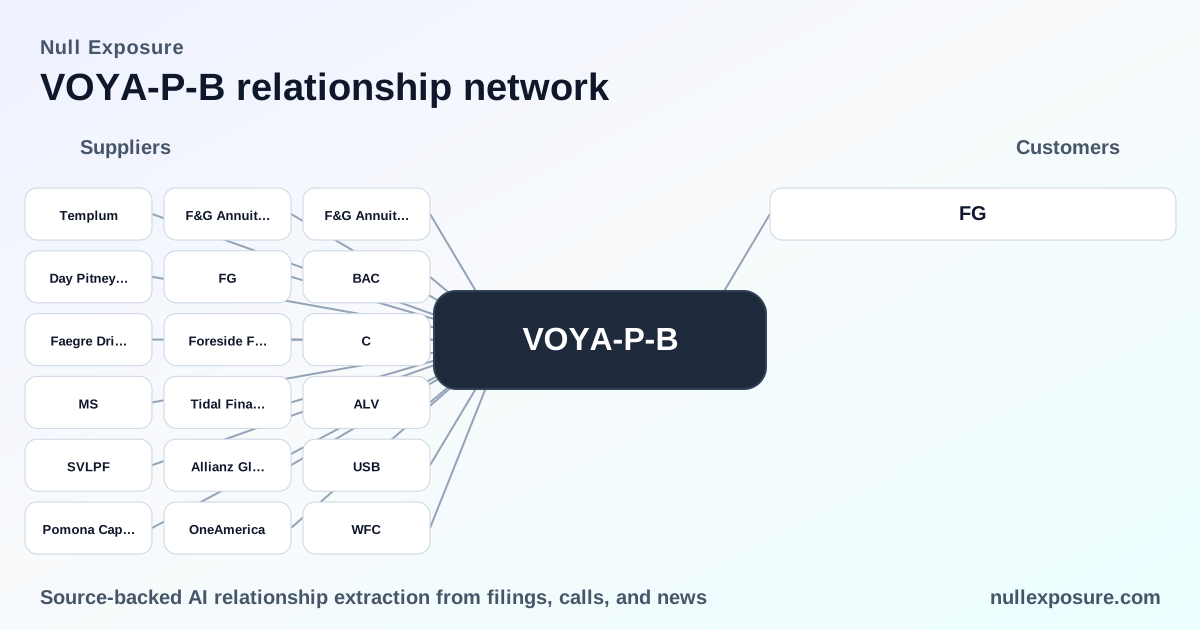
Voya Financial (VOYA-P-B): An investor briefing on customer relationships and annuity platform expansion
Voya Financial operates as an integrated retirement, investment and insurance provider that monetizes through fee-based asset management, insurance premiums and platform distribution partnerships—the firm expands scale and margin by hosting third-party annuity providers on its distribution and administration platform. Recent news flow documents a strategic partner onboarding that increases Voya’s access to protected-growth annuity supply and strengthens its distribution pipeline.
For deeper relationship analytics and source-traced signals on Voya’s commercial ties, visit https://nullexposure.com/ for primary access and modelled insights.
What the recent signals mean for strategy and monetization
The collected items show Voya executing on a platform-oriented growth strategy: Voya’s annuity platform is an active commercial channel that brings external annuity issuers into Voya’s distribution and servicing ecosystem. That operating posture converts distribution relationships into recurring fee opportunities (administration, recordkeeping, and distribution fees) while improving product diversity for distributors and clients.
From an operating-model perspective, this pattern signals:
- Contracting posture: Voya acts as a platform integrator and distributor, contracting with multiple annuity providers to widen product supply rather than relying solely on proprietary issuance.
- Commercial concentration and criticality: Adding a named partner increases product breadth but does not indicate single-counterparty concentration; partnerships like this are commercially important to product offering and revenue mix, especially for protected-growth annuities.
- Maturity and scale: Announcements of new entrants onto Voya’s platform are consistent with a mature distribution capability that can onboard and commercialize third-party products at scale.
These observations are drawn from the cited coverage below; Voya’s filings and market reporting document the announcement cadence and dates.
Document-level relationship log (each listed result)
-
Finviz news piece (published/first seen 2026-03-10) notes that F&G Annuities & Life joined Voya Financial’s annuity platform to expand access to protected growth solutions, indicating a new distribution partnership. Source: Finviz article covering Voya Q4 commentary (https://finviz.com/news/324670/rbc-capital-liked-what-it-saw-in-voya-financials-voya-q4).
-
MarketScreener item (first seen 2026-03-10) reports on the same development: F&G Annuities & Life is now on Voya’s annuity platform, broadening the platform’s product access, dated Feb. 25 in the article synopsis. Source: MarketScreener (https://www.marketscreener.com/news/voya-investment-management-and-pomona-capital-digitize-investment-access-to-the-pomona-investment-fu-ce7e5cd3d08df423).
-
StockTitan SEC filing mirror (first seen 2026-03-10) reproduces Voya’s disclosure that F&G Annuities & Life has joined the annuity platform, consistent with press and investor communications. Source: StockTitan SEC filings mirror (https://www.stocktitan.net/sec-filings/VOYA/144-voya-financial-inc-sec-filing-bdda0e6ee2f2.html).
-
StockTitan’s Form 4 mirror (first seen 2026-03-10) includes corporate filing context tied to the same announcement, reinforcing that the F&G partnership was part of Voya’s disclosed activity during the period. Source: StockTitan Form 4 mirror (https://www.stocktitan.net/sec-filings/VOYA/form-4-voya-financial-inc-insider-trading-activity-55049db5bb51.html).
-
A second StockTitan Form 4 entry (first seen 2026-03-10) repeats the filing context and reference to F&G joining Voya’s annuity distribution platform, matching other contemporaneous disclosures. Source: StockTitan Form 4 mirror (https://www.stocktitan.net/sec-filings/VOYA/form-4-voya-financial-inc-insider-trading-activity-5e62bce06235.html).
-
Additional MarketScreener capture (first seen 2026-03-10) duplicates the Feb. 25 narrative that F&G Annuities & Life is now available through Voya’s platform, underscoring distribution expansion messaging. Source: MarketScreener (same article link as above).
-
A further Finviz capture (first seen 2026-03-10) reiterates RBC Capital commentary around Voya Q4 and mentions the F&G onboarding as a positive signal for product accessibility on Voya’s platform. Source: Finviz (https://finviz.com/news/324670/rbc-capital-liked-what-it-saw-in-voya-financials-voya-q4).
-
An entry in StockTitan’s SEC mirror (first seen 2026-03-10) again records the corporate disclosure about F&G’s participation in the annuity platform, indicating the announcement propagated through regulatory mirrors and news aggregators. Source: StockTitan SEC filings mirror (https://www.stocktitan.net/sec-filings/VOYA/144-voya-financial-inc-sec-filing-bdda0e6ee2f2.html).
-
Another StockTitan Form 4 mirror entry (first seen 2026-03-10, FY2025 tag) re-presents the same language about F&G joining the annuity platform, showing item-level duplication across mirrored feeds. Source: StockTitan Form 4 mirror (https://www.stocktitan.net/sec-filings/VOYA/form-4-voya-financial-inc-insider-trading-activity-5e62bce06235.html).
-
StockTitan Form 4 (a separate mirror instance first seen 2026-03-10) again references the disclosure that F&G Annuities & Life joined Voya’s annuity platform, consistent with the public narrative. Source: StockTitan Form 4 mirror (https://www.stocktitan.net/sec-filings/VOYA/form-4-voya-financial-inc-insider-trading-activity-55049db5bb51.html).
-
MarketScreener duplicate capture (first seen 2026-03-10) reiterates the Feb. 25 line about F&G’s platform integration, underscoring cross-publication consistency. Source: MarketScreener (https://www.marketscreener.com/news/voya-investment-management-and-pomona-capital-digitize-investment-access-to-the-pomona-investment-fu-ce7e5cd3d08df423).
-
Final Finviz entry (first seen 2026-03-10) repeats the RBC/Finviz coverage that flagged F&G’s addition to Voya’s annuity platform as part of the broader Q4 narrative. Source: Finviz (https://finviz.com/news/324670/rbc-capital-liked-what-it-saw-in-voya-financials-voya-q4).
Key implications for operators and portfolio managers
-
Distribution-led growth: The repeated, multi-source coverage indicates Voya is prioritizing third-party annuity distribution partnerships to increase product variety and fee income. This strategy supports margin expansion without the capital intensity of sole proprietary issuance.
-
Low single-counterparty concentration signal: Multiple mirror entries point to broad dissemination rather than numerous distinct new counterparties; at present the evidence documents one named partner (F&G Annuities & Life) joining the platform, which improves product supply but does not signal overreliance.
-
Operational criticality: For annuity distribution, platform access is operationally critical to both Voya and participating insurers; onboarding requires integration, compliance and sales alignment that create modest switching friction and recurring revenue potential.
-
Communication cadence matters: The same announcement appearing across filings and news mirrors suggests Voya treats partner onboarding as an investor-relations narrative—useful for gauging management focus and sales strategy.
Risk factors and what to watch next
- Track whether the partnership converts into measurable product sales and fee income in subsequent quarters; announcements alone do not equate to recurring earnings uplift.
- Monitor the pipeline of additional issuer onboardings to evaluate whether Voya’s platform becomes a scaled marketplace or remains a complementary distribution channel.
- Watch regulatory filings for contract-level disclosures that would reveal economics, duration and termination terms—these are the levers that determine long-term revenue capture.
Bottom line and next actions
The corpus of coverage confirms that F&G Annuities & Life joined Voya’s annuity platform, reinforcing Voya’s platform-distribution strategy and potential for fee-based revenue expansion. For investors and operators, the immediate implication is a broadened product shelf and incremental distribution capability; the longer-term payoff depends on conversion and recurring fee realization.
For a systematic read of these signals and to track partner-level disclosures as they convert into financial outcomes, explore detailed analytical coverage at https://nullexposure.com/.
Bold, source-backed signals like this are foundational to operational due diligence—use the original filings and market reports cited above before adjusting position sizing or operational commitments.