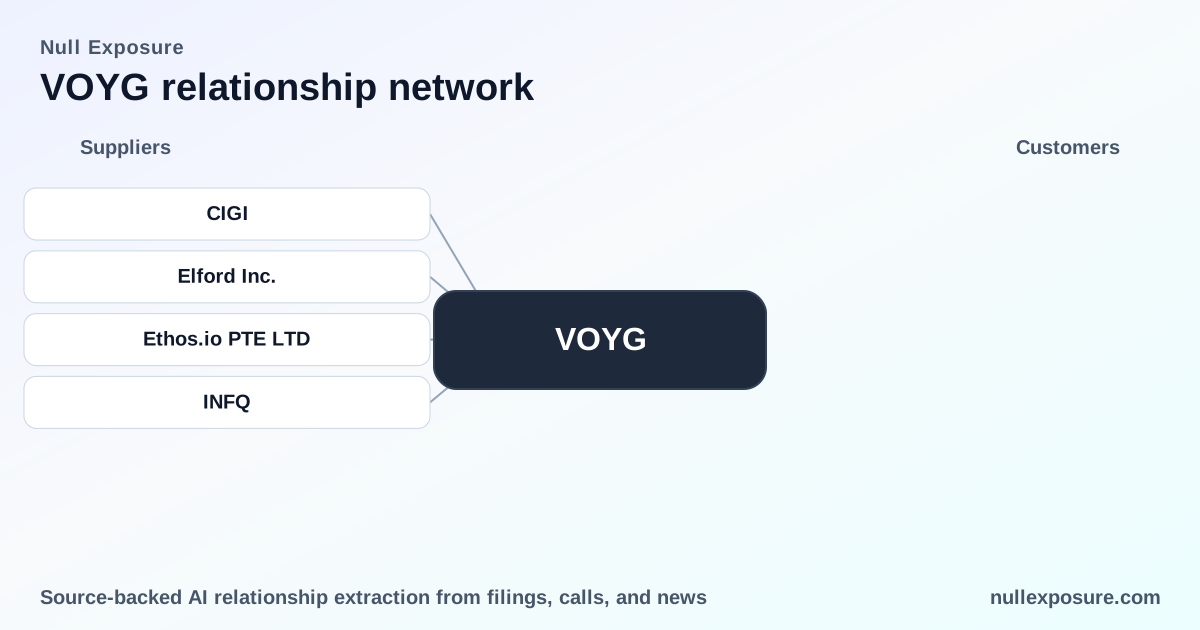
VOYG: Customer relationships that drive a defense- and space-focused revenue base
Voyager Technologies operates as a defense technology and commercial space integrator, monetizing through government and commercial contracts for crewed missions, spacecraft services and systems integration. The company generates revenue from mission orders, partnerships with defense primes and strategic collaborators, and recurring program work tied to NASA and defense customers; Voyager reported $166.4 million in trailing twelve‑month revenue with negative operating margins as it scales mission activity and R&D. For investors, the investment case hinges on execution of government and agency contracts, the quality of prime-partner relationships, and the runway to convert program wins into profitable scale. Learn more about the coverage at https://nullexposure.com/.
Why these customers matter for valuation and risk
Voyager’s customer list reads like a condensed who’s‑who of the U.S. defense and civil space ecosystem. That composition creates a specific operating posture:
- Contracting posture: Revenue originates from government and large-prime programs, which dictates long sales cycles, milestone-based billing, and heavy program management overhead.
- Concentration and leverage: A relatively small number of large partners creates revenue concentration and meaningful client leverage over pricing and contracting terms.
- Criticality: Relationships with NASA and defense primes are mission‑critical — program continuation and timing directly affect revenue cadence and cash flow.
- Maturity signal: Financials show meaningful top-line scale ($166.4M TTM) but negative margins and negative EBITDA, consistent with a company still investing heavily in growth and program delivery rather than generating steady free cash flow.
These company-level signals frame how investors should weight program wins and partner announcements when modeling revenue visibility and downside exposure.
Customer relationships — what the record shows
Below I cover every customer relationship found in the public signals for VOYG. Each relationship is summarized plainly with the source.
Lockheed Martin — a prime-tier partner
Voyager lists Lockheed Martin as one of its key partners and customers, reflecting engagement with a major defense prime that can open procurement channels and subcontracting opportunities. According to a MarketBeat instant alert (October 15, 2025), Lockheed Martin is named among Voyager’s key partners and customers: https://www.marketbeat.com/instant-alerts/voyager-technologies-inc-nysevoyg-given-consensus-recommendation-of-moderate-buy-by-brokerages-2025-10-15/.
Palantir — data and software collaborator
Palantir is cited alongside other strategic partners, indicating Voyager’s alignment with enterprise data and analytics capability providers to support mission operations or defense integrations. MarketBeat’s October 15, 2025 alert lists Palantir as a key partner and customer for Voyager: https://www.marketbeat.com/instant-alerts/voyager-technologies-inc-nysevoyg-given-consensus-recommendation-of-moderate-buy-by-brokerages-2025-10-15/.
NASA — direct agency mission orders
Voyager has secured orders from NASA, including crewed-transport mission work, which directly drives revenue and validates operational capabilities for human spaceflight services. A MarketScreener earnings flash (April 15, 2026) reported that Voyager won a NASA order for its seventh private astronaut mission to the International Space Station: https://www.marketscreener.com/news/earnings-flash-voyg-voyager-technologies-inc-posts-q4-adjusted-loss-0-37-per-share-ce7e5fdedb8bf02c.
Sierra Space — commercial space systems partner
Sierra Space appears in Voyager’s partner list, signaling collaboration with commercial space systems providers that expand Voyager’s addressable market in private astronaut missions and platform services. MarketBeat’s October 15, 2025 notice includes Sierra Space among Voyager’s key partners and customers: https://www.marketbeat.com/instant-alerts/voyager-technologies-inc-nysevoyg-given-consensus-recommendation-of-moderate-buy-by-brokerages-2025-10-15/.
How those relationships translate into measurable investor implications
The customer set is strategically valuable but also imposes structural characteristics that should feature in valuation models:
- Revenue visibility with milestone volatility: Agency and prime contracts generate identifiable revenue when milestones are achieved; however, schedule slips or re-scoping create revenue timing risk. Voyager’s $166.4M TTM revenue is meaningful, but the company reported negative EBITDA and operating margins, underscoring the margin pressure of ramping mission activity and investment in capability.
- De-risking through prime ties — but countervailing concentration risk: Partnerships with Lockheed Martin and Sierra Space provide program access and credibility, while engagement with Palantir suggests capability layering (software + hardware). These relationships reduce go‑to‑market friction but increase customer concentration risk, since a handful of large customers dominate program awards.
- Validation via NASA orders: Direct NASA orders are a strong validation lever for commercial human spaceflight capabilities and accelerate revenue recognition for mission services. The April 2026 NASA order constitutes both near‑term revenue and a reference customer for future commercial opportunities.
- Margin path depends on scale and contract mix: To achieve positive operating leverage, Voyager must convert program wins into a steady cadence of missions and higher-margin systems work; current EV/Revenue multiples (EV/Revenue ~9.31) reflect a market premium that presumes successful scaling.
If you want a focused subscription-grade read on how partner composition affects enterprise value and exposure, consider our broader coverage at https://nullexposure.com/.
Key takeaways for investors
- High-salience partnership roster: Lockheed Martin, Palantir, NASA and Sierra Space are complementary relationships that position Voyager across civil, commercial and defense markets — a strategic advantage for program origination.
- Execution risk remains the primary valuation driver: Milestone delivery, program schedules and contract renewals determine revenue realization and margin expansion. Investors should prioritize program-level disclosures and NASA/prime milestones when updating models.
- Balance of validation and concentration: NASA wins validate the technology and operational model, while dependence on a small set of large partners creates concentrated revenue risk that requires ongoing program success to mitigate.
Conclusion: Voyager’s partner set is a meaningful competitive asset that supports top-line growth opportunities across government and commercial space sectors, but the firm’s current financials and the milestone-driven nature of its contracts necessitate active monitoring of program execution and partner contract cadence for a clear path to profitability.