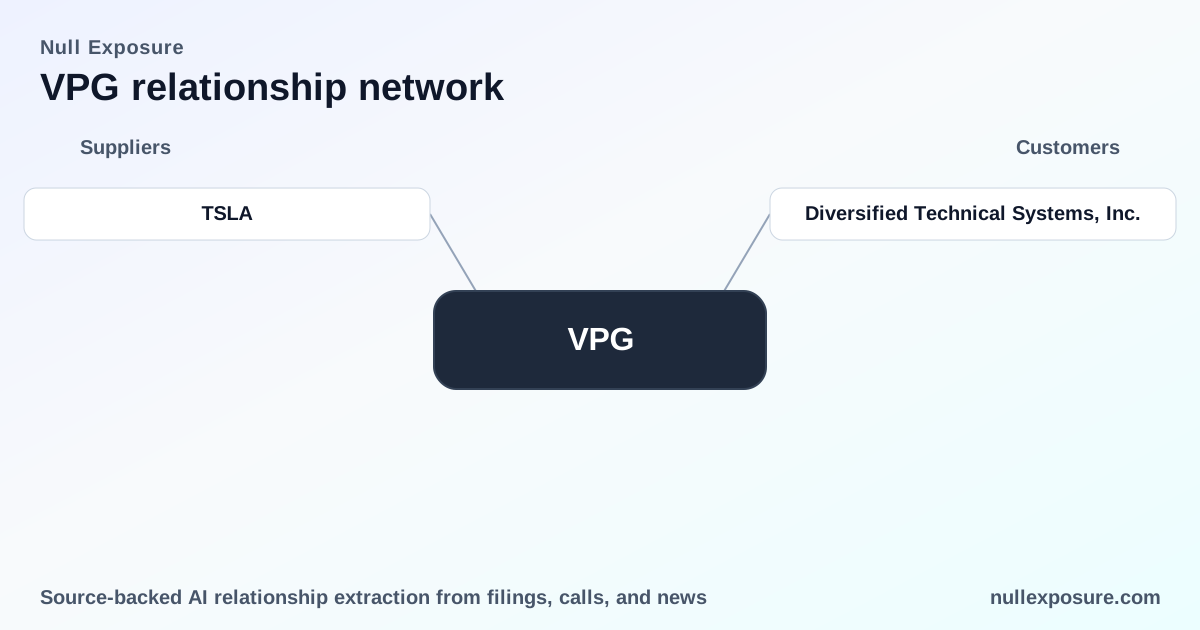
Vishay Precision Group (VPG): Customer Relationships and What They Signal for Investors
Vishay Precision Group designs, manufactures, and sells sensors, strain gauges, special resistors and measurement systems and monetizes primarily through point-of-sale product sales to industrial, aerospace, and automotive customers. Revenue flows are driven by short-term purchase orders and standard net‑30 to net‑60 payment terms, with backlog reflecting customer release-to-ship activity within the next twelve months. For investors, the combination of diversified end markets, modest margins, and a product set that is often “designed‑in” by customers defines both opportunity and operating risk.
If you want consolidated coverage of VPG customer ties and commercial posture, visit NullExposure for our research hub: https://nullexposure.com/
How VPG sells and how its contracts shape the business
VPG recognizes most sales at a point‑in‑time: the company evaluates customer credit, accepts short-term purchase orders, and generally collects on net 30–60 day terms. That contracting posture produces a working‑capital intensive operating rhythm—revenue is transactional, backlog is limited to orders released for shipment in the next 12 months, and there is no pervasive long‑duration service revenue stream. These are company disclosures drawn from the fiscal year filings and year‑end 2024 reporting.
- Contracting posture: Short-term, order-driven sales with limited financing components and standard payment terms.
- Revenue recognition: Point-in-time product sales predominate; backlog excludes long-term uncommitted demand.
- Operational implication: Cash flow and quarter‑to‑quarter revenue volatility track customer order timing rather than recurring contracts.
Geography matters: a global installed base
VPG’s revenue is broadly spread across North America, EMEA, and APAC. Company disclosures for the year ended December 31, 2024 show meaningful receipts across regions: North America (United States and Canada) contributes the largest single bloc, while Europe and Asia provide substantial follow‑through demand. This geographic footprint mitigates single‑market risk but requires a global supply and distribution posture.
According to the company’s year‑to‑date December 31, 2024 disclosure, Europe, the U.S., and Asia all contributed material revenue lines, with the U.S. representing the largest regional total and Asia providing accelerating growth. These figures demonstrate VPG’s cross‑regional sales balance and validate its multi‑market go‑to‑market model.
Customer concentration and commercial criticality
VPG reports that no single customer accounts for more than 10% of net revenues, a clear signal of low revenue concentration. That diversified base reduces counterparty risk but also caps pricing power relative to highly consolidated suppliers. Many of VPG’s products are “designed‑in” by customers, which increases product stickiness for specific applications; in certain end markets—automotive crash testing, aerospace structural testing—VPG components are functionally critical to customer test programs.
From an investor perspective, low concentration lowers headline credit risk while design‑in dynamics increase supplier leverage in selected product families.
Constraint signals and what they imply for investors
Company‑level disclosures and constraint excerpts provide direct investor signals instead of isolated statistics:
- Short‑term contracts (company level): The firm’s revenues derive from purchase orders and contracts typically settled in 30–60 days; backlog includes only orders released for shipment in the next 12 months. This creates a high turnover revenue model and a working‑capital emphasis for operations.
- Global revenue distribution (company level): Fiscal 2024 regional disclosures show material revenues in North America, Europe, and Asia, reinforcing a multi‑regional exposure that dampens single‑market cyclicality.
- Immaterial single‑customer concentration (company level): The company states no single customer made up more than 10% of net revenues—this is a structural diversification advantage for holders of VPG equity.
- Buyer/point‑sale relationship (company level): The company derives substantially all revenue from product sales and recognizes the majority of sales at a point in time; many products are customer‑designed‑in, creating focused but not universally recurring revenue.
Taken together, these constraints describe a manufacturing firm with transactional sales, diversified end markets, and pockets of high operational importance where specific sensors and recorders are essential to customer testing programs.
Customer snapshot — Diversified Technical Systems, Inc.
Diversified Technical Systems (DTS) is reported in media coverage as a close ecosystem partner for VPG product use and was referenced in connection with VPG’s strategic activity. According to CityBiz in March 2026, VPG announced an acquisition of Diversified Technical Systems, and the article notes that DTS recorders have been used with VPG strain gages for vehicle crash safety testing and other dynamic applications. This underscores a commercial alignment between VPG hardware and DTS data‑acquisition products and confirms an operational linkage between the firms (CityBiz, March 2026).
- Diversified Technical Systems, Inc.: VPG’s acquisition and product compatibility with DTS recorders tie VPG strain‑gage hardware into vehicle crash‑test and dynamic measurement workflows, reinforcing VPG’s exposure to automotive safety testing markets (CityBiz, March 2026).
What that relationship means strategically
The DTS link illustrates two practical investor takeaways:
- Product ecosystem value: When VPG components are used in integrated test chains—strain gauges feeding DTS recorders—VPG benefits from cross‑product demand and increased replacement/consumable cycles. The CityBiz coverage frames the relationship as both complementary and strategically consolidating.
- Market exposure: VPG’s role in safety and dynamic testing reinforces its exposure to automotive OEM and supplier capital programs; those programs are cyclical but also mission‑critical when active.
Risks and valuation context
VPG trades as an industrial‑technology supplier with modest margins and relatively high multiple metrics relative to reported earnings; investors should weigh thin operating margins and dependence on order timing against the company’s diversified customer base and design‑in advantages. The fiscal signals—short‑term contracts, global revenue mix, and immaterial single‑customer concentration—suggest the company is operationally stable but earnings are sensitive to cyclical end‑market demand.
For deeper diligence and ongoing monitoring of VPG’s customer relationships and commercial signals, visit NullExposure for our full coverage and relationship maps: https://nullexposure.com/
Bottom line: investable characteristics
- Strengths: Diversified customer base; global footprint across NA/EMEA/APAC; design‑in orientation driving product stickiness in safety and test markets.
- Constraints: Order‑driven, short‑term contracts concentrate execution risk on quarter‑to‑quarter order flow; margins are thin and earnings are sensitive to cyclical demand.
- Key relationship: The DTS connection highlights VPG’s embedded role in vehicle safety testing—an important, mission‑critical end market that supports recurring replacements and system upgrades.
For investors and operators evaluating VPG, the company’s commercial dynamics are clear: transactional, diversified, and strategically integrated into key test ecosystems—a profile that rewards careful cycle timing and operational execution.