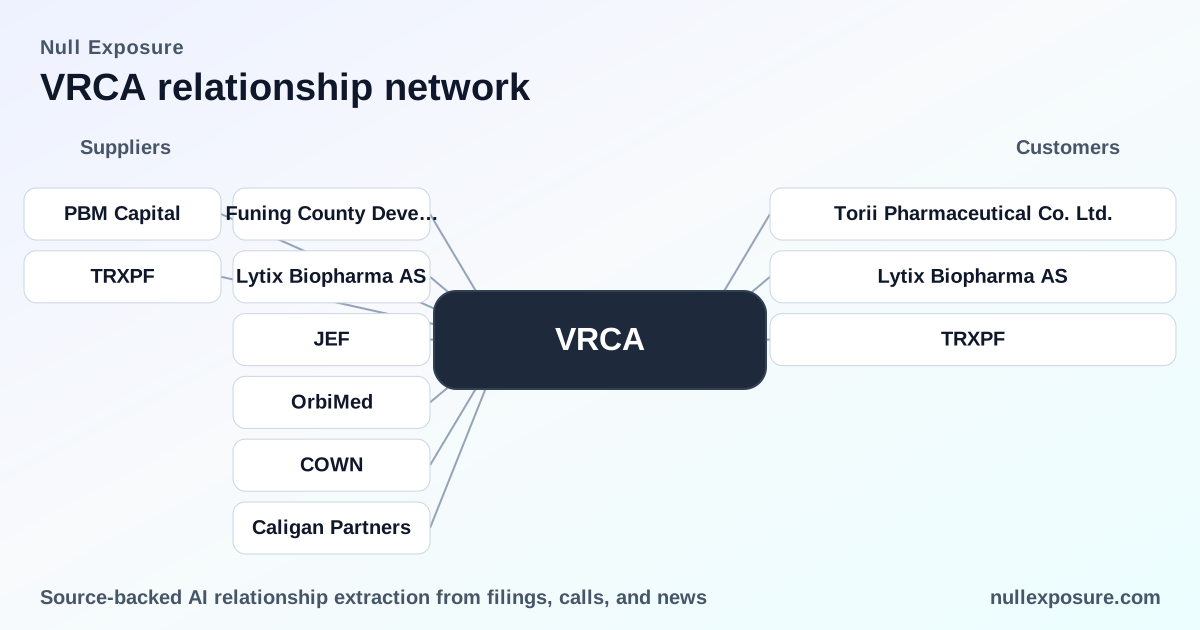
Verrica Pharmaceuticals (VRCA): Customer Relationships, Partner Cashflows, and Commercial Levers
Verrica develops and commercializes dermatology therapies and monetizes through direct U.S. product sales, license and collaboration revenue (milestones and transfer pricing), and future royalties from ex‑U.S. partners. The company sells YCANTH (VP‑102) into the U.S. market through a small dedicated field sales force and pharmaceutical wholesalers, while leveraging international partners to launch and scale the product overseas and to co‑fund late‑stage development for pipeline assets. For a concise view of relationship signals and implications, visit https://nullexposure.com/.
The quick thesis for investors
Verrica is a focused specialty dermatology company with a commercial foothold in the U.S. and a partnership‑driven international strategy that converts regulatory wins into near‑term cash (milestones/transfer pricing) and longer‑term royalties. Key value drivers are partner milestone inflows, cost sharing on trials, and transition from transfer pricing to royalty economics in markets like Japan. The business model concentrates revenue around a small number of products and partners, which amplifies upside from successful launches but raises single‑product and partner concentration risk.
What the relationship signals say about how Verrica operates
Verrica’s commercial and contracting posture is hybrid: direct‑to‑physician selling in the U.S. through a modest field force (≈35 reps) combined with distributor channel sales to wholesalers, and an outsized reliance on partner arrangements for non‑U.S. commercialization and late‑stage funding. Company disclosures show YCANTH was commercially launched in the U.S. in August 2023 and is actively generating product revenue, while partner agreements have already produced milestone receipts and funded a material portion of global trial budgets. These factors indicate:
- Concentration and criticality: A narrow product portfolio and dependence on a handful of partners make individual partner outcomes material to revenue and cash flow.
- Contracting posture: Verrica uses licensing, milestone payments, transfer‑pricing and cost‑share structures to de‑risk capital intensity of global development.
- Maturity: Product commercial for multiple years in the U.S. but early in international rollouts; revenue profile contains both transactional sales and one‑time/recurring collaboration receipts.
Counterparty rundown: every relationship recorded and what it means to investors
Torii Pharmaceutical Co. Ltd.
Torii launched YCANTH in Japan following regulatory approval, converting an approval milestone into commercialization activity and initial transfer pricing revenue for Verrica. A Globenewswire press release summarizing Verrica’s Q4/FY2025 results notes launch activity and that license and collaboration revenue included amounts tied to Torii’s YCANTH launch (Mar 11, 2026: https://www.globenewswire.com/news-release/2026/03/11/3253711/0/en/Verrica-Pharmaceuticals-Reports-Fourth-Quarter-and-Full-Year-2025-Financial-Results.html).
Torii Pharmaceutical (alternate naming in press)
Torii agreed to a contract structure that has already produced a one‑time $10 million milestone payment to Verrica for Japanese approval, and will fund a large share of global Phase 3 costs: Torii will pay the first $40 million of trial costs and split overall program costs 50/50, materially de‑risking Verrica’s near‑term development spend (company releases and investor filings, FY2025–FY2026; see Globenewswire and associated press coverage).
Torii (single‑word reference found in market coverage)
Market reports and trading coverage indicate Verrica will transition from receiving transfer pricing for applicators into royalty receipts on net sales in Japan after a manufacturing transfer is completed, changing Verrica’s margin mix in that market over time (see investing.com coverage on the Torii launch, May 2026: https://m.investing.com/news/stock-market-news/verrica-pharmaceuticals-stock-rises-after-partner-launches-ycanth-in-japan-93CH-4494177?ampMode=1).
TRXPF (inferred symbol for Torii coverage in several feeds)
Certain market aggregators and news feeds annotate Torii with an inferred symbol (TRXPF) when reporting the YCANTH launch and milestone recognition; these summaries track the same commercial and milestone dynamics noted above and were widely reported in March–May 2026 (example aggregator coverage: Finviz and stock briefs referencing the launch in March 2026).
Lytix Biopharma AS
Verrica entered a worldwide license agreement with Lytix to develop and commercialize VP‑315 (formerly LTX‑315) for non‑melanoma skin cancers, broadening the company’s pipeline beyond YCANTH and creating a development/royalty pathway distinct from the Torii relationship (company announcement summarized on Yahoo Finance, FY2025: https://finance.yahoo.com/news/verrica-pharmaceuticals-announces-development-partner-120000025.html).
(Each of the above names appears in public reporting between FY2025 and FY2026 across press releases and market coverage; readers can consult the cited releases for original language and timing.)
How these relationships shape runway, revenue and risk
- Near‑term cash: Torii’s $10M milestone is a tangible, booked inflow that supports operations; Verrica also reported $1.4M of license and collaboration revenue in Q4 2025 tied primarily to Torii commercial supply (Globenewswire, Mar 11, 2026).
- Cost deferral and leverage: The Torii cost‑share for global Phase 3 work ($40M funded by Torii up front; 50/50 split) reduces Verrica’s cash burden and accelerates trial progress without proportionate equity dilution.
- Revenue transition: Ongoing transfer pricing for applicators provides transitional revenue, but royalties on Japanese net sales after manufacturing transfer represent higher‑leverage, longer‑duration upside.
- Distribution and sales model: Verrica’s U.S. commercialization relies on a specialized field sales team of roughly 35 representatives focusing on dermatologists and select pediatricians, with primary distribution through pharmaceutical wholesalers — this structure supports targeted uptake but limits scale efficiencies relative to larger commercial platforms.
Bottom line and action items for modelers
Verrica’s partner arrangements convert regulatory events into immediate cash and outsourced trial spend while establishing future royalty streams; this reduces capital risk and creates clear binary outcomes tied to partner commercial execution in Japan and to clinical progression of VP‑315. For valuation and risk modeling, emphasize partner milestone cadence, the timing of the manufacturing transfer (royalty onset), and concentration risk around YCANTH revenues. For deeper signal analysis and to track partner event timing, explore our coverage at https://nullexposure.com/.
Investor takeaway: Verrica’s value today is driven by partner‑enabled cash inflection points and the conversion of transfer pricing to royalties; downside remains concentrated to execution on a small product set and the commercial effectiveness of international partners.