Varex Imaging (VREX): Customer relationships that drive a hardware‑centric medical OEM play
Varex Imaging designs and manufactures X‑ray imaging components and sells them primarily to large OEMs, distributors, and service providers; it monetizes through product sales (tubes, detectors, generators), licensed imaging software, and multi‑year service and pricing agreements that create recurring revenue and backlog. Revenue concentration with global OEMs and long‑term contracts stabilize cash flow, while hardware exposure and large customer dependency concentrate commercial risk. For a deeper read on comparable customer analytics, visit https://nullexposure.com/.
The operating model in plain language
Varex is a manufacturer and seller of critical X‑ray hardware, supplemented by software licensing and services. The company’s Medical segment combines hardware (X‑ray tubes, detectors, generators) with software (image processing, 3D reconstruction) and aftermarket service offerings. The corporate disclosures indicate Varex routinely enters multi‑year pricing and service agreements with established customers and licenses proprietary imaging software to package sub‑assemblies for industrial applications, which makes revenue streams a mix of transactional product sales and contracted service/licensing income (company filings summarized in FY2025).
Geography is intrinsic to the business model: Varex sells globally across the Americas, EMEA, and APAC, exposing margins to foreign exchange and regional demand cycles. The firm reports an active backlog (approximately $262 million at October 3, 2025), which underlines ongoing order flow and multi‑period revenue recognition. Overall: a capital‑intensive, industrial OEM supplier with diversified product lines but concentrated customers.
What matters commercially: contracting posture and constraints
- Contracting posture: The business combines spot sales with long‑term pricing agreements and service contracts, particularly for industrial Linatron products, which creates durable revenue but also binds the company to negotiated pricing over time (FY2025 disclosures).
- Counterparty profile: Customers are primarily large OEMs, meaning sales cycles are long but individual customers are capable of delivering material purchase volumes.
- Product mix: Varex sells hardware, software licenses, and services — the software licensing role supplements margins and creates recurring value, while hardware sales drive volume and capital intensity.
- Scale and concentration: The top five customers collectively accounted for approximately 40% of revenue in FY2025, a material concentration that amplifies counterparty risk and negotiation leverage.
- Geographic footprint: Sales are global (Americas, EMEA, APAC), so FX volatility and regional healthcare capex cycles are economic drivers of revenue and profitability.
- Backlog and maturity: An active backlog (~$262M as of Oct 3, 2025) signals ongoing demand and execution obligations across multiple periods.
Customer relationships: the ones disclosed and what they mean
Below are the relationships found in the available results; each entry includes a concise plain‑English description and the original source context.
NNOX (Nano‑X) — a development partnership supplying digital X‑ray tubes
Nano‑X disclosed in its 2025 Q3 earnings call that it is developing glass‑based digital X‑ray tubes for use in the Nano‑X ARC and is working with third parties such as CEI and Varex to build tubes, indicating Varex’s role as a supplier/partner for a novel imaging system (Nano‑X 2025 Q3 earnings call, first seen March 2026).
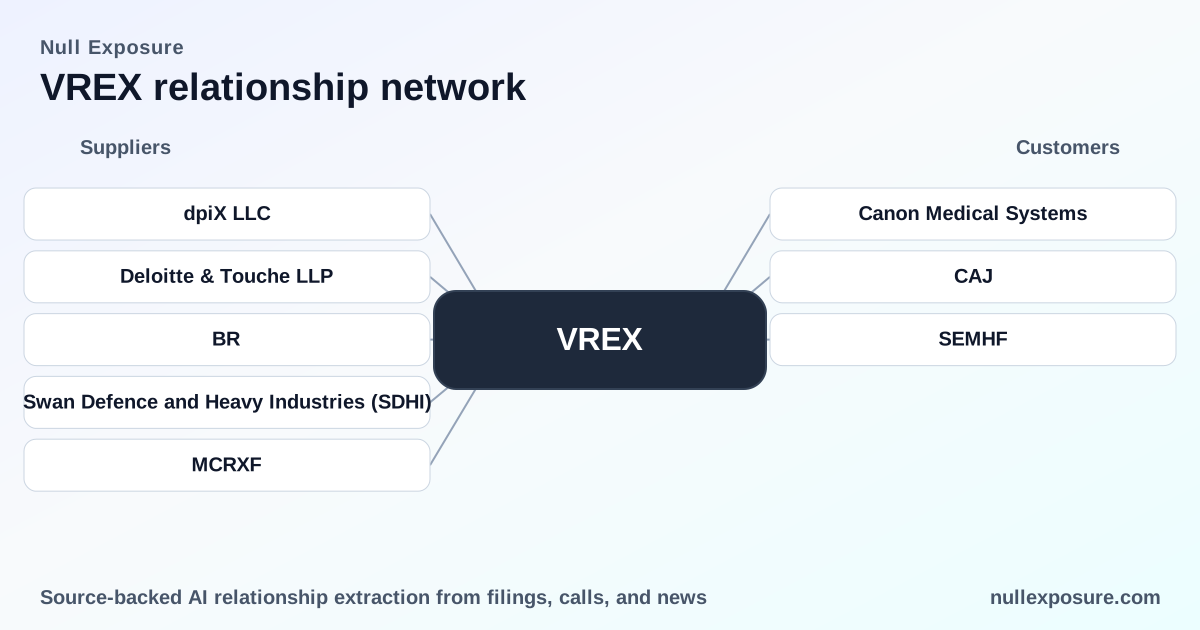
Canon Medical Systems — a top‑five OEM customer and material revenue contributor
Varex’s SEC filing summary for FY2025 shows Canon Medical Systems is one of Varex’s top five customers, and the top five collectively accounted for about 40% of total revenue in fiscal 2025, which makes Canon a material commercial relationship for Varex (SEC 10‑K summary reported via TradingView, March 2026).
CAJ (Canon / Toshiba legacy supply reference) — historical CT tube supply tied to an acquisition
Reporting on Varex’s 2017 acquisition activity noted that through that deal, Varex would supply Toshiba Medical with computed tomography tubes for integration into CT imaging systems, illustrating an example of a manufacturing‑to‑OEM supply relationship that persisted after the acquisition (MassDevice coverage of the PerkinElmer Medical Imaging acquisition, FY2017).
Toshiba Medical — OEM integration partner mentioned in acquisition coverage
Coverage of the FY2017 acquisition likewise identifies Toshiba Medical as an OEM integrating Varex CT tubes into its CT systems, reinforcing Varex’s long history of supplying large OEM imaging platforms (MassDevice, FY2017 reporting).
SEMHF / Siemens Healthineers — another material top‑five OEM
Siemens Healthineers is named among Varex’s top five customers in FY2025, contributing to the roughly 40% top‑five revenue concentration disclosed in company filings; this positions Siemens as a material OEM counterparty in Varex’s revenue base (SEC 10‑K summary via TradingView, March 2026).
(Each relationship summary above is drawn from the cited earnings call, company filing summaries, and news coverage as indicated.)
For the full analytical platform and a consolidated view of disclosed customer ties, see https://nullexposure.com/ for comparison tools and relationship signal tracking.
Investment implications and a concise risk checklist
Varex’s relationship profile creates a clear set of investment considerations:
- Concentration risk is real and measurable. Top five customers ~40% of revenue increases sensitivity to contract renewals and OEM purchasing cycles; Canon and Siemens are explicitly called out as material customers in FY2025 filings.
- Contractual durability offsets some cyclicality. Multi‑year pricing and service agreements provide revenue visibility and support backlog conversion over future quarters.
- Hardware dependence creates margin and capital risks. Large ticket components and manufacturing scale mean margins will fluctuate with mix (hardware vs. software/service) and commodity/FX pressure.
- Global footprint requires active FX management. Sales across Americas, EMEA, APAC expose reported USD results to currency swings.
- Diversified revenue streams help: hardware + software licensing + services. The software licensing capability acts as a margin lever and a point of differentiation when bundled with hardware sub‑assemblies.
Key takeaways for investors: Varex combines durable contractual relationships with concentrated OEM exposure; that structure supports revenue predictability but also creates significant counterparty concentration risk. The active backlog and multi‑year agreements provide near‑term visibility, while hardware capital intensity and global FX create ongoing profit volatility.
Bottom line
Varex is a specialized OEM supplier with material top‑customer exposure, a blended revenue model of hardware sales, software licensing, and services, and evidence of active, long‑term contractual relationships that both stabilize and concentrate business risk. Investors should balance the predictability offered by long‑term agreements and backlog against the negotiation leverage and capex cycles of major OEM customers.
For a practical view of comparable customer exposure across industrial suppliers, visit https://nullexposure.com/ to benchmark Varex’s customer concentration and contract signals against peers.