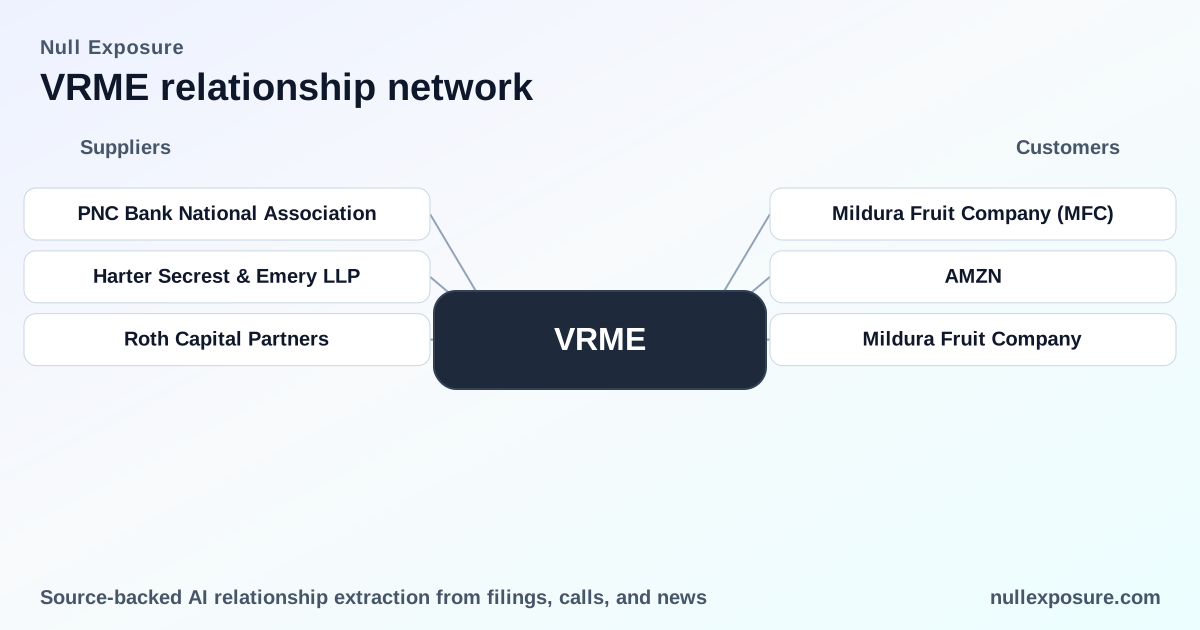
VerifyMe (VRME) — Customer Relationships and Commercial Signals
VerifyMe monetizes brand protection and supply‑chain traceability software and services, selling authentication and traceability solutions through its Authentication segment and a logistics-oriented Precision Logistics line. Revenue derives from recurring and transaction services: anti‑counterfeit verification, GS1 2D barcode solutions, and value‑added parcel logistics delivered through a proprietary platform and channel partners such as Trust Codes Global. Investors should value VRME as a small‑cap technology‑services company whose growth hinges on customer wins with large platforms and adoption by supply‑chain participants. Learn more at https://nullexposure.com/.
Why customer relationships drive the investment case
VerifyMe operates at the intersection of technology and services, which creates a blended commercial posture. The company's filings and market mentions signal four structural characteristics that determine revenue durability and upside:
- Contracting posture — short‑term transactional exposure. Company disclosures describe Proactive service terms that typically range from seven to 30 days, indicating limited contractual lock‑in for certain service lines and modest revenue visibility beyond monthly/quarterly cycles.
- Customer concentration — material single‑customer risk. Public filings state that one customer represented 16% of revenues in 2024 and another 17% in 2023, which creates outsized sensitivity to a small number of commercial relationships.
- Role and criticality — service provider with platform functionality. VerifyMe functions as a service vendor (Precision Logistics) and a product vendor (Authentication), delivering predictive analytics, parcel management, and anti‑counterfeit functionality via portals and barcode/tracking integrations.
- Segment maturity — mixed product/service mix. The Authentication segment focuses on anti‑counterfeit and brand protection, while Precision Logistics is a services offering generating revenue through software‑enabled logistics; each has different margin and scale profiles.
These are company‑level signals from filings and public statements and should shape any revenue or valuation model for VRME.
What the market sources reveal — every reported relationship
Mildura Fruit Company (PR Newswire, March 2026)
Mildura Fruit Company selected Trust Codes Global, a New Zealand subsidiary of VerifyMe, to deliver traceability and machine‑learning enabled integrated solutions for produce traceability, underscoring VerifyMe’s footprint in fresh‑food supply chains. According to a PR Newswire release (March 2026), MFC highlighted Trust Codes’ ML capability and integrated offering as the deciding factor.
Mildura Fruit Company (BlueBookServices, March 2026)
A BlueBookServices article reiterates that Trust Codes Global has a proven platform and cites Mildura Fruit Company as a customer leading GS1 2D barcode migration, validating VerifyMe’s practical deployment in barcode standards conversion projects. BlueBookServices reported on MFC’s implementation (March 2026), framing the relationship as a use case for enterprise migration to modern traceability standards.
Amazon / Transparency Program (InvestorPlace, April 2024) — entry 1
InvestorPlace noted that VerifyMe’s traceability technology integrates with Amazon’s Transparency program, which increases VerifyMe’s relevancy in e‑commerce anti‑fraud and provenance workflows and provides a scalable channel into consumer goods sellers. InvestorPlace coverage (April 2024) emphasizes that the integration expands VerifyMe’s customer reach and industry profile.
AMZN / Amazon (InvestorPlace, April 2024) — entry 2
A duplicate InvestorPlace listing identifies VerifyMe as a participant in Amazon’s Transparency ecosystem and positions that participation as a credibility multiplier for VerifyMe’s traceability services among online sellers and brands. The same InvestorPlace article (April 2024) frames the Amazon link as a strategic distribution and validation route for VerifyMe technology.
What these relationships imply for growth, risk, and positioning
The customer mentions collectively present a coherent commercial story: proof‑point deployments in vertical supply chains (fresh produce) and platform integration with a major e‑commerce ecosystem (Amazon). Those two threads are complementary — vertical case studies demonstrate product fit and enterprise functionality, while platform integrations provide distribution scale.
Key implications:
- Commercial validation but limited scale today. Mildura Fruit Company is a demonstrable enterprise client validating GS1 2D and traceability capabilities; Amazon Transparency integration signals potential for broad channel adoption. Yet VerifyMe’s trailing revenue (approximately $16.4M TTM) and market cap near $10.4M indicate these wins are early stage relative to the addressable market.
- Concentration amplifies both upside and downside. The company’s disclosure that single customers comprised ~16–17% of revenue in consecutive years is a clear concentration risk; the loss or downgrading of one large buyer would materially impact revenue and margins.
- Short contract terms limit revenue visibility. The Proactive service line’s 7–30 day terms are a structural constraint on predictability; even with large customers, transactional settlement terms reduce lock‑in and increase churn risk.
- Service orientation implies ongoing operating costs. As a service provider with predictive analytics and logistics execution, VerifyMe bears operational cost to sustain platform performance and client success, which affects near‑term profitability and cash flow.
Investment takeaways and next steps
- Bull case: Platform integrations with Amazon and enterprise references like Mildura Fruit Company demonstrate credible product‑market fit and give VerifyMe the channel and testimonial credibility needed to scale recurring traceability revenue.
- Risk case: High customer concentration and short‑term contracting produce low revenue visibility and significant sensitivity to customer behavior, constraining a multiple expansion thesis until customer diversification or longer‑term contracting is evident.
- Operational focus: Management must prioritize conversion from reference deployments to recurring, contractually secured customers and demonstrate margin expansion as scale accrues.
For a synthesized exposure map and continuous monitoring of VRME customer signals, visit https://nullexposure.com/. For investors modeling VRME, prioritize scenarios that stress customer concentration and contract tenure while assigning upside to platform distribution through partners like Amazon.