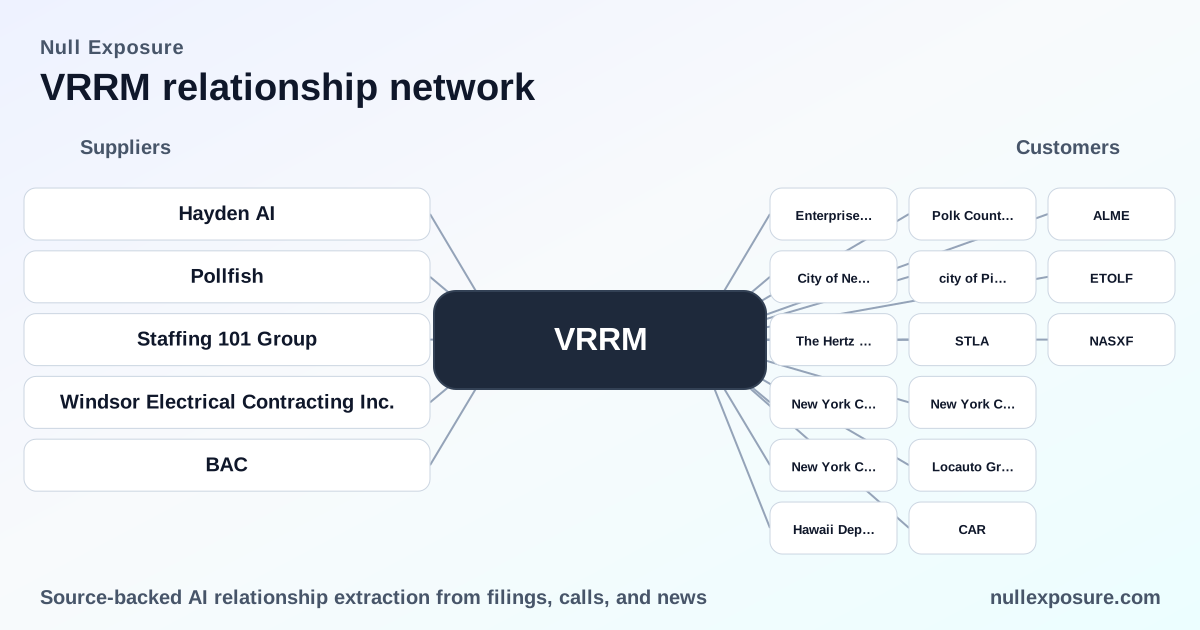
Verra Mobility (VRRM) — customer relationships that drive recurring, mission‑critical revenue
Verra Mobility monetizes an integrated stack of hardware, software and services for tolling, automated enforcement, parking and fleet payment solutions; revenue mixes across long‑term government contracts, subscription SaaS, per‑transaction processing fees and discrete hardware sales. For investors, the business is best thought of as a recurring‑revenue operator with concentrated government exposure, deep incumbency value around city/state programs, and expanding commercial and international toll partnerships that broaden margins and scale. Explore more company intelligence at https://nullexposure.com/.
Why customers define VRRM's risk and upside
Verra operates across two complementary business models. Government Solutions provide automated enforcement and photo‑enforcement hardware and program operations under multi‑year public contracts; Commercial Services sell toll processing, title services and in‑vehicle payments to rental car companies (RACs), fleets and OEMs. The operating model shows four important, investor‑relevant characteristics:
- Contracting posture — long term with recurring revenue: Verra discloses it operates under long‑term contracts and a highly recurring service revenue model, and its Parking Solutions include SaaS subscription fees. This combination supports predictable cashflow but requires contract renewal execution. (FY2024 Form 10‑K)
- Counterparty concentration and criticality: Three large RACs represented roughly 36% of revenue in 2024, creating concentration risk but also deep, sticky commercial relationships. Meanwhile, government programs are mission critical for municipalities, making Verra a high‑dependency vendor when contracts are live. (FY2024 Form 10‑K)
- Geographic footprint and expansion: The company is principally North American but explicitly operates in Europe, Australia and Canada and is actively expanding toll and enforcement programs across EMEA and U.S. states—introducing both revenue diversification and regional execution risk. (FY2024 Form 10‑K)
- Maturity and delivery model: The business mixes hardware manufacturing, software licensing (SaaS) and outsourced program operations; investors should treat Verra as a hybrid services/software company where margin improvement depends on scale in processing and software adoption.
Relationship roll‑call — line‑by‑line customer summaries
Below are every customer mention surfaced in the collected results, presented with a concise plain‑English summary and the source noted.
- City of New York Department of Transportation — Verra warned in its FY2024 Form 10‑K that its Government Solutions segment can be affected by changes in political acceptance or government restrictions on automated safety programs. (FY2024 Form 10‑K filing)
- The Hertz Corporation — Verra states it has a long‑standing commercial relationship with The Hertz Corporation as one of the three largest rental car companies that drive its RAC processing business. (FY2024 Form 10‑K filing)
- Enterprise Mobility — Verra cites long‑standing relationships with Enterprise Mobility as a core commercial customer in its RAC-focused Commercial Services segment. (FY2024 Form 10‑K filing)
- New York City Department of Transportation (news) — Multiple press releases in early 2026 report Verra finalized a five‑year, $998 million contract to manage and expand NYC’s automated enforcement camera programs, with an option for a five‑year extension. (PR and news coverage, March–May 2026)
- Hawaii Department of Transportation (HDOT) — Verra announced a 10‑year, approximately $160 million statewide contract to expand red‑light and speed enforcement in Hawaii, described as the first statewide automated enforcement program in the U.S. (PR Newswire and contemporaneous news, Feb–May 2026)
- New York City Department of Transportation (Finviz coverage) — Financial news outlets reiterated the five‑year, $998 million NYC contract and its effective date (January 1, 2026) as material to Government Solutions revenue. (Finviz news item, May 2026)
- New York City Department of Transportation (SAHM Capital release) — SAHM Capital’s release echoed the finalized NYC contract and optional extension, underscoring the revenue significance for Verra in FY2026. (SAHM Capital news, March 2026)
- Locauto Group — Verra announced a partnership to provide an electronic toll payment solution across Italy with Locauto Group, expanding its European toll footprint. (StockTitan and press releases, March–May 2026)
- Hawaii Department of Transportation (PR Newswire) — A dedicated PR Newswire release detailed HDOT’s statewide automated enforcement expansion and Verra’s role in implementation and operations. (PR Newswire, May 2026)
- New York City Department of Transportation (SAHM Capital Arabic release) — International SAHM Capital distribution reiterated the NYC DOT deal and its financial scale for Verra. (SAHM Capital distribution, March 2026)
- New York City Department of Transportation (StockTitan summary) — StockTitan summarized the NYC contract scope to include red‑light, speed, bus lane and weight‑limit camera programs, effective 2026. (StockTitan news, March 2026)
- Polk County Public Schools — Local reporting noted Polk County approved a contract in April to outfit more than 500 school buses with cameras supplied and installed by Verra. (Local press report via The Ledger, July 2024)
- Stellantis — Verra has a strategic partnership with Stellantis to deploy its AutoKinex in‑vehicle payments and nationwide automated tolling services to compatible Chrysler, Dodge, Jeep and Ram vehicles. (Company press releases and earnings commentary, FY2025–FY2026)
- city of Pittsburgh — Verra announced a partnership to deliver, operate, and maintain a red‑light camera program in Pittsburgh as part of municipal safety initiatives. (SAHM Capital news release, March 2026)
- Stellantis (AutoKinex launch coverage) — Multiple press releases in late 2025 described the AutoKinex rollout to Stellantis models (2021+), positioning Verra for scale in connected payments. (PR Newswire and SAHM Capital, Nov 2025–2026)
- CAR (symbol CAR) — Verra’s Form 10‑K lists CAR (Avis Budget Group symbol) among the three large RAC customers that account for a material share of revenue. (FY2024 Form 10‑K filing)
- Avis Budget Group — Avis Budget Group is explicitly named in Verra’s 10‑K as a long‑standing RAC customer in the Commercial Services segment. (FY2024 Form 10‑K filing)
- Alamo — Coverage of the Locauto program notes the Locauto partnership covers Locauto plus Enterprise, National and Alamo brands via Locauto’s exclusive partnership, expanding Verra’s European toll presence. (StockTitan reporting on the Locauto announcement, March 2026)
- Enterprise (stocktitan entry) — StockTitan’s Locauto story highlights coverage for Enterprise brand customers through the Locauto distribution agreement. (StockTitan news, March 2026)
- ETOLF — The Locauto announcement and associated reporting referenced ETOLF as part of the program coverage (tickered in some news items), linking Verra to broader European RAC billing relationships. (StockTitan reporting, March 2026)
- National — The Locauto partnership coverage notes National brand inclusion via Locauto’s exclusive arrangement, extending Verra’s processing relationships in Europe. (StockTitan news, March 2026)
- New York City (concentration risk coverage) — Analyst commentary in late 2025 highlighted that Government Solutions revenue relied heavily on New York City, with renewal delays creating concentration and revenue‑swing risk. (Analyst note / SAHM Capital and other commentary, FY2025)
What this roster means for investors: practical takeaways
- Revenue durability is high but concentrated. Large, multiyear public‑sector contracts and deep RAC relationships produce predictable processing fees, but NYC and the three largest RACs collectively drive material revenue volatility when procurements lapse or renew. (FY2024 Form 10‑K; 2025–2026 press coverage)
- Execution risk sits in public procurement and political acceptance. Government programs are renewable and sometimes subject to appropriation or policy shifts; Verra’s growth depends on winning and operating multi‑year municipal contracts. (FY2024 Form 10‑K)
- Margin expansion runway exists through software and in‑vehicle payments. Partnerships with OEMs like Stellantis and European toll deals (Locauto) broaden higher‑margin recurring revenue streams beyond hardware and photo enforcement. (PR releases, FY2025–FY2026)
For additional detail on contract-level exposure and competitive positioning, visit https://nullexposure.com/.
Bottom line
Verra Mobility is a recurring‑revenue, mission‑critical operator with concentrated customer exposure that both raises risk and creates high barriers to entry once large municipal or RAC programs are onboarded. Investors should weigh the company’s demonstrated contract wins in 2026 against the renewal dynamics disclosed in FY2024 filings and the ongoing push to monetize software and connected‑vehicle payments.