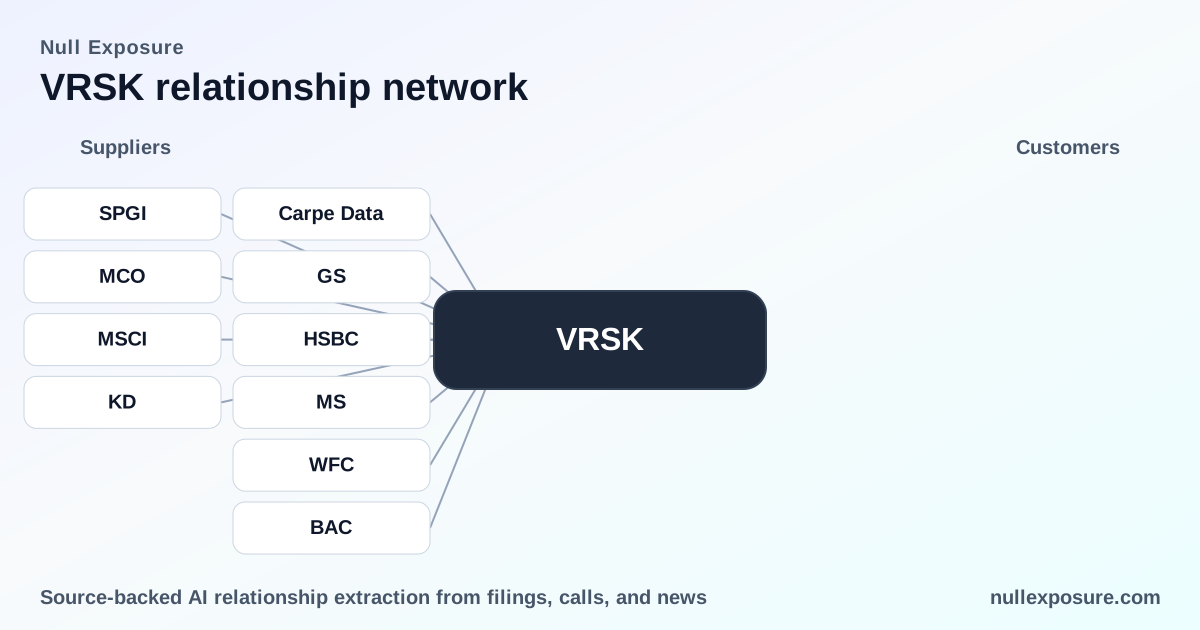
Verisk’s customer map: how relationships drive recurring value and operational risk
Verisk Analytics monetizes through subscription-based analytics and advisory services sold primarily to large insurers, governments, and enterprise risk managers; its business model converts proprietary data and models into recurring hosted subscriptions, consulting engagements, and transaction-based offerings that together generate a high-margin, predictable revenue stream. For investors, the critical lens is on customer concentration, contract tenor, and the strategic quality of integrations that expand use across underwriting, claims, and investigations. Learn more about how stakeholders track customer relationships at https://nullexposure.com/.
Why customer relationships determine Verisk’s cashflow durability
Verisk’s commercial DNA is subscription and long-term contracting. Company disclosures show roughly 81% of revenue in 2024 came from annual or multi-year prepaid subscriptions, with hosted subscriptions recognized ratably over the contract term. That structure produces strong visibility into near-term revenue but elevates the importance of renewals and cross-sell to sustain growth.
At the same time, customers are material but diversified: the top 50 customers accounted for approximately 43% of revenue in 2024, yet no single customer represented more than ~3%. This trade-off — significant concentration at the top fifty while avoiding single-client dependency — supports large-account sales efficiency while keeping counterparty risk bounded. Verisk’s customer base spans commercial insurers, federal/state agencies, and large enterprises, giving it both scale and exposure to public procurement cycles.
Company-level customer signals investors should weigh
- Contracting posture: Predominantly long-term, prepaid annual or multi-year subscriptions; hosted services recognized on a straight-line basis over the subscription period. This produces recurring revenue and deferred revenue on the balance sheet.
- Revenue mix: Subscription-first, with advisory/consulting and transactional solutions supplementing recurring income; services segment contributes materially to client stickiness.
- Customer types: Mix includes large enterprises and government agencies, creating a blend of commercial renewal dynamics and procurement-driven stability.
- Geography: Strong North American footprint (majority of revenue), with meaningful global and EMEA adoption for property/claims solutions.
- Materiality and concentration: Top 50 customers are collectively material (~43% of revenue) but Verisk has deliberately avoided outsized single-client dependence.
- Relationship posture: Verisk functions as both seller of analytics and service provider (hosted portal access, advisory), and renewals are a repeated operational focus through account executives and subject matter experts.
These signals position Verisk as a subscription-first, enterprise SaaS-style operator inside insurance and risk verticals, where measuring renewal rates, average contract term, and penetration of adjacent service lines provides the clearest read on revenue durability.
Recent customer relationship highlights and what they mean
Below are the customer interactions surfaced in recent coverage. Each entry is condensed to a plain-English takeaway with the original reporting cited.
-
Pilotbird — Verisk has implemented new integrations with Pilotbird as part of broader efforts to tie underwriting, claims, and investigations into unified digital tools, signaling deeper workflow entrenchment with inspection and claims orchestration vendors. (Source: Sahm Capital reporting on AccuLynx integrations, April 26, 2026.)
-
Roofr Inc. — Roofr is among the third-party platform partners that Verisk integrated to streamline roof inspections and claims input into underwriting and claims ecosystems, indicating product-led expansion into contractor and inspection workflows. (Source: Sahm Capital reporting on AccuLynx integrations, April 26, 2026.)
-
ActiveProspect — ActiveProspect acquired Verisk’s Marketing Solutions assets, renaming the unit InfutorData, a move that represents a portfolio simplification and the transfer of non-core data product assets to a specialized acquirer; market notices also recorded Verisk’s completion of the divestiture in late April 2026. (Sources: AlphaStreet coverage and MarketBeat reporting, April 2026.)
How these relationships influence Verisk’s operational posture
The Pilotbird and Roofr integrations reflect a strategy of embedding Verisk models into partner workflows, shifting the company from pure data vendor to an integrated service provider across the claims lifecycle. That increases customer stickiness because integrations create product dependence across multiple use cases (underwriting, inspections, claims). The ActiveProspect divestiture shows active portfolio management — Verisk is pruning non-core marketing solutions to sharpen focus on insurance and risk analytics, which improves margin profile and strategic clarity.
Investment implications: upside, risk and monitoring checklist
Verisk’s model delivers high margin, recurring revenue with enterprise-grade customers, which supports premium valuation multiples relative to traditional industrial peers. Key investment levers and risks are:
-
Upside drivers:
- Cross-sell into claims and underwriting via partner integrations increases revenue per customer.
- High renewal rates and prepaid subscriptions sustain cash flow visibility and support capital allocation.
-
Risks:
- Renewal concentration risk remains relevant because top customers account for a sizable share of revenues even though no single customer dominates.
- Procurement cycles in government and large enterprises can create lumpy timing for new deals.
- Successful integration with third-party platforms is required to convert partner integrations into material revenue.
Monitor these metrics in quarterly filings and calls: renewal rates, average contract length, deferred revenue balance, revenue from integrations/partner channels, and the pace of divestitures or acquisitions that change the product mix. Verisk’s financials — strong operating margin and high return on equity — reflect its subscription economics, but the company’s growth hinge sits squarely on execution in enterprise renewals and partner-led expansions.
For a deeper read on how customer relationships affect enterprise value, visit https://nullexposure.com/.
Bottom line
Verisk runs a subscription-first, enterprise-oriented analytics business where long-term contracts, government and large insurer customers, and strategic integrations determine both cashflow stability and growth runway. Recent integrations with roof inspection and claims platforms strengthen product stickiness, while the divestiture of marketing assets sharpens strategic focus. Investors should weigh strong recurring economics against renewal concentration at the top fifty customers and the operational task of converting integrations into measurable revenue uplift.