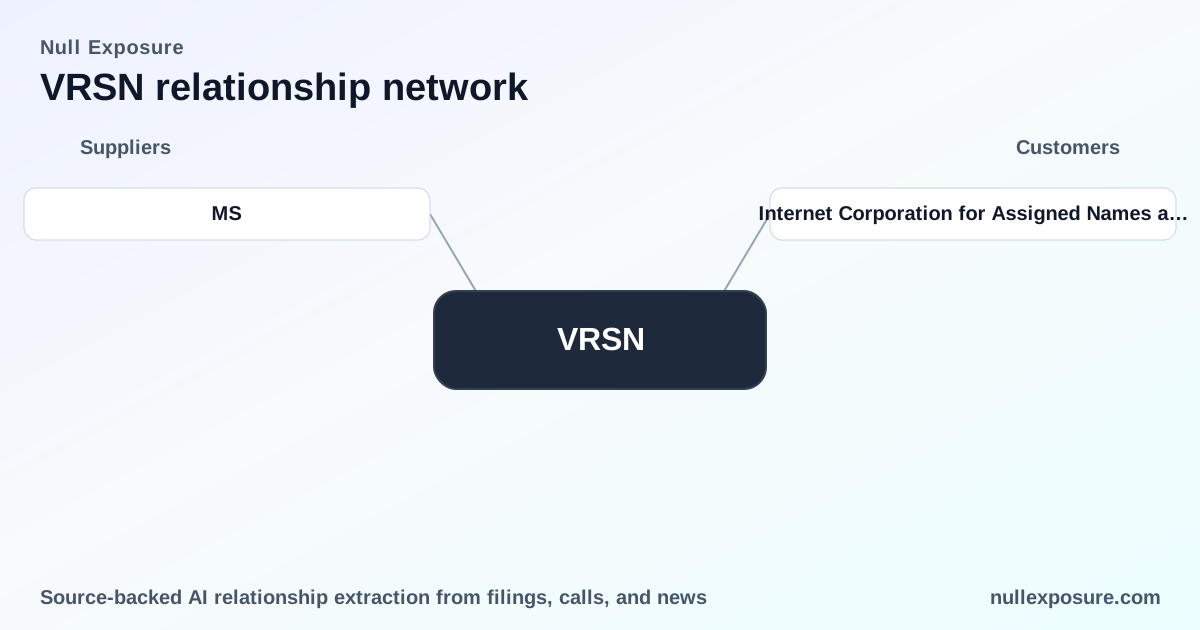
VeriSign (VRSN): Customer relationships that underpin a monopoly cash machine
VeriSign operates the authoritative registry for .com and .net and monetizes that control through wholesale registry fees charged to accredited registrars, recurring renewal economics, and higher-margin security and managed-DNS services. The business blends structural pricing power with high operating leverage and concentrated customer flows, producing predictable free cash flow but exposing the company to renewal timing and registrar behavior. Learn more at https://nullexposure.com/.
Why customers matter to VeriSign’s economics
VeriSign’s revenue engine runs on two intertwined dynamics: wholesale pricing per domain and a durable base of renewals. Registrars (GoDaddy, Tucows and others) are the distribution channel; end customers are individuals and organizations who ultimately pay retail prices. Company disclosures show VeriSign’s largest single customer represented approximately 31% of revenues in 2025, making counterparty behavior materially relevant to near-term growth and retention statistics. According to filings and earnings commentary in FY2026, the company tightened its domain-base growth outlook and reiterated that registrar promotional activity can drive short-term registration spikes that affect future renewal mixes.
- Concentration: A top customer contributes roughly a third of revenue, creating a single-counterparty sensitivity to registrar strategy.
- Criticality: VeriSign provides critical, always-on registry services under contract with ICANN; outages or contractual shifts would have immediate systemic impact.
- Global reach: Revenues are global across NA, EMEA, APAC and Latin America, so regional demand patterns and registrar marketing tactics matter for growth.
Contracting and operating posture: regulated monopoly with commercial dynamics
VeriSign’s role is governed by contractual arrangements with the Internet Corporation for Assigned Names and Numbers (ICANN), which defines service obligations and oversight while leaving fee-setting and commercial relationships to VeriSign within that framework. That structure delivers monopoly-like economics for .com/.net operations but under a public-interest and contractual lens, so pricing moves are powerful but attract scrutiny from registrars, customers and sometimes regulators. Company filings and FY2026 public commentary emphasize the company’s continuous, security-focused operations as core to its service promise.
Customer-by-customer read: what the market tracked in FY2026
Below are the relationships surfaced in recent source material. Each entry includes a concise plain-English summary and the source referenced.
Internet Corporation for Assigned Names and Numbers (ICANN)
VeriSign performs its registry role under contractual agreements with ICANN and is responsible for high-availability, secure operations that enable continuous internet connectivity for the top-level domains it manages. Source: MarketBeat instant alerts citing FY2026 company disclosures on the registry role (Mar–Apr 2026) — https://www.marketbeat.com/instant-alerts/.
GoDaddy (GDDY)
GoDaddy is identified repeatedly in FY2026 earnings transcripts as VeriSign’s largest registrar counterparty and a bellwether for promotional-driven registration volume, with analysts probing how GoDaddy’s marketing impacts new-registration spikes and subsequent renewal mixes. Multiple earnings-call transcripts in April–May 2026 document this line of questioning and management responses. Sources: Q1 FY2026 earnings call transcripts and coverage (The Motley Fool, Investing.com, InsiderMonkey, ad-hoc-news) — see April–May 2026 call transcripts reporting.
Tucows (TCX)
Tucows represents a key registrar competitor referenced in market coverage as part of the broader registrar ecosystem; Tucows’ 2024 filing records that VeriSign’s 2024 .com price increase of 7% impacted Tucows’ cost of revenues, demonstrating direct P&L sensitivity for registrars when registry fees rise. Source: Tucows 10‑K (fiscal 2024) and media summaries discussing fee dynamics (TCX 2024 filing; coverage in 2026 articles).
What the constraints tell investors about the business model
Company-level signals drawn from filings and disclosures illuminate operational characteristics that drive both upside and downside:
- Service provider and infrastructure posture: VeriSign is a global provider of domain registry and internet infrastructure services, which positions it as a critical backbone provider rather than a retail-facing vendor. This explains high margins on registry revenue and the company’s emphasis on continuous, secure operations.
- Materiality and concentration: The largest customer represented ~31% of revenue in 2025; this concentration compresses downside but also centralizes negotiation leverage to a small set of registrars.
- Global footprint: The company reports meaningful revenue across North America, EMEA, APAC and Latin America, which diversifies demand but leaves the firm exposed to regional registrar tactics and local promotional cycles.
- Counterparty mix includes individuals: End-users are individuals and organizations establishing online identities; registrar promotions and end-user adoption patterns therefore shape long-term renewal economics.
- Segments: infrastructure and services: Revenue is split between the core registry (infrastructure) and higher-value services (managed DNS, DDoS mitigation, threat reporting), enabling incremental margin expansion as services adoption grows.
Investment implications — what investors should price in
- Pricing power is real and consequential. VeriSign’s ability to raise wholesale fees (as seen in past increases) supports long-term revenue per-domain expansion, but registrar pushback and first-year renewal gaps create timing and renewal-rate risk.
- Concentration risk requires active monitoring. With a top customer contributing about a third of revenue, any sustained change in registrar behavior (promotions, contract renegotiation, or channel diversification) would be material to growth and margins.
- Operational criticality reduces substitution risk. The registry function is mission-critical and infra-heavy, meaning competitors cannot easily displace VeriSign’s role in .com/.net—this underpins valuation multiples but invites regulatory and contractual oversight.
- Service upsell is a margin lever. Growth in managed DNS and security services compounds revenue without the same registrar-driven volatility of new domain registrations.
Bottom line and next steps
VeriSign combines monopoly-like registry economics with concentrated customer exposure and contractual obligations to ICANN. That mix delivers predictable cash flow with discrete renewal- and registrar-driven volume risks. For investors evaluating VRSN, focus on registrar behavior (promotional cadence), first-year renewal trends, and the company’s commentary on fee pass-through and domain-base growth.
For a deeper dive into customer-level signals and how they affect valuation scenarios, visit https://nullexposure.com/.
Bold takeaways:
- High structural pricing power from registry control.
- Material customer concentration (~31% from the largest customer).
- Critical infrastructure role that constrains substitution but invites oversight.