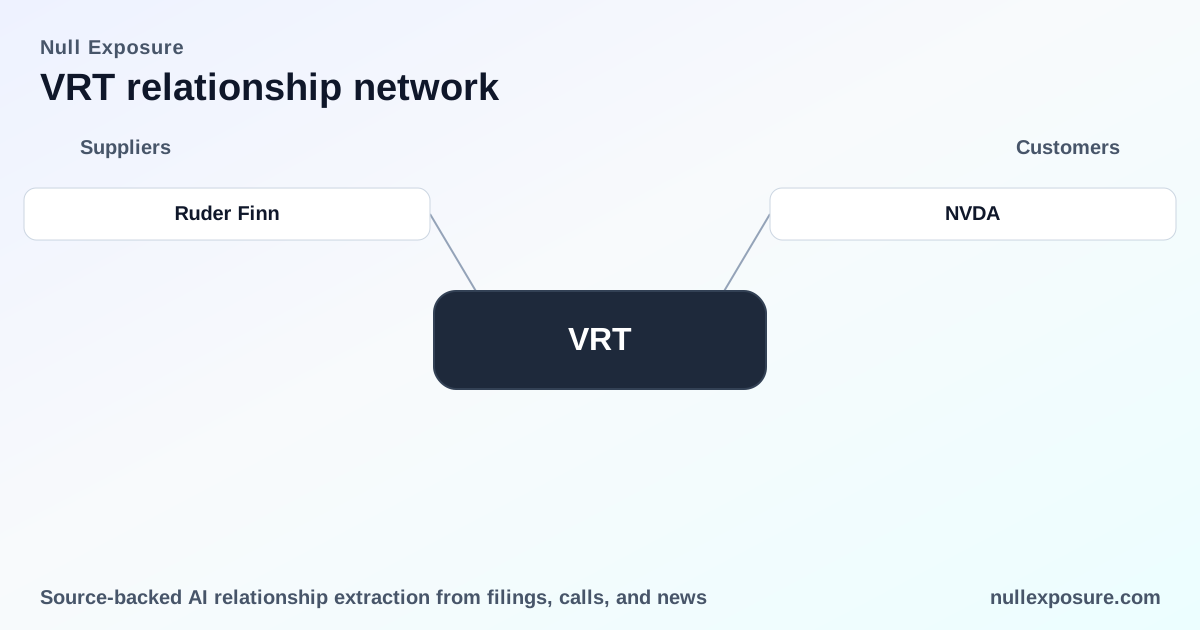
Vertiv and NVIDIA: Infrastructure for AI at Scale — an investor primer
Vertiv designs, manufactures and services power, cooling and integrated infrastructure for data centers and communications networks and monetizes through product sales, lifecycle services, spares and recurring maintenance contracts with large enterprise and hyperscale customers. The company converts high-margin hardware wins into longer-duration services and aftermarket revenue, and its recent public positioning alongside NVIDIA frames Vertiv as a critical infrastructure partner for AI deployments. For a consolidated view of customer relationships and their commercial implications, visit the NullExposure homepage: https://nullexposure.com/.
Why the NVIDIA relationship matters for revenue and strategic positioning
Vertiv’s collaboration with NVIDIA is not a marketing footnote; it is a structural alignment with the fastest-growing segment of data center demand — AI compute. Vertiv is being pitched as the systems integrator for high-density power and thermal management at rack and pod scale, supplying validated power / cooling assets and modular infrastructure blocks that accelerate customer deployments. That positioning supports both upfront equipment revenue and recurring services, while anchoring Vertiv in the hardware-software stack that hyperscalers and enterprise AI customers require.
A strategic partnership with NVIDIA also signals technology co-development (power architectures and validated system interfaces) that increases switching costs for customers and raises the threshold for competitors to replicate that integration. This is a structural competitive advantage for Vertiv as hyperscalers standardize on AI reference designs.
What the press actually reported — every relationship entry in the file
Vertiv’s NVIDIA relationship is covered repeatedly across financial and trade press; below are each of the items captured in the file with a plain-English summary and source.
-
Simply Wall St (May 4, 2026) described Vertiv’s role in NVIDIA’s Vera Rubin DSX AI factory reference design and Omniverse DSX Blueprint, noting that Vertiv provides simulation-ready digital power and cooling assets plus standardized 12.5MW Vertiv OneCore infrastructure blocks intended to support AI from small clusters up to gigawatt-scale projects. Source: Simply Wall St coverage, first seen May 4, 2026.
-
Yahoo Finance (Zacks coverage, March 10, 2026) highlighted Vertiv’s partnership with Nvidia to address critical thermal and cooling challenges for AI deployments, positioning Vertiv as a supplier of solutions targeted at high-performance computing environments. Source: Yahoo Finance Zacks article, March 10, 2026.
-
A parallel Yahoo Finance mention (same March 10, 2026 item) reiterated Vertiv’s partnership with Nvidia to solve cooling challenges for AI, reflecting syndication of the Zacks analyst commentary across finance aggregators. Source: Yahoo Finance Zacks piece, March 10, 2026.
-
The Globe and Mail (May 3, 2026) reported that Vertiv is co-developing an 800-volt DC power architecture with NVIDIA, timed to coincide with the 2027 rollout of NVIDIA's Rubin Ultra platforms — an engineering-level claim that implies next-generation electrical design work and systems validation. Source: The Globe and Mail reporting, May 3, 2026.
-
TradingView (Zacks-sourced “Bull of the Day”, March 10, 2026) repeated the Zacks observation that Vertiv “boasts a partnership” with NVIDIA focused on cooling and other infrastructure challenges for AI hardware. Source: TradingView summary of Zacks commentary, March 10, 2026.
-
A second TradingView entry (same March 10, 2026 Zacks feed) again cited Vertiv’s collaboration with Nvidia on thermal challenges, illustrating broad distribution of the analyst note across market-news platforms. Source: TradingView re-publication of Zacks content, March 10, 2026.
Constraints that shape Vertiv’s customer relationships (company-level signals)
The filings and sales disclosures generate clear, company-level operating signals that shape how investors should value customer risk and growth optionality:
-
Contracting posture — short-term delivery cadence. Vertiv reports that the majority of its combined backlog as of December 31, 2024 is expected to ship within one year, signaling a business that converts backlog to revenue quickly rather than relying on very long-duration fixed-price contracts.
-
Counterparty profile — large enterprise focus. Vertiv explicitly serves communication network operators, cloud/hyperscale and colocation providers as a material portion of its customer base, implying high client concentration and procurement sophistication.
-
Geographic footprint — global but North America weighted. Sales mix for 2024: roughly 56% Americas, 22% Asia Pacific, 22% EMEA, with Latin America / Canada reported separately; the business is globally distributed and thus sensitive to regional capex cycles.
-
Role and product mix — seller plus service provider across hardware, infrastructure, software and services. Vertiv sells AC/DC power systems, thermal management, modular solutions, racks and controls, and also provides preventative maintenance, remote monitoring, spares and consulting — enabling cross-sell from capex to recurring opex.
-
Materiality and maturity signals. Large enterprises are a material component of revenue; Vertiv combines manufacturing scale with service operations, which positions it as a mature industrial firmware-plus-hardware supplier rather than a pure software vendor.
These constraints explain why Vertiv’s NVIDIA alignment is commercially meaningful: the relationship plugs into Vertiv’s core strengths (hardware + services) and sits comfortably inside its short-cycle, high-touch commercial model.
Investment implications: upside drivers and risks
-
Upside drivers: direct exposure to AI infrastructure demand, validated integration with NVIDIA reference designs, and an installed-base service opportunity that converts one-time sales into recurring revenue. Vertiv’s ability to supply modular 12.5MW blocks and next-generation 800V power architectures positions it to capture higher-value, system-level contracts as customers standardize on AI reference platforms.
-
Key risks: customer concentration and short backlog duration increase vulnerability to hyperscaler capex volatility; shipping within one year means revenue is cyclical to procurement windows. International exposure ties results to regional capex cycles and currency swings. Finally, Vertiv’s valuation multiples imply market expectations for continued growth: Market capitalization is roughly $127 billion against trailing revenue of about $10.8 billion and EBITDA around $2.38 billion (company figures), which embeds high growth assumptions into the share price.
-
Operational considerations: manufacturing scale and services delivery are advantages, but execution risk is non-trivial when implementing bespoke, high-voltage power architectures at hyperscale sites. Co-development with NVIDIA raises switching costs but also concentrates technical and roadmap dependency.
Bottom line and action points for investors and operators
Vertiv is no longer a peripheral supplier to AI — it is actively co-developing power and thermal architectures with NVIDIA and delivering modular infrastructure blocks that map to hyperscale reference designs. That elevates Vertiv from commodity supplier to strategic infrastructure partner, with revenue upside from both initial deployments and services follow-on.
For a consolidated, investor-grade view of Vertiv’s customer relationships and coverage, see NullExposure: https://nullexposure.com/.
Key takeaway: the NVIDIA alignment materially improves Vertiv’s addressable market in AI compute infrastructure, but valuation already prices high growth expectations and leaves the stock exposed to hyperscaler capex cycles and short-term backlog dynamics.