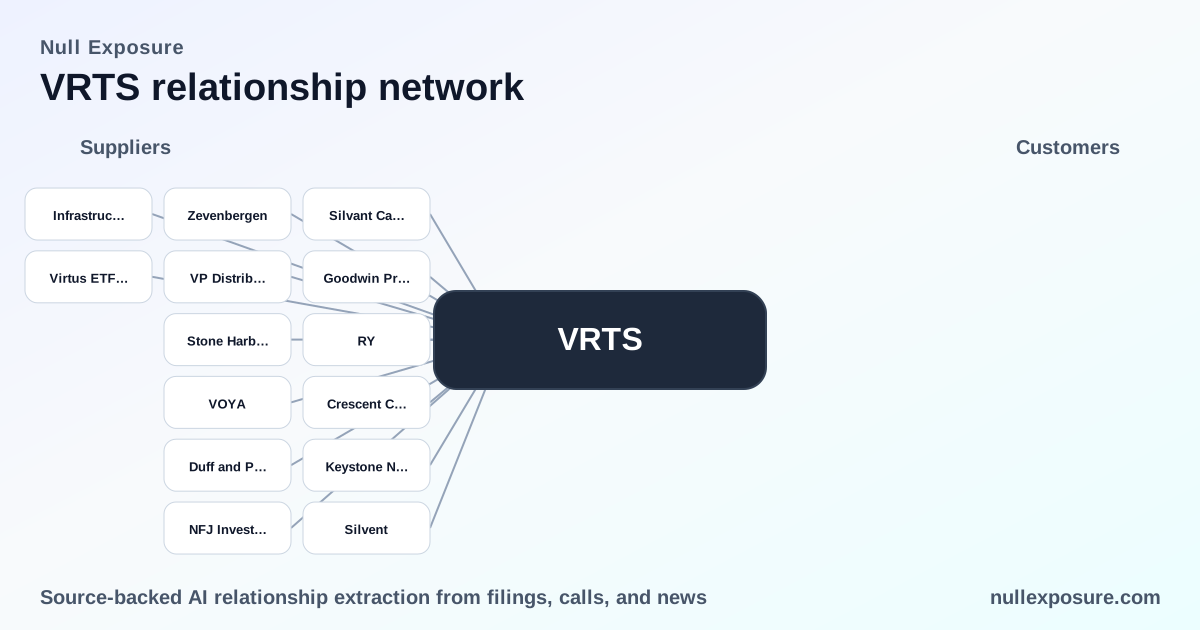
Virtus (VRTS) — Customer Relationships: Who Virtus Serves and How That Shapes Revenue and Risk
Virtus Investment Partners operates as a fee-driven asset manager that monetizes through investment management and related fund services: advisory fees from proprietary and third‑party funds, distribution and shareholder services, and platform investments to amplify distribution. Its business combines active management, closed‑end and open‑end funds, and an expanding ETF lineup to capture fee income while leveraging distribution capabilities to scale AUM. For a practitioner‑grade view of counterparty exposure and fund relationships, see NullExposure’s intelligence hub: https://nullexposure.com/.
How Virtus’ customer design influences economics and volatility
Virtus’ customer base and contract posture define the company’s revenue profile and operational sensitivity. Contracts are predominantly short‑term in nature, which enforces direct linkage between product performance/distribution and fee revenue; this encourages active product innovation but raises AUM volatility on downturns. The firm serves a diverse counterparty mix — institutions, individuals, public retirement systems, and non‑profits — with global product coverage, which spreads market and client concentration risk but keeps the business dependent on market cycles and investor flows.
- Service provider posture: Virtus functions as an active investment manager and fund servicer (administration and shareholder services), so recurring fee streams coexist with performance‑sensitive management fees.
- Global product footprint: Offerings span domestic, international and emerging markets, and multiple asset classes, supporting diversified inflows but increasing compliance and distribution complexity across jurisdictions.
- Customer concentration and maturity signals: Institutional ownership of the equity is high, and the company operates largely as a services segment rather than a product manufacturer; this is consistent with an active, client‑facing business model where client retention is critical.
These operating model signals translate into revenue growth potential through distribution expansion and product launches, paired with the risk of AUM drawdowns from short‑notice client exits.
Publicly observed customer and fund relationships
Below are every customer relationship referenced in the available reporting, summarized in plain English with source attribution.
NCV-P-A (Virtus Convertible and Income Fund) — FinancialContent / BusinessWire, Dec 1, 2025 (FY2025)
Virtus Investment Advisers, LLC is named as the investment adviser to the Virtus Convertible and Income Fund, while Voya Investment Management is identified as the fund’s subadviser, establishing Virtus’ advisory control with delegated portfolio execution. This was disclosed in a BusinessWire release circulated via FinancialContent on December 1, 2025.
NCV-P-A (Virtus Convertible and Income Fund) — WRAL carrying BusinessWire, Dec 1, 2025 (FY2025)
WRAL reproduced the same BusinessWire announcement on December 1, 2025, reiterating that Virtus Investment Advisers, LLC serves as the adviser and that Voya Investment Management acts as subadviser to the fund.
AIO (Virtus Artificial Intelligence & Technology Opportunities Fund) — Yahoo Finance (Singapore), Mar 9, 2026 (FY2025)
Virtus Investment Advisers, LLC is the adviser to the AIO fund and Voya Investment Management is the subadviser, reflecting Virtus’ model of pairing in‑house advisory oversight with third‑party subadvisory expertise for specialized strategies, as reported by Yahoo Finance on March 9, 2026.
Keystone National Group — CityBiz, May 4, 2026 (FY2026)
Virtus completed an investment in Keystone National Group to expand its distribution and platform capabilities; CityBiz noted that Keystone will benefit from Virtus’ distribution capabilities and long‑standing manager support model, indicating strategic platform investing to broaden distribution channels (CityBiz, May 4, 2026).
VEM (Virtus Emerging Markets Dividend ETF) — SahmCapital coverage, Feb 10, 2026 (FY2026)
Virtus launched the Virtus Emerging Markets Dividend ETF (VEM), an actively managed fund targeting dividend‑paying companies in developing markets, demonstrating a deliberate expansion into ETF distribution as a growth vector, according to SahmCapital’s February 10, 2026 report.
What these relationships reveal about the business model
The disclosed relationships show two clear strategic threads:
- Adviser + subadviser structure: Multiple fund disclosures name Virtus Investment Advisers, LLC as the adviser while contracting subadvisers such as Voya; this signals a governance and product‑sponsorship role rather than exclusive in‑house portfolio construction for all strategies. That model preserves distribution economics while outsourcing specialized portfolio management where appropriate.
- Distribution and platform investments: The Keystone transaction and the VEM ETF launch underscore an explicit push to scale distribution and grow fee‑bearing ETF assets, shifting some product mix toward vehicles that facilitate retail and institutional distribution.
Collectively, these elements point to a hybrid monetization strategy: recurring advisory and administrative fees from in‑house and sponsored funds, supplemented by platform investments that increase distribution reach and AUM potential.
Constraints and investor implications — actionable takeaways
The report’s constraint signals function as company‑level operating indicators:
- Contracting posture: short‑term — Investor flows will directly influence fee revenues; monitor quarterly AUM and fee yield metrics closely.
- Counterparty mix includes institutions, individuals, governments, and non‑profits — This diversity tempers single‑segment concentration but requires multiple distribution strategies and compliance frameworks.
- Global footprint — International and emerging markets exposure enhances growth optionality but raises geopolitical and currency sensitivities.
- Service provider role and active relationship stage — Virtus earns fees for ongoing fund services, which stabilizes baseline revenue but leaves upside tied to product launches and performance.
Bold takeaways for investors:
- Revenue is fee‑driven and flow sensitive — short‑term contracts and active management orientation make AUM trends the principal earnings lever.
- Distribution is a strategic priority — ETF launches and platform investments indicate management is prioritizing scalable distribution to offset active‑management headwinds.
- Counterparty diversity reduces single‑point risk, but not performance risk — institutional ownership of the equity is high, so market cycles that pressure AUM will disproportionately affect earnings despite diversified investor types.
Investor checklist and monitoring cadence
- Track quarterly AUM and net inflows by product category (active funds, ETFs, closed‑end funds).
- Monitor performance attribution for flagship strategies where Virtus acts as adviser versus subadviser arrangements.
- Watch distribution footprint expansion metrics (ETF launches, platform investments such as Keystone), as these drive scalable fee growth.
- Monitor regulatory and geopolitical developments in regions where Virtus offers emerging markets products.
For deeper counterparty and relationship analytics, explore NullExposure’s platform for structured visibility into adviser relationships and fund counterparty linkages: https://nullexposure.com/.
By synthesizing public fund filings and press coverage, the visible customer relationships show a firm executing a fee-oriented, distribution‑led growth strategy built on advisory sponsorship, selective subadvisory partnerships, and targeted platform investments — a profile that supports steady revenue when markets cooperate and demands vigilance against AUM drawdowns when they do not.