Vertex Pharmaceuticals (VRTX): customer relationships that drive revenue — and risk
Vertex monetizes a focused, high-margin pharmaceutical portfolio by developing and commercializing specialty medicines—principally in cystic fibrosis (CF) and, increasingly, in genetic blood disorders—then selling those products through a small number of specialty distributors and pharmacies, government payors, and international distributors. The business model combines concentrated commercial channels, recurring product revenue from large-market therapies (TRIKAFTA/KAFTRIO), and selective profit‑sharing collaborations (notably the CASGEVY partnership with CRISPR Therapeutics). For investors evaluating customer exposure and counterparty risk, the mix is highly lucrative but materially concentrated. Learn more about how we map these relationships at https://nullexposure.com/.
How Vertex’s customer footprint translates into commercial dynamics
Vertex operates with a dual contracting posture that creates a predictable revenue base while exposing the company to concentrated counterparty and reimbursement risks. The company’s public filings describe:
- Mixed contract tenors: Vertex has annual reimbursement arrangements in some international markets (short‑term) and extended long‑term reimbursement agreements in select markets (for example, NHS England for CF medicines). These two contracting styles coexist in the revenue base and shape cash flow visibility.
- Channel concentration: In the U.S., Vertex sells principally to a limited number of specialty pharmacies and specialty distributors, who account for the largest portion of revenues; internationally, sales occur via distributor arrangements and retail pharmacies. This concentration compresses the customer list but increases the commercial leverage and single‑counterparty materiality.
- Government payor exposure: The company sells into hospitals, clinics and national health systems; government payors are a material part of the reimbursement mix and can influence pricing and access.
- Global reach with U.S. dominance: Vertex reports a substantial U.S. revenue base (roughly $6.7bn in 2024) and significant ex‑U.S. revenues, with TRIKAFTA/KAFTRIO available in more than 50 countries—creating geographic diversification alongside localized reimbursement risk.
- Product centrality: CF medicines — especially TRIKAFTA/KAFTRIO — are core products, accounting for the majority of product revenue and making customer relationships critical to near‑term performance.
These dynamics create a business that is commercially mature (single pharmaceutical segment), highly profitable, and operationally reliant on a compact set of customer channels.
The named counterparties and what they imply for investors
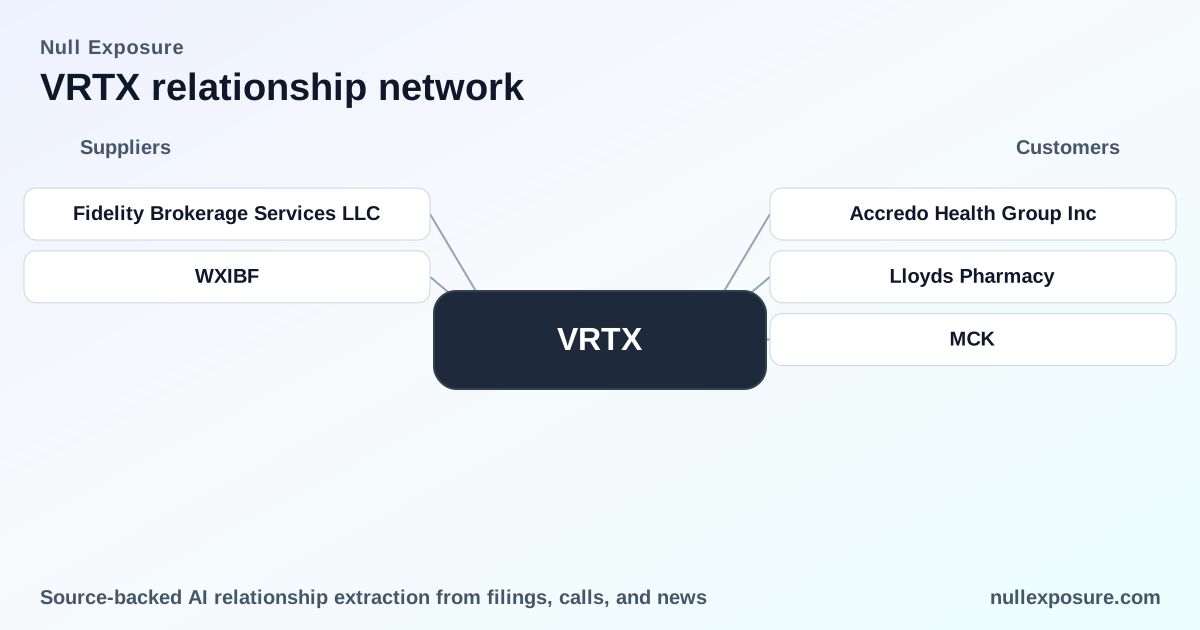
Accredo Health Group Inc
Accredo is listed by Vertex as a material customer within the FY2025 Form 10‑K, reflecting its role as a specialty pharmacy/distributor that aggregates patient access and reimbursement for CF products. According to Vertex’s FY2025 10‑K filing, Accredo is included among customers with concentrated product revenue exposure (FY2025 10‑K, filed 2026).
Lloyds Pharmacy
Lloyds Pharmacy is cited in Vertex’s FY2025 10‑K as an international retail/pharmacy channel that purchases and distributes Vertex medicines to patients in ex‑U.S. markets, underscoring Vertex’s reliance on established pharmacy networks for non‑U.S. sales (Vertex FY2025 10‑K, filed 2026).
McKesson Corporation (MCK)
McKesson appears in Vertex’s FY2025 10‑K as a significant U.S. distributor partner; McKesson’s scale positions it as a principal conduit for Vertex’s specialty products into pharmacies and health systems (Vertex FY2025 10‑K, filed 2026).
CRISPR Therapeutics (CRSP)
Vertex and CRISPR updated their collaboration on CASGEVY so that Vertex leads global development, manufacturing and commercialization and shares program costs and profits on a 60/40 basis with CRISPR Therapeutics; Vertex is the manufacturer and exclusive license holder for CASGEVY. This arrangement is documented in press disclosures from CRISPR and a GlobeNewswire release in early 2026 describing the amended agreement and the 60/40 economics (GlobeNewswire Feb 12, 2026; CRISPR press releases Jan–Mar 2026).
Royalty Pharma (RPRX)
Royalty Pharma publicly lists royalties on Vertex products (including TRIKAFTA and ALYFTREK) among its portfolio holdings in investor communications and dividend disclosures, illustrating how Vertex’s commercial success is monetized by third‑party royalty capital structures; this appears in Royalty Pharma coverage in early 2026 (Quiver Quantitative and MarketScreener reporting, Feb–Mar 2026).
Operating model signals and constraints investors should weight
The filings and excerpts produce clear company‑level signals investors must incorporate in valuation and risk workstreams:
- Contracting posture: Vertex’s go‑to‑market combines annual reimbursement limitations with select long‑term deals (company‑level evidence shows annual contracts with some government customers and a multi‑year NHS England agreement). That mix drives revenue durability but exposes Vertex to periodic renegotiation and reimbursement pressure.
- Concentration and materiality: Vertex reports significant customers that individually account for 10% or more of gross product revenues or receivables; combined with U.S. channel concentration, this creates counterparty concentration risk that is non‑trivial for credit and liquidity analysis.
- Criticality of core products: The product set is highly concentrated in CF therapies, with TRIKAFTA/KAFTRIO dominating product revenues and therefore making distributor and payor relations critical to enterprise value.
- Global distribution complexity: Vertex’s international model—distributors, retail pharmacies, and government payors—creates both market expansion upside and reimbursement complexity across geographies and payor systems.
- Spend scale: Reported product revenues exceed $11bn, implying large spend bands for counterparties and reinforcing the strategic importance of major distributors and pharmacies.
Investment implications: concentrated payoff with definable counterparty exposures
Vertex’s revenue engine is structurally attractive: high gross margins, blockbuster product sales, and profitable collaborations (e.g., CASGEVY economics). However, investors must price in concentrated customer exposure, government reimbursement risk, and dependence on a limited set of specialty distributors. The CRISPR partnership is a strategic diversification of R&D/commercial risk into gene‑editing therapeutics, but it also places manufacturing and commercialization obligations on Vertex under a shared‑profit construct (GlobeNewswire, early 2026). For deeper diligence on customer counterparty exposure and concentration management, see our work at https://nullexposure.com/.
Bottom line: what matters for holders and allocators
- Revenue upside is real and largely driven by a narrow set of products and channels; TRIKAFTA/KAFTRIO remains the dominant cash engine.
- Counterparty concentration and government reimbursement are the principal operational risks; these are explicit in Vertex’s FY2025 disclosures and require active monitoring.
- Strategic partnerships (CRISPR) and third‑party royalty holders (Royalty Pharma) materially influence cash flows and optionality—both positive for growth and important for scenario modeling.
Key takeaway: Vertex delivers durable, high‑quality revenue through a concentrated, well‑monetized product roster, but valuation and downside analyses must incorporate concentrated distributor relationships, government reimbursement dynamics, and the commercial obligations embedded in large collaborations.