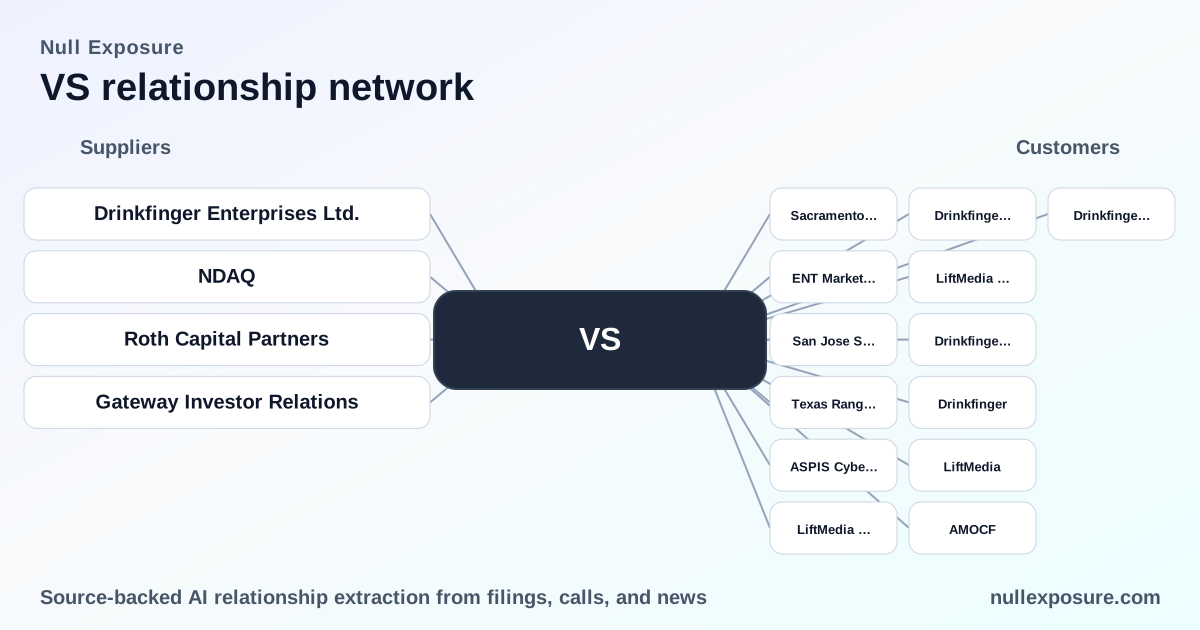
Versus Systems (VS) — Customer Map and Commercial Signals for Investors
Versus Systems operates a B2B engagement platform that licenses interactive gamification and reward mechanics to publishers, sports teams, agencies and out-of-home media operators, monetizing through licensing fees, campaign implementations, and revenue shares tied to audience engagement. For investors, the company’s growth is driven by a small set of higher-value enterprise relationships (sports franchises and media partners) and expanding DOOH and beverage activations that convert engagement into recurring licensing revenue. Learn more about relationship coverage and commercial risk at https://nullexposure.com/.
Quick commercial thesis: what drives revenue and risk
Versus sells software-as-licensed-engagement rather than consumer products, meaning revenue concentrates in multi-year licenses and commercial partnerships where a handful of buyers generate the bulk of deployed monetization. This model produces high customer concentration and a mix of active enterprise contracts and strategic rollouts, so investor focus should be on contract durability, renewal cadence, and pipeline conversion of announced pilots into license revenue.
Customer relationships — who’s on the ledger today
Below I cover every named customer and partner found in public filings and press releases. Each entry is a plain-English one- or two-sentence summary with a source callout.
San Jose Sharks
The San Jose Sharks were listed as one of Versus’ three largest customers in 2023, showing the company’s penetration of professional sports as a core go-to-market channel. This detail is disclosed in Versus’ Form 10‑K for fiscal year 2024.
Sacramento Kings
The Sacramento Kings also ranked among Versus’ three largest customers in 2023, reinforcing the company’s positioning selling engagement tools to NBA franchises and other large sports operators. (10‑K FY2024)
ENT Marketing
ENT Marketing, described in the 10‑K as a marketing agency that used Versus’ platform to promote Coca‑Cola products, appears as one of the top three customers in 2023, illustrating demand from agencies executing brand‑sponsored activations. (10‑K FY2024)
LiftMedia LDA.
Versus executed a definitive agreement to integrate its interactive engagement technology across LiftMedia’s DOOH network in the Iberian Peninsula, opening a sizeable European DOOH channel that reaches millions daily and promises impression‑driven monetization. (GlobeNewswire press release, Dec 3, 2025; definitive agreement announced Dec 11, 2025)
Drinkfinger Enterprises Ltd. (Drinkfinger)
Versus signed a definitive agreement (after an initial letter of intent) with Drinkfinger to integrate Versus technology into Drinkfinger’s beverage engagement products and to power global activations across Brazil, the U.S., U.K., and select markets. (GlobeNewswire press release, Dec 23, 2025; follow‑on reports Mar 2026)
Texas Rangers
Versus renewed and expanded a multi‑year collaboration with the Texas Rangers to continue deploying its Filter Fan Cam at Globe Life Field through the 2026 MLB season, demonstrating retention with a marquee sports franchise and ongoing stadium product deployment. (GlobeNewswire and TradingView reports, Mar–May 2026)
ASPIS Cyber Technologies / ASPIS Cyber Technologies, Inc.
The company disclosed a license agreement with ASPIS that granted ASPIS use of Versus’ technology, with ASPIS contractually committed to pay a license fee of $165,000 per month beginning January 2025 and to fund required development work—an example of a larger, recurring licensing arrangement disclosed in SEC filings. (License agreement disclosure in company SEC filings / 2025 10‑Q; corporate press summaries)
Animoca Brands (AMOCF)
Following a share exchange in 2019, Animoca Brands and Versus agreed to progress a strategic cooperation framework where Animoca could utilise Versus’ Winfinite platform for advertising via Animoca’s partner network, indicating an earlier token strategic relationship with a blockchain/gaming investor. (ExchangeWire, Aug 2019 — cited as Animoca Brands / AMOCF)
What these relationships collectively tell investors about the business model
- Contracting posture — licensing is core. Versus primarily sells under licensing arrangements and positions itself as the licensor of three core software products to teams, ad agencies and content creators; that licensing posture drives recurring revenue potential. (Company disclosures; contract excerpts)
- Concentration — revenue pools in a few enterprise deals. The 10‑K lists three customers as the largest in 2023 and notes just two active customers as of Dec 31, 2024, which signals high customer concentration and corresponding single‑client risk for near‑term revenue stability. (10‑K FY2024)
- Customer types — enterprise sports and agency buyers. Public statements repeatedly highlight professional sports clubs and marketing agencies as primary buyers, confirming a go‑to‑market centered on large venues and brand activations rather than broad consumer subscriptions. (10‑K FY2024; press releases Dec 2025–Mar 2026)
- Geography — North America core with selective international expansion. The firm’s operational footprint is North‑America centric but the LiftMedia DOOH and Drinkfinger agreements are explicit commercial expansion levers into Europe, Latin America and global beverage channels. (Company releases Dec 2025–Mar 2026)
- Contract economics — high‑value, multi‑month license economics. The ASPIS arrangement, which commits $165k per month plus development funding, puts a concrete spend band in the $1m–$10m range for at least one counterparty and demonstrates the firm’s ability to close material license deals. (License agreement disclosure; 2025 SEC filings)
Operational maturity and commercial criticalities
Versus shows a mix of established renewals (Texas Rangers) and recent definitive agreements (LiftMedia, Drinkfinger), which signals a company in the transition from pilot‑led activity to recurring contractual revenue. The presence of an ASPIS license with explicit monthly fees indicates commercially meaningful license economics, but the small number of active customers reported at year‑end 2024 underlines client concentration risk and the importance of converting announced partnerships into sustained revenues.
Key takeaways for investors
- Revenue is license-centric and concentrated — watch renewal outcomes and the conversion of DOOH and beverage agreements into recurring license inflows.
- Enterprise sports partnerships validate product fit but concentrate exposure. High profile renewals (Texas Rangers) are evidence of product stickiness; however, the small active-customer base at year‑end 2024 is a risk factor.
- ASPIS provides a concrete pricing signal ($165k/month plus development spend), useful for modeling near‑term revenue should the agreement be executed as disclosed.
- International expansion is deliberate (LiftMedia, Drinkfinger), which diversifies addressable market but requires execution across local media and channel partners.
For a concise, data‑driven read of Versus’ customer relationships and contract signals, or to model potential revenue scenarios from the ASPIS and DOOH deals, see the company overview and relationship tracking at https://nullexposure.com/.