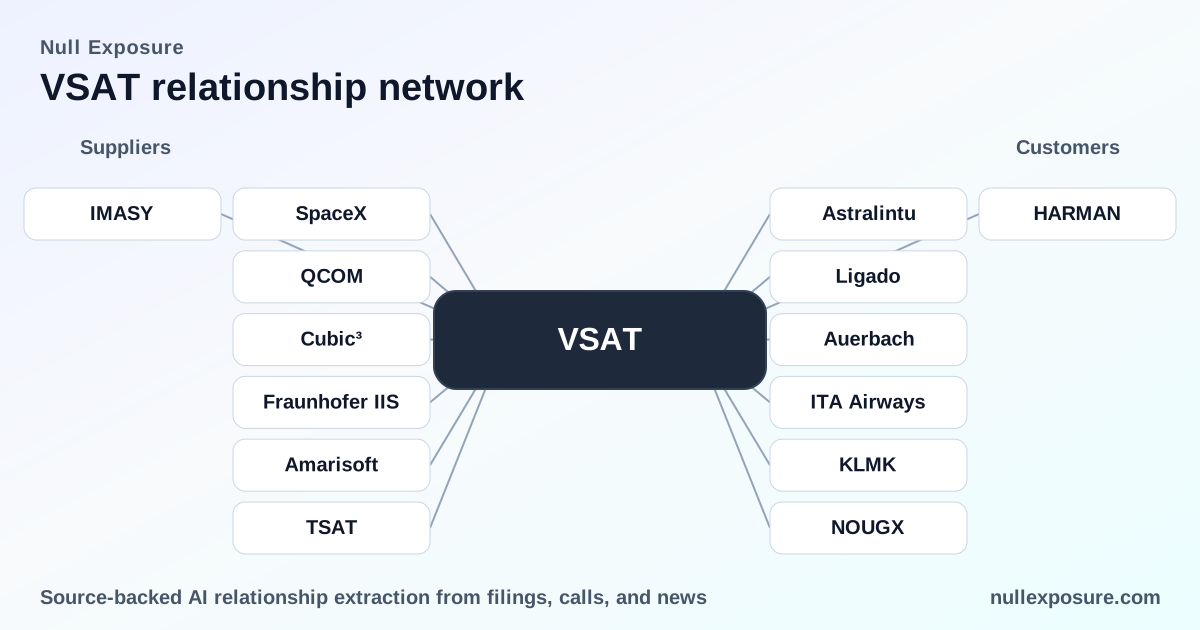
ViaSat (VSAT): Customer Relationships That Drive Revenue and Risk
Viasat monetizes an integrated satellite communications platform through a mix of equipment sales, recurring connectivity subscriptions, and multi-year government and enterprise contracts. The company sells ground and user terminals, operates satellite capacity and networks, and captures annuity-like service revenue from airlines, maritime fleets, fixed broadband subscribers and government customers—creating a blend of product-driven and subscription cash flows. For investors evaluating customer exposure and contract durability, Viasat’s mix of long-term federal contracts, high-revenue government counterparties, and broad commercial mobility wins are the most material signals. Learn more at https://nullexposure.com/.
How Viasat’s customer model translates to cash flow and risk
Viasat’s operating model combines three commercial realities that determine investor outcomes:
- Contracting posture: long-duration and mixed. The company operates under federal government contracts that require performance over multiple months to years and commercial deals that pair terminal sales with recurring connectivity commitments. The 10‑K documents government contract lengths and typical advance or recurring payments for connectivity services, which underpin predictable revenue streams.
- Concentration and criticality. The U.S. Government represents a significant single counterparty: the company’s 10‑K reports government revenues at roughly 18% of total revenue for FY2025, FY2024 and FY2023, making government demand both material and strategically critical.
- Global commercial scale with regional exposure. Viasat reports about 31% of revenues from international sales and highlights a strong North American fixed-services base; the company’s solutions span aviation, maritime, enterprise and consumer markets, producing diversified but geographically concentrated cash flows.
Taken together, these characteristics yield a business that collects both one-time equipment revenue and subscription-like service fees, with downside protection from government and airline long-term engagements but exposure to aircraft retrofits, roaming agreements and spectrum/partner settlements.
Customer catalogue: what every named relationship says to investors
Below is a concise, source‑backed rundown of every customer relationship mentioned in the collected reporting.
Astralintu
Viasat sold two advanced S/X/Ka‑band ground antennas to Astralintu to support an Equatorial Ground Station Network, reflecting antenna hardware sales and ground‑infrastructure revenue. (GlobeNewswire, Feb 11, 2026; additional press releases March 2026.)
Boeing
Viasat entered Boeing’s technical evaluation process to qualify its AERA electronically steered antenna across Boeing commercial programs, signaling potential platform‑level adoption that would scale IFC terminal shipments if qualified. (Aircraft Interior Expo coverage and GlobeNewswire announcement, Apr 2026.)
Auerbach
Viasat’s Inmarsat Maritime division was selected to install NexusWave connectivity across Auerbach’s German shipping fleet, representing a commercial maritime rollout and recurring connectivity revenue. (IndexBox / Finviz reporting on Q4 earnings, Mar 2026.)
Ligado
A one‑time lump‑sum payment from Ligado materially improved reported quarterly net income via interest income recognition on deferred payments and represents spectrum leasing/cash‑settlement activity. (Earnings coverage and analyst reports citing FY2026 results, Mar 2026.)
Jetstar Airways
Jetstar selected Viasat’s AMARA IFC solution for its upgraded Boeing 787 Dreamliner fleet, an order that combines hardware installation and ongoing passenger connectivity service contracts for long‑haul routes. (GlobeNewswire and UK Yahoo Finance press release, Apr–May 2026.)
National Airlines
National Airlines chose Viasat to install advanced in‑flight Wi‑Fi on A330 aircraft, expanding Viasat’s installed base in commercial long‑haul and transcontinental operations. (The Globe and Mail and ASDnews coverage, Mar–Apr 2026.)
KVHI
KVH’s global upgrade to mini‑VSAT broadband uses Viasat’s ArcLight spread spectrum technology, noting Viasat’s role in technology licensing and underlying network capability for maritime customers. (SpaceWar reporting on KVH upgrade, May 2026.)
Bharat Sanchar Nigam Ltd. (BSNL)
BSNL partnered with Viasat to support the next phase of the Indian Navy’s satellite communications upgrade, a public‑sector collaboration that combines defense and national telecom operator engagement. (Fortune India coverage, Jan 2026 / reported in Mar–Apr 2026 articles.)
Vueling
Viasat provides free, fast in‑flight Wi‑Fi to Vueling’s connected A320 fleet, an example of Viasat’s airline partnerships that convert passenger experience into recurring service revenue and potential upsell opportunities. (ASDnews and tradersunion reports, Apr 2026 onward.)
ITA Airways
ITA Airways adopted Viasat’s next‑generation Iris technology for its flights, indicating continued airline demand for Viasat’s cockpit and cabin connectivity solutions. (ASDnews coverage referencing Feb 2026 product launches.)
NOUGX
A 10‑K excerpt lists "NOUGX" in connection with government revenue reporting for FY2025; this entry appears in the company filing used to disclose customer concentration metrics. (Viasat 10‑K, fiscal year ended Mar 31, 2025.)
U.S. Government
The U.S. Government accounted for approximately 18% of total revenues in each of FY2023–FY2025, highlighting a material government revenue stream and contractual dependence for Viasat. (Viasat Form 10‑K, fiscal year ended Mar 31, 2025.)
HARMAN
Viasat announced a collaboration with HARMAN to introduce voice‑calling capabilities for vehicles using satellite communications, signaling automotive OEM/technology partner wins and new product integrations. (TradersUnion / press reports citing Mar 2026 announcements.)
KLMK / KLM
Reporting references KLM (and the KLMK tag) in the context of accelerating free in‑flight Wi‑Fi across Europe powered by Viasat, reflecting airline partner deployments in European markets. (ASDnews defense/aerospace coverage, Feb–Mar 2026.)
Note: multiple press outlets repeated many of the same announcements (GlobeNewswire, ASDnews, WebWire, IndexBox and others across Mar–May 2026); the summaries above cite the primary release or filing referenced in each item.
Constraints and what they imply about commercial durability
Viasat’s disclosures and reporting produce several company‑level signals that matter for investment assessment:
- Contract types: The business blends long‑term federal contracts and subscription-style connectivity agreements; government deals create durable backlog while subscriptions provide predictable recurring revenue.
- Counterparty mix: Government customers are material (explicitly the U.S. Government at ~18% of revenues), while commercial contracts span airlines, shipping operators and national telcos, producing diversification but also exposure to a handful of large counterparties.
- Geography and scale: The company reports strong North American revenue concentration by dollars and roughly 31% international sales, indicating global market reach with regional revenue skew.
- Relationship stage and portfolio dynamics: A large installed base (thousands of aircraft and business jets) supports active recurring service revenue; the firm also documents asset and portfolio exits (for example, the Link‑16 TDL sale completed Jan 3, 2023), signaling active portfolio management.
- Business segment: The communications services segment dominates revenue, combining aviation IFC, maritime, fixed broadband and government satcom—this is the unit that will drive near‑term cash generation.
Investment implications and next steps
Viasat’s customer relationships reflect a hybrid model: one‑off hardware revenue plus annuity service fees and significant government contracts. The company’s recent commercial wins with airlines and maritime fleets expand addressable recurring revenue, while spectrum and settlement items (e.g., Ligado) introduce episodic financial volatility. For an investor, focus on trends in IFC installed fleet growth, churn and ARPU in fixed broadband subscribers, renewal terms on multi‑year government contracts, and the pace of Boeing AERA qualification as accelerants to scale.
For a structured view of how these customer dynamics affect cash flow and credit profile, see further analysis and relationship mapping at https://nullexposure.com/.
Bold takeaways: government revenue concentration is material (≈18%), airline and maritime contracts drive recurring service revenue, and hardware + subscription pairing produces visible revenue durability with episodic earnings sensitivity to one‑time settlements.