VSE Corporation (VSEC) — customer map, operating posture, and what investors should know
VSE Corporation operates as an aftermarket distribution and maintenance, repair and overhaul (MRO) service provider for air and land transportation assets. The company monetizes by selling parts, supporting rotable exchanges, delivering MRO services and managing customer inventory programs — frequently under multi‑year distribution and sustainment contracts and through fleet inventory-management agreements. With trailing revenue just above $1.11 billion and a meaningful managed‑inventory program for the United States Postal Service, VSE generates recurring, contract‑driven cash flows that hinge on service continuity, logistics execution and parts availability. For an investor primer and ongoing coverage, see https://nullexposure.com/.
How VSE makes money and why customer relationships matter
VSE’s business is split along two commercial axes: distribution (global parts supply and logistics) and services (MRO and repair operations). The company sells goods and labor to both commercial and government clients, collecting margins on parts plus recurring service revenue from long‑term inventory and repair programs. VSE’s FY2024 filings and disclosures indicate:
- Contracting posture: VSE operates several multi‑year programs and has been scaling multi‑year distribution and repair agreements, which supports predictable revenue streams and longer customer life‑times.
- Customer concentration: The U.S. market is the dominant geography for revenue, and VSE’s USPS managed‑inventory program is explicitly identified as a material revenue and profit contributor.
- Channel role: The company functions as both a distributor and a service provider — combining parts inventory, just‑in‑time logistics and MRO execution in one offering set.
- Growth/maturity: Several programs are described as ramping (new international expansions and recently expanded flagship distribution agreements), indicating a mix of mature and growth-stage contracts.
Collectively, these characteristics create stable, contractual cash flow with concentrated operational risk around fulfillment and specific large customers. For ongoing coverage and tooling, visit https://nullexposure.com/.
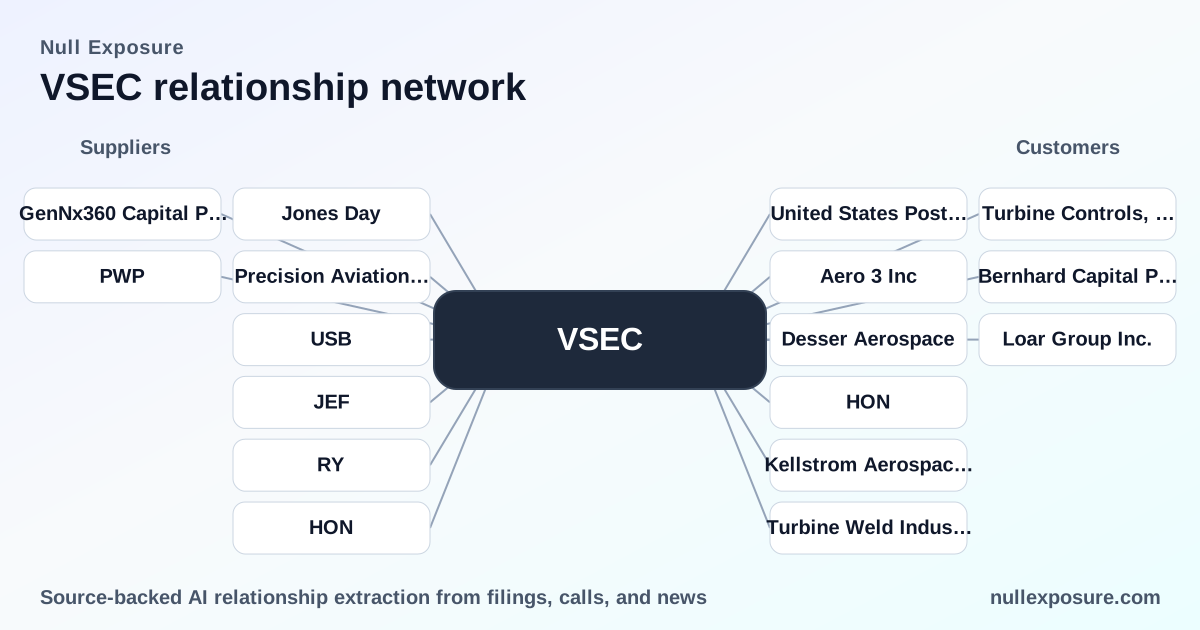
Customer map — the reported relationships and what they mean
Below I list every customer relationship referenced in the provided results, with a concise plain‑English summary and source reference.
-
United States Postal Service
VSE’s Fleet segment (branded Wheeler Fleet Solutions) supports the USPS with parts, sustainment solutions and managed inventory services, and the company’s filing states the USPS managed‑inventory program constitutes a material portion of revenues and profits. Source: VSE FY2024 Form 10‑K (fleet segment disclosure and materiality statement). -
Aero 3 Inc
Aero 3 Inc is listed among customer relationships in VSE’s latest filing and related public filings, indicating a commercial customer relationship in VSE’s aviation/aftermarket mix. Source: FY2026 filing cited via SEC filing repost on StockTitan (March 2026). -
Desser Aerospace
Desser Aerospace is recorded as a customer relationship in the company’s FY2026 filing; concurrently, VSE disclosed divestiture activity involving Desser’s proprietary solutions business. Source: FY2026 filing reposted on StockTitan (March 2026) and related 10‑K exhibits. -
HON (ticker HON)
Honeywell International is reported as a customer relationship in VSE’s filings, reflecting a supplier/partner dynamic within aerospace aftermarket distribution and MRO services. Source: FY2026 filing reposted on StockTitan (March 2026). -
Honeywell International
Honeywell International is recorded again (separately identified) as a customer relationship in the filing, reinforcing Honeywell’s presence among VSE’s aerospace customers. Source: FY2026 filing reposted on StockTitan (March 2026). -
Kellstrom Aerospace Group, Inc.
Kellstrom is listed among VSE’s customer relationships, consistent with VSE’s positioning in aftermarket parts distribution and MRO support for third‑party aviation suppliers and distributors. Source: FY2026 filing reposted on StockTitan (March 2026). -
Turbine Weld Industries, LLC
Turbine Weld is named as a customer relationship in the FY2026 disclosures, reflecting VSE’s engagement with specialized maintenance and component supply chains. Source: FY2026 filing reposted on StockTitan (March 2026). -
Turbine Controls, Inc.
Turbine Controls is identified as a customer relationship in the filing, consistent with VSE’s MRO and distribution footprint in powerplant-related aftermarket services. Source: FY2026 filing reposted on StockTitan (March 2026). -
Bernhard Capital Partners
VSE announced the sale of its federal and defense unit to Bernhard Capital Partners in a cash deal worth up to $100 million, a transaction that changes VSE’s exposure to certain government‑facing businesses and rebalances its customer/contract portfolio. Source: GovConWire report on the transaction (March 2026). -
Loar Group Inc.
Following a related transaction, VSE sold Desser Aerospace’s proprietary solutions business to Loar Group Inc. for cash consideration of $31.8 million, indicating portfolio reshaping and monetization of non‑core assets. Source: FY2026 filing reposted on StockTitan (March 2026).
What the disclosed constraints tell investors about operational risk
The filings and excerpts provide direct signals about firm‑level operating characteristics:
- Long‑term contracting is a core feature: VSE explicitly references multi‑year distribution and repair programs; this supports revenue visibility but increases the importance of contract execution and price discipline.
- Government exposure is material: VSE works with multiple U.S. government agencies (the USPS and FAA are named), which creates contract stability but also dependency on procurement cycles and compliance.
- Geographic profile is North America‑centric with expanding EMEA exposure: FY2024 revenue is concentrated in the U.S., while management cites ramped programs supporting EMEA. This mix reduces single‑market risk as international programs scale.
- Role concentration: VSE’s combined distribution + service model makes it critical to customers’ uptime and inventory reliability — a commercial advantage that simultaneously raises operational concentration risk if fulfillment falters.
- Relationship stage: Several programs are described as ramping, which generates growth potential but also execution risk during scale‑up.
- Material customer risk: The USPS program is explicitly material; that single customer concentration is a clear counterparty risk line item for investors.
Investment implications and risk checklist
- Positive: Recurring, contract‑based revenue from long‑term commercial and government clients, complemented by a parts distribution platform that drives gross margin stability.
- Key risk: Concentration — the USPS managed‑inventory program is material and the recent divestiture of the federal and defense unit (Bernhard deal) alters but does not eliminate government exposure.
- Operational execution: International ramping programs and integration of distribution and MRO services require consistent logistics and quality performance; failure here would compress margins quickly.
- Corporate actions: The Loar and Bernhard transactions demonstrate active portfolio management — these moves both reduce certain exposures and provide near‑term cash.
Bottom line
VSE is a contract‑centric aftermarket operator whose value is derived from long‑term service relationships, inventory control and integrated distribution/MRO capabilities. The USPS program is an important revenue anchor and the company is actively reshaping its portfolio through asset sales — both of which should be central to any investment or operational diligence. For further analysis and trackable signals on VSE’s customer relationships, visit https://nullexposure.com/.