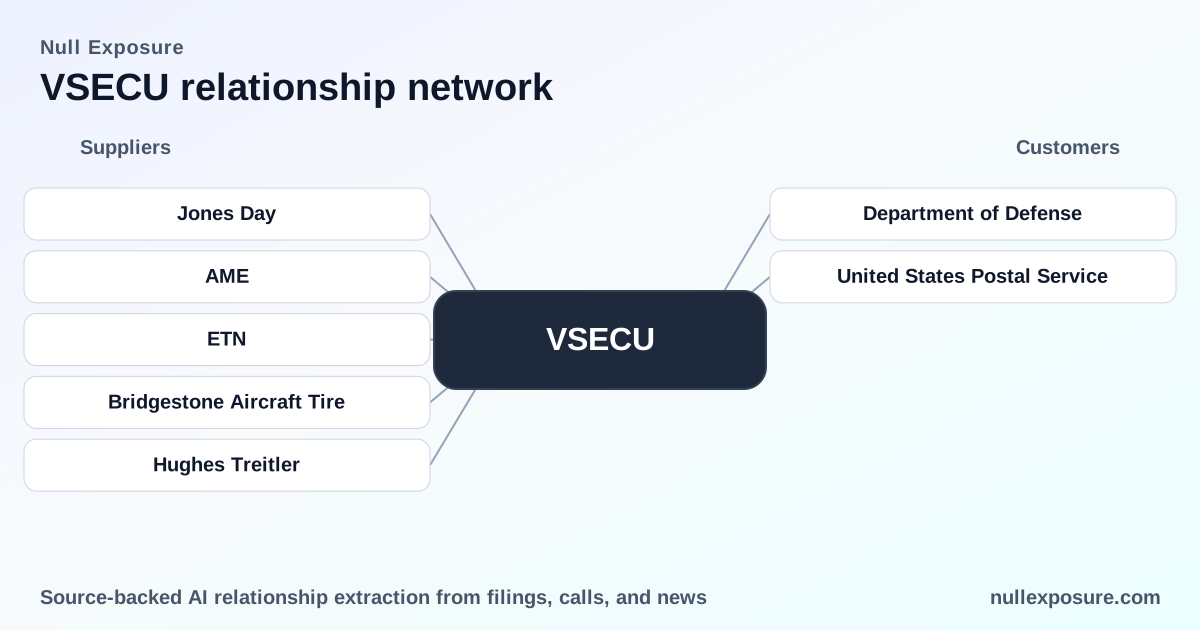
VSE Corporation: Customer Footprint and What It Signals for Investors
VSE Corporation operates a bifurcated aftermarket business: parts distribution and maintenance, repair, and overhaul (MRO) for aviation and fleet assets. The company monetizes through recurring parts sales, longer-term distribution agreements, and contract-driven MRO services for commercial and government clients, capturing margins both from inventory turnover and service contracts. For investors evaluating customer relationships, VSE’s commercial strategy is built on contracted revenue streams, program ramping, and government exposure, which together create a blend of durability and procurement dependency. Learn more about how these signals are extracted at Null Exposure.
How VSE makes money — a concise investor view
VSE’s revenue base is anchored in two complementary activities: global parts distribution (through centralized distribution centers and rotable exchange programs) and field MRO services (fuel controls, avionics, pneumatics, brakes, and fleet sustainment). The company converts installed base relationships into multi-year distribution and repair programs and supplements recurring revenue with ad hoc repair orders. FY2025/TTM figures show revenue of roughly $1.11 billion with operating leverage coming from service margins and supply-chain scale (gross profit roughly $158 million; operating margin ~12%). These economics make customer contract structure and counterparty mix materially relevant to valuation.
Major customer relationships disclosed in the FY2024 filing
VSE’s FY2024 Form 10‑K lists government and large institutional customers as significant and strategic clients. Below I summarize each named relationship disclosed in the filing and provide the source context.
United States Department of Defense (DoD)
VSE historically provided aftermarket refurbishment and sustainment services for military vehicles, ships, and aircraft, delivered through a Federal and Defense segment prior to the sale of that segment. This illustrates VSE’s role as a government contractor for lifecycle sustainment rather than a simple parts reseller. According to VSE’s FY2024 Form 10‑K filing (vsecu-2024-12-31), the Federal and Defense business delivered aftermarket refurbishment and sustainment services for the U.S. Department of Defense in prior periods.
Source: VSE FY2024 Form 10‑K (vsecu-2024-12-31), Fiscal Year 2024.
United States Postal Service (USPS)
VSE operates Wheeler Fleet Solutions within its Fleet segment to support the USPS and commercial truck fleets with parts, sustainment solutions, and managed inventory services, positioning VSE as an integrated fleet parts and logistics partner rather than a one-off supplier. The FY2024 10‑K specifically notes Wheeler Fleet Solutions’ support for the United States Postal Service.
Source: VSE FY2024 Form 10‑K (vsecu-2024-12-31), Fiscal Year 2024.
What these relationships collectively imply about VSE’s operating model
The public disclosures and associated constraint evidence reveal a consistent operating posture and risk profile that investors should incorporate into valuation and diligence.
-
Contracting posture: long‑term, program-oriented. VSE notes it “ramped up several multi-year distribution and repair programs” in 2024, which indicates a strategic preference for multi-year, contractually-backed cash flows rather than volatile spot sales. Long-term contracts support predictability in backlog and revenue recognition.
-
Counterparty mix: significant government exposure alongside commercial customers. Company-level statements confirm revenues derive from both commercial and government customers; government counterparty exposure is explicit and material to operations. Government clients demand compliance, stable pricing over contract lives, and often longer payment cycles — all structural features that affect working capital and margin timing.
-
Geographic reach: global distribution with targeted regional expansion. VSE describes expansion of a flagship distribution agreement supporting Europe, the Middle East, and Africa (EMEA) and a broadly diversified global client base, indicating that revenue and supply-chain risk are geographically distributed but require regional logistics and regulatory capabilities.
-
Service and distribution integration drives criticality. VSE supplies parts and performs MRO services, which makes it a critical supplier for clients’ asset readiness — particularly for fleet and aviation customers who need rapid turnaround. That criticality supports pricing power in service contracts but also increases operational exposure if facilities or logistics fail.
-
Concentration and materiality: certain customers represent material revenue. The company acknowledges that “certain customers comprise a material portion of our revenue,” which signals the potential for concentration risk if a large program is lost or sold (as illustrated by the prior sale of the Federal and Defense segment).
-
Maturity and growth posture: ramping programs and international expansion. Evidence of program ramping and new international markets suggests growth through contract wins and scaling distribution footprints rather than purely episodic demand cycles.
Key investment implications and risk factors
-
Revenue durability is higher than a pure parts distributor because of multi-year programs and MRO contracts; investors should value backlog and known program ramp schedules highly when modeling future cash flows.
-
Government contracts are double-edged: they increase revenue resilience but introduce procurement, compliance, and payment-timing risk. When government counterparty exposure is material, expect working capital volatility and higher administrative overhead.
-
Concentration risk requires active monitoring. The admission that certain customers are material means a loss or divestiture of a major contract can have outsized P&L and cash-flow impact — the prior sale of the Federal and Defense segment is an explicit example of strategic turnover.
-
Geographic expansion into EMEA and other international markets diversifies demand but raises execution risk—logistics, inventory positioning, and regional regulatory compliance now factor into margin projections.
-
Operational criticality supports higher service margins but demands capex and skilled labor investment. Investors should track repair-facility utilization and distribution-center scale economics as leading indicators of margin expansion or contraction.
Practical next steps for due diligence
- Review contract lengths, renewal cadence, and termination rights for VSE’s largest customers to quantify downside exposure to contract loss.
- Inspect working-capital trends relative to contract billing schedules, especially for government clients with delayed payments.
- Monitor the company’s disclosed backlog and program ramp commentary to calibrate near-term revenue growth and margin trajectory.
For a deeper feed of customer-relationship signals and to track changes in real time, visit Null Exposure.
Bottom line
VSE’s customer mix — anchored in long-term distribution agreements and MRO service contracts for government and large commercial fleets — creates a business that is predictable in revenue profile but sensitive to contract concentration, procurement cycles, and international logistics execution. Investors should value the company’s service integration and program ramping as durable drivers of cash flow while pricing in the operational and contract-retention risks that accompany government and institutional clients.