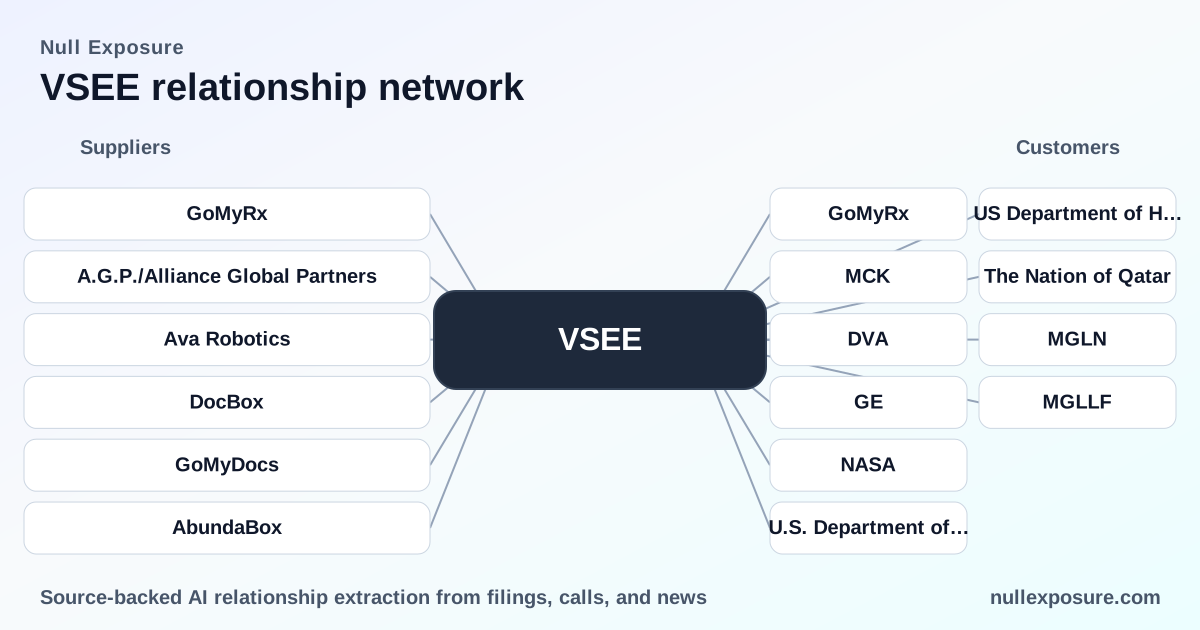
VSee Health: enterprise telehealth with FedRAMP access and concentrated customer exposure
VSee Health operates a combined software-and-services telehealth platform that it monetizes through subscription software, multi-year service agreements, and managed services for hospitals, health systems, government agencies and large enterprise partners. The company sells a stack of telehealth building blocks (video, remote monitoring, scheduling, RCM) and supplements recurring software revenue with professional services and managed services arrangements that bill pass-through costs plus a margin. Learn more about the full relationship map at https://nullexposure.com/.
How VSee contracts and the commercial posture investors should expect
VSee’s commercial model blends subscription economics with longer professional-service commitments. Public disclosures and company statements document that subscription fees are typically billed in advance and run on 12‑month cycles, while many institutional contracts are written for two-to-three year terms with automatic renewal. The business therefore combines predictable recurring revenue with service work that introduces variability and higher margin opportunities.
- Contracting posture: Predominantly subscription-based for core platform modules; supplemented by managed services and professional services that are billed on an expense-plus or fixed-fee basis.
- Customer makeup: A mix of government, large enterprises (health systems, vendors), and small/micro hospitals — the company explicitly calls out both ends of that spectrum.
- Concentration and criticality: Financial disclosures indicate customer concentration — at different points two customers represented a large share of receivables and revenue, and historically five customers comprised the bulk of accounts receivable — a material and operational concentration that creates downside sensitivity to a few counterparties.
- Geographic focus and maturity: Operations are primarily U.S.-centric, with international engagements for select nation-scale clients; the product set is positioned as mature enough to carry FedRAMP High Authority to Operate status for federal work.
- Revenue mix: Software (subscription) and services (managed services, RCM, tele-physician services) together drive revenue; this hybrid model supports both scale and higher-touch, higher-margin professional relationships.
These structural signals imply recurring revenue durability balanced by client concentration risk and execution required to scale services — key factors for valuation and diligence.
Customers and partners named in public reporting
Below are every customer/partner listed in the available relationship results, each summarized in plain English with a short source note.
GoMyRx, Inc.
VSee has a managed services agreement to provide platform administration, customer support, third-party vendor coordination and governance for GoMyRx, billing actual expenses plus a 10% margin under a contract that runs through December 26, 2027 with limited extension rights. According to a press release cited by The Globe and Mail (May 4, 2026) and TradingView coverage (March 10, 2026), VSee also invested in GoMyRx as part of the arrangement.
DaVita (DVA)
DaVita is listed among VSee’s enterprise clients, indicating use of the platform for clinical workflows and telehealth services; VSee cites DaVita alongside other large healthcare partners in investor communications. Multiple press releases and market notices referenced DaVita as a named client in FY2025–FY2026 (markets.financialcontent.com, Newswire, March–May 2026).
General Electric (GE)
GE appears in VSee’s client roll as an enterprise partner leveraging the platform for healthcare-related integrations and solutions; the company is cited in FY2025/FY2026 corporate disclosures and press material listing GE among large clients (markets.financialcontent.com and Barchart, March 2026).
McKesson
McKesson is repeatedly called out as a VSee customer and integration partner, appearing across multiple press releases and distribution partners in FY2025–FY2026 reporting; VSee positions McKesson among its large-enterprise healthcare accounts (OpenPR, Newswire, March–May 2026).
Magellan (MGLN / MGLLF)
Magellan is identified as a named client in VSee press material and investor notices, suggesting enterprise-level engagements for behavioral health or managed care workflows that VSee supports (Barchart and Markets FinancialContent, March–May 2026).
NASA
NASA is cited as a client using VSee’s secure communications and telehealth capabilities, a notable reference given the platform’s emphasis on secure, accredited deployments (Barchart and other press outlets, FY2025–FY2026).
U.S. Department of Health and Human Services (HHS)
VSee explicitly holds a FedRAMP High Authority to Operate from HHS and lists HHS programs among clients, establishing the firm as an approved supplier for federal telehealth and emergency response use cases (AccessNewswire / press releases, March 2026).
The Nation of Qatar
VSee lists the entire country of Qatar as a customer in public press materials, indicating nation-scale deployments or contracts outside the U.S. alongside its domestic client base (OpenPR and company press, March 2026).
LA County Department of Mental Health
VSee helped the LA County Department of Mental Health onboard 800+ providers in under seven days, which underscores the company’s capacity for rapid large-scale deployment in public-sector behavioral health settings (Finviz press coverage, May 2026).
(Each of the relationships above is documented in the referenced company press releases and market notices across March–May 2026; see the cited press channels for the original filings and announcements.)
What the relationship map implies for investors
The relationship roster delivers several clear investment signals: FedRAMP High ATO and named federal clients materially raise the bar for addressable public-sector revenue, while partnerships with system integrators and large health vendors (McKesson, GE, DaVita, Magellan) validate enterprise-market product fit. However, customer concentration is a material risk — company filings disclose that a handful of customers historically account for a disproportionate share of receivables and revenue, which amplifies downside if a major partner churns.
Operationally, VSee’s model is hybrid and execution-sensitive: subscription revenue provides baseline predictability, but managed services and revenue-cycle operations require delivery capacity and increase working-capital friction. That mix supports higher gross margins when scaled but requires disciplined contract management and client diversification to stabilize EBITDA.
Midway diligence action: review the service-level terms and renewal mechanics for the largest accounts and evaluate FedRAMP-related pipelines for sustainable federal bookings. For a strategic summary and tracked relationship intelligence, visit https://nullexposure.com/.
Key takeaways for investment and operational diligence
- Enterprise and government clients validate platform capability, reinforced by FedRAMP High ATO and named customers such as HHS and NASA.
- Revenue is subscription-anchored but materially augmented by managed services and professional fees, so watch margin leverage as services scale.
- Customer concentration is material and operationally critical, with a small number of counterparties historically representing a large portion of receivables.
- Geography is U.S.-centric with some nation-scale international engagements, which concentrates regulatory and reimbursement exposure domestically.
For investors and operators, the combination of FedRAMP certification, marquee clients, and explicit managed-service deals like the GoMyRx agreement provides both growth avenues and clear concentration risks to be addressed during due diligence.