VSee Health: Telehealth platform selling software, hardware and physician services into U.S. hospitals
VSee Health operates an integrated telehealth business that monetizes through a mix of subscription software, contracted clinical services and hardware fees, selling to hospitals, health systems, government facilities and smaller clinics across the United States. The company combines recurring platform revenue with fee-for-service tele-physician activity and device provisioning, creating a blended revenue model that is anchored in recurring contracts but supplemented by professional services. For investors evaluating customer relationships, VSee’s model signals both steady revenue visibility and exposure to healthcare operating cycles and liability dynamics.
Explore relationship intelligence at NullExposure.
How the business makes money and why customers stick around
VSee’s revenue model is multi-threaded: subscription fees for the VSee Lab platform, periodic hardware sales for remote monitoring and EEG telemedicine, and professional fees through its iDoc clinical service lines. The company discloses that customers commonly pay fixed monthly fees for platform access, EEG interpretation, and telemedicine consultation, while certain services are billed per encounter. Financials show $14.6 million in trailing twelve-month revenue and a gross profit of roughly $7.36 million, indicating software and service margins that can scale if customer acquisition and retention continue to improve.
- Recurring revenue is the anchor. Subscription services and renewals provide predictable cash flow when contracts are in force.
- Clinical services create higher margin variability. Professional fees and medical liability cost elements increase operational complexity and working capital demands.
The operating posture you need to know: contracting, concentration and criticality
VSee’s public disclosures and constraint signals point to a contracting posture that blends short-term subscriptions with multi-year institutional agreements. Company-level evidence indicates:
- Contracts often span 12 months for subscription offerings, cancellable with 30 days’ notice, while institutional service contracts are commonly two to three years with automatic renewal provisions. This structure produces a base of annual recurring revenue with pockets of longer-term institutionally locked revenue.
- Customer mix spans government, large enterprise (hospital systems) and small healthcare providers, creating diversified counterparty exposure but concentrating revenue risk inside the U.S. market.
- The company operates predominantly in North America (United States), which centralizes regulatory and market risk to the U.S. healthcare system.
- VSee functions as a seller and service provider—not just software licensing—so customers often rely on VSee for ongoing clinical operations and equipment provisioning.
- Product segmentation includes software (core platform), hardware (EEG and remote devices), and services (tele-physician and ICU specialty services via iDoc), positioning the company as an integrated vendor rather than a single-product SaaS pure-play.
These signals define VSee as a commercially mature telehealth integrator with recurring revenue characteristics and embedded operational risk through clinical service delivery.
Customer relationships surfaced in the data
The dataset provides a discrete view into a named customer engagement. Below is every relationship returned in the results.
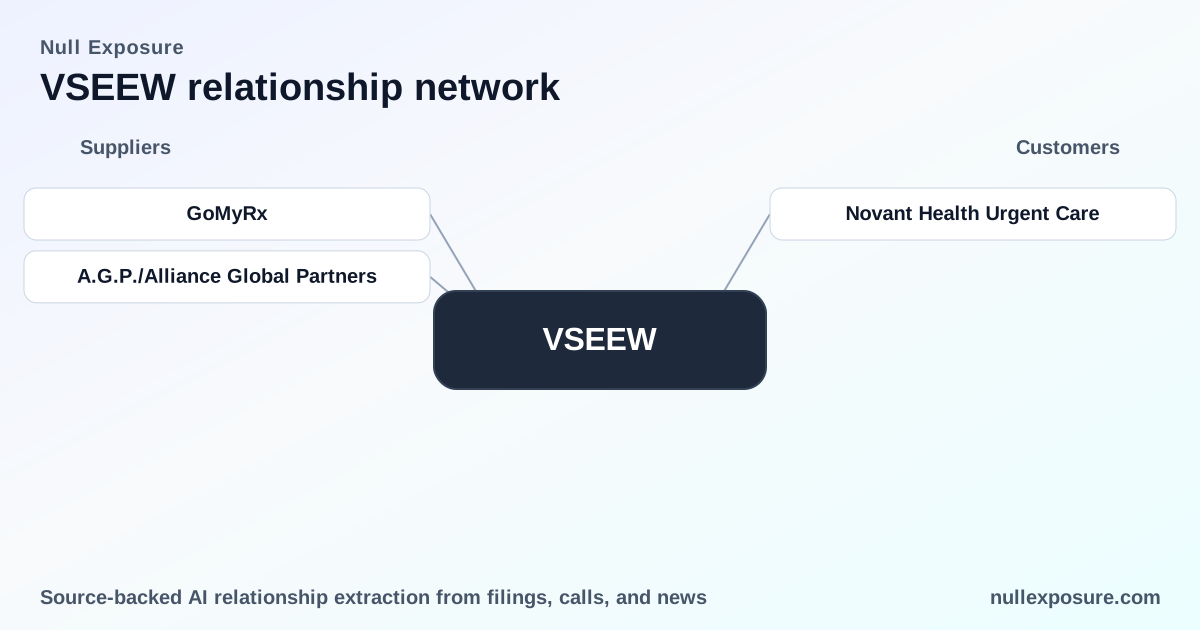
Novant Health Urgent Care
VSee executed a client engagement with Novant Health Urgent Care to streamline clinic operations, customize digital intake forms and execute a full brand refresh across web and mobile, indicating a platform deployment that spans workflow, patient intake and front-end branding work. This engagement was reported in a news item on March 10, 2026 (StockTitan news). (Source: StockTitan news, March 10, 2026 — https://www.stocktitan.net/news/VSEE/)
What the relationships imply about commercial strategy
The Novant Health Urgent Care engagement illustrates VSee’s commercial focus on operationalizing telehealth inside ambulatory and urgent care settings, not only delivering point video visits but replacing intake, triage and patient-facing digital assets. Because the company sells both software and clinical services, customer relationships often include multiple contract lines—platform subscriptions, professional fees and device provisioning—creating higher per-customer lifetime value when deployments scale.
Constraints and company-level signals that affect customer durability
Treat the following as company-level operating characteristics rather than relationship-specific facts:
- Contracting mix: The company documents both 12-month cancellable subscription terms and 24–36 month institutional contracts with automatic renewal. That contract mix provides a baseline of predictable annual revenue while retaining the potential for multi-year locked revenue from large customers.
- Geographic concentration: The company’s operations and market opportunity are U.S.-centric, concentrating regulatory and reimbursement exposure domestically.
- Counterparty diversity: VSee serves government facilities, large hospital systems and smaller providers, which smooths client-type concentration but keeps revenue sensitive to health system purchasing cycles.
- Product breadth: VSee’s go-to-market bundles software, hardware and clinical services, which increases revenue per account but raises integration and liability complexity.
- Revenue recognition and role: The company recognizes revenue under ASC 606 as a seller and service provider; that posture increases the need for robust contract management and claims mitigation for medical-liability exposures.
Investment takeaways — why this matters for valuation and diligence
- Growth lever: Successful upsells from platform deployments into clinical services and device provisioning create outsized account economics compared with standalone SaaS sales. VSee’s mix of software plus professional services supports a differentiated monetization path.
- Profitability headwinds: Operating margins are negative and EBITDA is currently a loss (historical EBITDA reported at approximately -$7.0M), so revenue growth needs to outpace fixed-cost absorption for valuation expansion.
- Concentration risk: Heavy U.S. exposure and reliance on hospital systems for larger contracts concentrate policy and reimbursement risk in one geography.
- Operational complexity: Delivering tele-physician services introduces medical-liability and staffing risks that typical SaaS vendors do not face.
Key investors should balance the stability of recurring subscriptions and multi-year institutional contracts against the cost profile of clinical services and U.S.-centric regulatory exposure.
If you are evaluating customer-level exposure or monitoring contract renewal cadence, NullExposure maintains relationship-level signals and constraint summaries that accelerate diligence — visit NullExposure for deeper coverage.