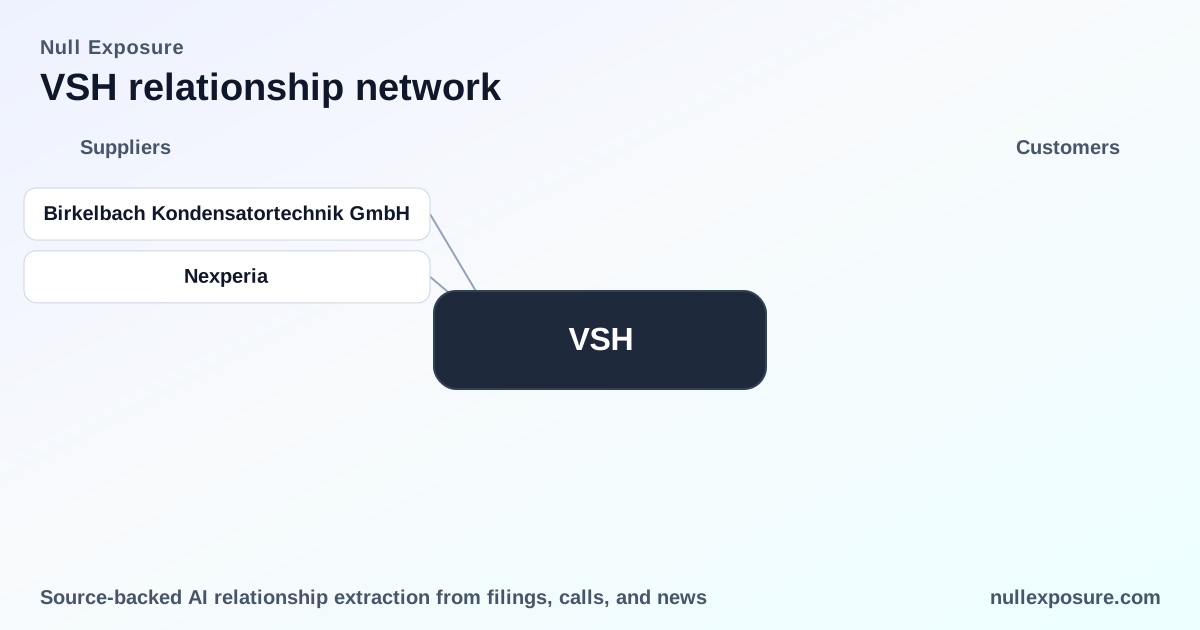
Vishay Intertechnology (VSH): Customer Relationships and Commercial Readiness
Vishay Intertechnology operates as a global manufacturer and supplier of discrete semiconductors and passive electronic components, monetizing through product sales to OEMs, EMS providers and independent distributors across automotive, industrial, computing, telecommunications and other end markets. Revenue is driven by broad product portfolios sold on a mix of short-term order flow and selective longer-term supply agreements, while geographic diversification and top-customer concentration shape commercial risk. For a deeper view of relationship intelligence, visit https://nullexposure.com/.
Investment thesis — why customer relationships matter for VSH
Vishay’s business model is a classic component-supplier play: scale manufacturing, wide product breadth, and channel distribution convert engineering content into repeatable sales. The company captures value by selling high-volume hardware components to large enterprise OEMs and distributors, leveraging global footprint and product variety to maintain share across cyclical end markets. Financially, Vishay’s top 30 customers account for roughly three quarters of revenue while no single customer exceeds 10% of total sales — a structure that concentrates risk at the customer cohort level rather than at an individual counterparty.
What the recent relationship signals tell investors
Vishay’s public relationship signals in 2026 are concentrated around automotive supply-chain activity and recognition, illustrating two strategic facts: Vishay is a critical supplier to smart mobility customers, and the company achieves measurable operational value that customers acknowledge publicly. Evidence sourced from company and press releases shows supply awards and continued product support in automotive subsystems.
The AUMOVIO relationship — supplier recognized for supply-chain performance
Vishay received a 2025 “Excellent Supply Chain Award” from AUMOVIO Automotive Systems (Changchun), reflecting delivery of passive and semiconductor components including MOSFETs, power inductors, Schottky diodes, rectifiers and current sense resistors used in automotive smart mobility and safety applications. According to a GlobeNewswire release in April 2026, Vishay was cited for enhancing AUMOVIO’s supply chain capabilities and supporting sales growth through that product breadth. Additional reporting on the same award appeared on Intellectia.ai and other outlets in April 2026.
Source: GlobeNewswire press release (April 2026); corroborated by Intellectia.ai and industry news summaries in April 2026.
How Vishay contracts with customers — practical operating constraints
Vishay’s commercial posture combines short lead, transactional business with pockets of longer-term coverage for specific products:
-
Contracting posture: The company states it has selected longer-term contracts (greater than one year) with certain customers for particular products, while the broader business operates on orders expected to ship within the next 12 months and payment terms generally under 90 days. This mix creates predictable near-term cash conversion with targeted multi-year commitments where strategic value or qualification cycles exist.
-
Order and payment cadence: Backlog recognition and receivables are managed on a 12-month horizon with payment terms typically less than 90 days, supporting working-capital visibility and limiting receivables duration.
-
Customer types and roles: Vishay sells to large enterprise OEMs, EMS providers and independent distributors; it acts primarily as a seller/manufacturer and supplies parts that distributors and EMS firms re-sell or embed into customer assemblies.
-
Geographic footprint: The business is truly global — about 76% of 2025 revenues were derived from customers outside the U.S., with meaningful revenue generation in Asia, Europe and the Americas. This geographic reach supports diversification but also exposes the company to regional demand cycles and supply-chain complexity.
-
Concentration dynamics: No single customer contributed more than 10% of revenues in 2025, yet the top 30 customers together represent approximately 74% of consolidated net revenues, a structural concentration that amplifies the commercial impact of portfolio shifts among those top counterparties.
-
Business segment and criticality: Vishay is squarely a hardware component supplier whose products are often critical line items in automotive, industrial and computing systems; this raises the potential for durable content wins but also the need to sustain qualification and supply discipline.
These constraints function as company-level signals that define how investor expectations should be set for customer stickiness, working capital, and risk exposure.
What this means for investors and operators
-
Customer stickiness is product- and qualification-driven. Longer-term contracts for specific products indicate that when Vishay secures design wins or supply agreements, those wins can generate multi-year revenue streams, particularly in automotive safety and industrial applications.
-
Concentration risk is concentrated, not idiosyncratic. The absence of any single >10% customer reduces single-counterparty risk but leaves the company exposed to shifts among its top 30 customers; portfolio-level churn among those accounts will materially affect results.
-
Global revenue mix is a double-edged sword. Geographic diversification supports demand smoothing but increases operational complexity and sensitivity to regional trade, logistics, and policy changes.
-
Short cash-conversion cycles support liquidity but amplify volume sensitivity. Payment terms under 90 days and a one-year backlog horizon offer good receivables turnover, making near-term revenue fluctuations quickly visible in cash flow.
Relationship-by-relationship coverage (exhaustive)
AUMOVIO Automotive Systems (Changchun) Co., Ltd. — Vishay provided a broad portfolio of passive and semiconductor solutions (MOSFETs, power inductors, Schottky diodes, rectifiers, current sense resistors) and received a 2025 Excellent Supply Chain Award recognizing its support for AUMOVIO’s smart mobility and safety applications. According to a GlobeNewswire release in April 2026, the award highlights Vishay’s role in enhancing AUMOVIO’s supply-chain capability; similar coverage ran on Intellectia.ai and industry news outlets in April 2026.
Source: GlobeNewswire press release (April 2026); Intellectia.ai report (April 2026); industry news summaries (April 2026).
Risk checklist and monitoring priorities
- Monitor quarterly disclosure of top-customer revenue mix and any shifts within the top 30 concentration bucket. A move in share among the top 30 is a leading indicator of revenue momentum or erosion.
- Track updates to long-term contract count and scope; large, multi-year supply agreements materially change revenue visibility.
- Watch geographic sales trends across APAC, EMEA and the Americas for regional demand inflection.
- Keep an eye on operational metrics tied to cash conversion and backlog shipping horizons given the short payment terms.
For investors and corporate operators requiring structured tracking of customer relationships and signal-driven risk scoring, explore the analytic offerings at https://nullexposure.com/ for ongoing coverage and alerts.
Conclusion — actionable read
Vishay’s customer profile combines broad, hardware-driven product exposure with concentration at the top-customer cohort and a pragmatic contracting posture that mixes short-term order flow with selective longer-term commitments. The AUMOVIO award is a concrete signal that Vishay’s supply reliability and product breadth translate into commercial recognition in strategic verticals such as automotive. For investors, that recognition supports a case for durable content wins, while the top-30 concentration and global exposure remain the principal commercial risks to monitor.