Vistra’s hyperscaler PPAs rewrite the playbook for merchant power — and valuation
Vistra is an integrated retail and power-generation company that monetizes through a mix of merchant market sales, retail customer contracts, and long-term power purchase agreements (PPAs) that lock in price and volume for large corporate buyers. The company is now converting a material portion of its nuclear fleet economics into multi-decade, fixed arrangements with hyperscalers — a shift that directly uplifts visibility on cash flows for its nuclear assets while leaving the rest of the portfolio exposed to short-term wholesale markets. For active investors and operators evaluating Vistra’s customer relationships, the strategic takeaway is clear: corporate anchor PPAs materially change revenue certainty for nuclear plants, even as merchant risk and geographic regulatory exposure remain central constraints.
Learn more at https://nullexposure.com/.
Why these deals matter to value — the new cash-flow architecture
Vistra’s core product is electricity, delivered through both retail channels and wholesale generation. Historically the company balanced merchant sales with retail contracts; the recent 20-year agreements with major tech customers transform part of Vistra’s merchant nuclear generation into long-duration, investment-grade-like revenue streams. The result is a hybrid contracting posture:
- Long-term contracting: Evidence in company disclosures highlights Vistra’s deliberate push into multi-year transactions to hedge commodity volatility and extend planning to 2027–2028.
- Merchant exposure remains: Vistra continues to monetize much of its non-contracted capacity on a short-term basis, preserving upside but also commodity risk.
- Geographic concentration: Operations and these PPAs sit primarily in U.S. wholesale markets (ERCOT, PJM, MISO, NYISO, ISO‑NE), so regulatory and regional market design remain key risk/catalyst vectors.
These characteristics increase cash-flow certainty for nuclear plants and support capital allocation to extended operations or strategic acquisitions, while leaving broader earnings volatility intact for the merchant and retail books.
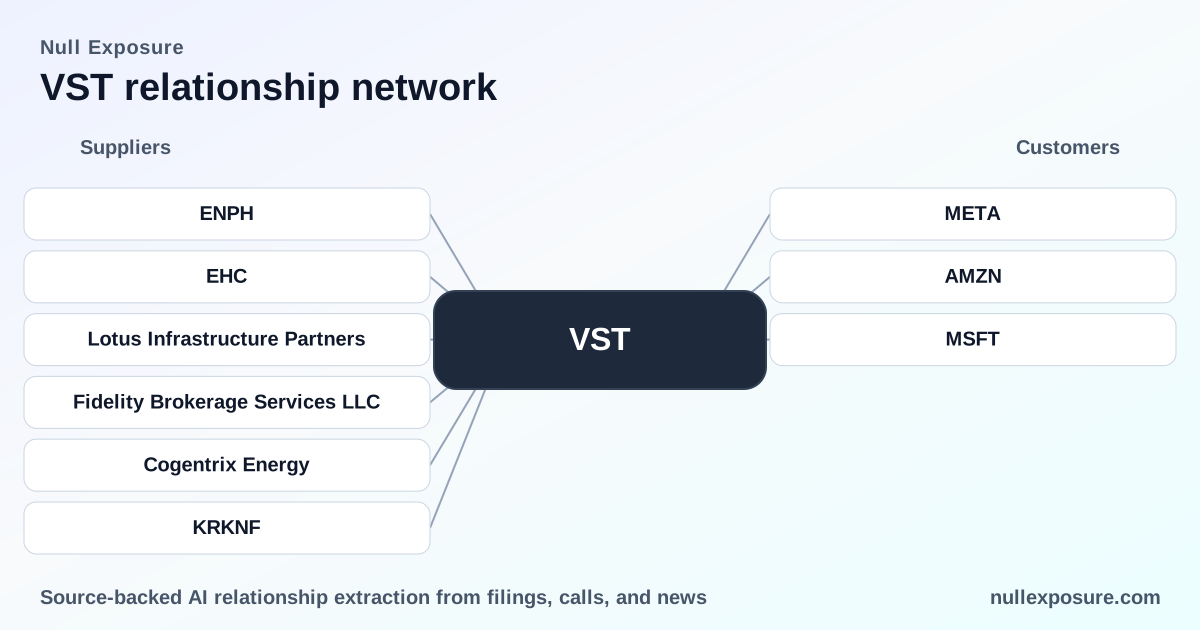
The customer list — who signed, what they bought, and where the traction sits
Amazon / Amazon Web Services (AWS)
Vistra has contracted a 20-year PPA for 1,200 megawatts at the Comanche Peak nuclear plant to supply Amazon Web Services. The agreement is explicitly cited on Vistra’s Q4 2025 earnings call and reported across industry outlets in March 2026, which also note expected energization timelines tied to multi-year ramp plans. (Sources: Vistra Q4 2025 earnings call; World Nuclear News, March 2026; financial press coverage, Feb–Mar 2026.)
Meta Platforms (Meta / META)
Vistra announced 20-year agreements with Meta covering roughly 2,176 MW of operating nuclear capacity plus approximately 433 MW of uprates/upgrades across PJM, often aggregated in press reporting as ~2.6 GW of Meta-linked nuclear power, capacity and uprates. These contracts are presented by management as anchor deals that support extended operations and uprate programs across PJM plants. (Sources: Vistra Q4 2025 earnings call; Finviz / press reporting, March 2026; World Nuclear News, March 2026.)
Microsoft
Vistra cited execution of the Pulaski solar PPA with Microsoft as part of its broader renewables PPAs signed in the prior year, reflecting the company’s strategy of pairing long-term contracts across technologies and customers to diversify offtake. The Oak Hill and Pulaski references appear in the same Q4 2025 earnings commentary that described the hyperscaler nuclear deals. (Sources: Vistra Q4 2025 earnings call transcript; Globe and Mail coverage, Feb–Mar 2026.)
How these relationships are structured and what that implies operationally
Vistra’s disclosures and public commentary establish several company-level signals about contracting and operations:
- Contract maturity and duration: The nuclear deals are 20-year PPAs, which convert large, discrete generation blocks into multi-decade cash flows that support plant uprates and life-extension work. (Company disclosures and Q4 2025 call.)
- Hybrid contracting posture: The firm continues to sell substantial volumes in short-term wholesale and bilateral markets for merchant facilities, but is actively marketing and pursuing longer-term capacity deals to lock prices and reduce commodity exposure. (Company filings and investor commentary.)
- Receivables and financing arrangements: Vistra operates receivables purchase and servicer arrangements (e.g., master framework / receivables facilities) that standardize cash collection and support working-capital financing — a structural strength for retail collections but also a counterparty ecosystem to monitor. (Evidence from receivables facility amendments and framework agreements in filings.)
- Geography and regulatory exposure: Operations and the new PPAs are concentrated in U.S. competitive markets (PJM, ERCOT, etc.), so changes in market design, state policy, or federal regulation directly affect redispatch economics and the realized value of these contracts. (Company regulatory disclosures.)
These signals combine into a clear operational profile: Vistra is moving capital-intensive, baseload nuclear assets from merchant risk toward long-term contracted revenue, while preserving optionality and upside in other parts of the fleet.
Risk and sensitivity — what investors should watch next
- Counterparty concentration: A handful of hyperscalers now anchor a meaningful share of contracted nuclear MW; any change in those customers’ data-center strategies or offtake needs is a high-impact event. (Press coverage and company commentary, Feb–Mar 2026.)
- Execution risk on uprates and timelines: The energization and full ramp schedules cited for certain projects (e.g., initial energization for Amazon site timelines discussed in analyst notes) create multi-year execution milestones that will affect near-term cash flows. (Analyst and market reporting, Mar 2026.)
- Regulatory and market design: PJM and other ISOs’ rules remain primary determinants of how capacity and uprate value are realized; policy shifts or transmission constraints are core operational risks. (Company filings on regulatory exposures.)
- Residual merchant exposure: Despite the long-term PPAs, the majority of Vistra’s facilities operate merchant-style without guaranteed returns; this preserves both upside and downside volatility in earnings. (Company disclosures.)
Investors should track project milestone updates, counterparties’ long-term offtake confirmations, and ISO filings that could reshape capacity valuation curves.
Bottom line: visibility improved, but not all volatility eliminated
Vistra’s 20-year PPAs with Amazon (AWS) and Meta materially increase certainty around nuclear revenue and support plant uprates and life-extension economics. These contracts materially de-risk portions of the generation fleet, while the rest of the portfolio continues to trade off wholesale market cycles and regulatory outcomes. For investors, the message is straightforward: re-rate Vistra’s nuclear asset cash flows under a long-term contracting lens, but preserve merchant exposure in models for the remainder of the business. For more detailed customer relationship analytics and evidence-driven summaries, visit https://nullexposure.com/.
Bold, corporate-grade PPAs have moved Vistra from a pure merchant narrative toward a mixed, predictable-cash-flow model — and that shift is the principal driver of the company’s current valuation reappraisal.