Virtuix (VTIX) — Defense Footprint Gains Scale but Financials Remain Early Stage
Virtuix builds and sells full‑body virtual reality hardware — most notably the Omni One omni‑directional treadmill — and monetizes through unit sales to commercial and institutional customers, software/terrain products for simulation, and research and development agreements with defense entities. For investors, the critical takeaway is that Virtuix is converting product innovation into defense channel traction, which increases order size and contract visibility, even as the business remains revenue‑light and loss‑making on a trailing‑twelve‑month basis. Learn more at the company hub: https://nullexposure.com/.
How Virtuix actually makes money — a concise investor view
Virtuix sells physical VR systems and associated software to a mixed base of commercial gamers and institutional buyers. Revenue is driven by one‑time system sales supplemented by software/features that increase system utility in training and simulation, and the company is actively pursuing contracting and development agreements with U.S. defense organizations to create recurring, higher‑value relationships. The public filings show modest revenue (roughly $4.46M TTM) and negative operating margins consistent with an early commercializing hardware vendor.
What the customer relationships tell us about go‑to‑market and risk
- Contracting posture: Virtuix is pursuing formal research and purchase relationships with U.S. defense organizations, indicating a move from ad‑hoc sales toward structured agreements and program integration.
- Concentration and criticality: Defense customers are becoming a material part of the narrative; winning validation with service academies and training commands raises product criticality but creates dependency on a small number of large institutional buyers.
- Maturity and scalability: Defense purchases are currently test units and pilot integrations, signaling early‑stage program adoption rather than wide deployment; scaling to sustained volume will require contracting, logistics, and certification maturity.
- Financial profile: With negative EBITDA and sub‑$5M revenue, the company’s growth depends on converting pilot programs into larger procurement orders and commercial market expansion.
For a deeper look at coverage and investor materials, visit the company hub: https://nullexposure.com/.
Defense and government customer map — who’s buying and why it matters
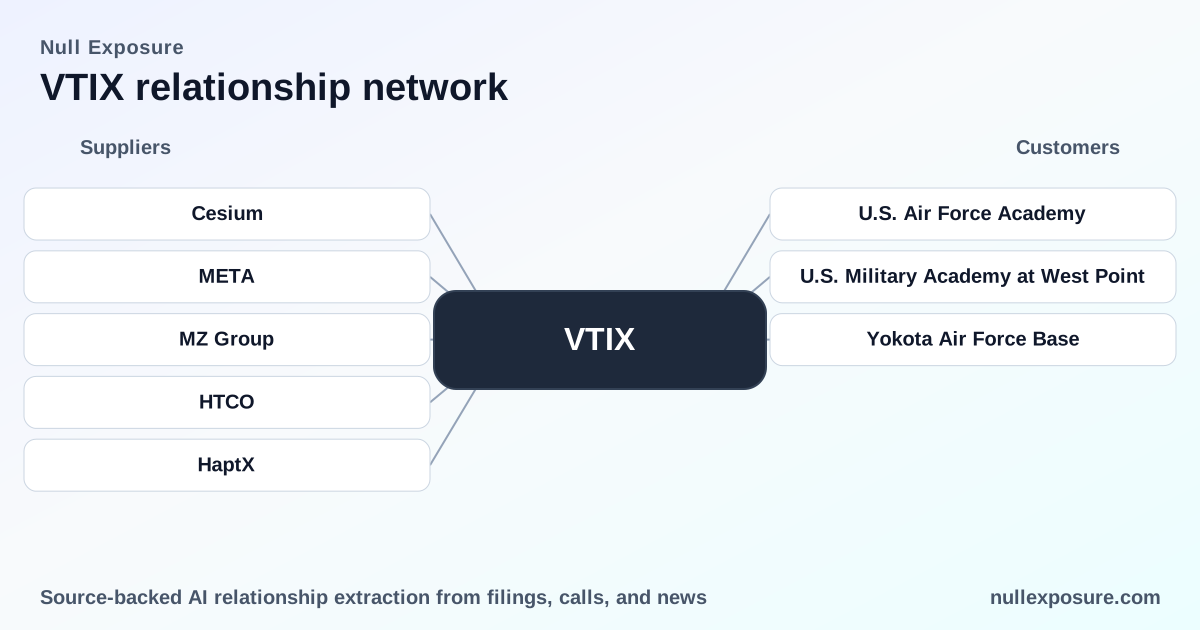
Below I walk through every public customer relationship captured in recent coverage, with short, source‑linked context.
-
Naval Postgraduate School — Virtuix signed a cooperative research and development agreement to deliver an Omni One system to the MOVES Institute for evaluation of omni‑directional navigation in military training. This formal R&D agreement positions Virtuix for applied research funding and longer‑term procurement pipeline opportunities (Sahm Capital, March 2026).
-
U.S. Military Academy at West Point — West Point purchased test units of the Omni One, cited repeatedly as an early adopter for the Virtual Terrain Walk capability and defense training experiments. West Point functions as a reference customer within the Army education system (Finviz, March 2026; Sahm Capital, March 2026).
-
Yokota Air Force Base (Yokota Air Base) — Yokota has purchased Omni One test units, marking an overseas U.S. base adoption and demonstrating Air Force operational interest outside the continental U.S. (Finviz, March 2026; Sahm Capital, March 2026).
-
YokoWERX — YokoWERX, an innovation cell of the U.S. Air Force, purchased two VTW prototype stations, representing program‑level experimentation and direct engagement with innovation units that feed larger Air Force acquisition pathways (TradingView, May 2026; fiscal references FY2025).
-
U.S. Air Force Academy (Air Force Academy) — The Academy has obtained test units for evaluation, giving Virtuix access to student and cadet training environments and strengthening an institutional sales case to other Air Force commands (Finviz, March 2026; Sahm Capital, March 2026).
-
U.S. Marine Corps / U.S. Marine Corps Training and Education Command (TECOM) — TECOM purchased an Omni One through Virtuix’s strategic partner KBR for warfighter training and mission planning; Virtuix later integrated Omni One into a FARP (Forward Arming and Refueling Point) training simulator developed by Vigilante, showing system integration into Marine Corps training workflows (Sahm Capital, March–April 2026).
-
U.S. Army — The Army, represented by West Point activity and other mentions, is a buyer of test units and an early channel for applied training demonstrations that can convert to wider Army program interest (Sahm Capital, March 2026).
-
U.S. Navy — Virtuix executed its first formal research agreement with the Navy, signaling cross‑service applicability and the opening of a Navy acquisition pathway beyond ad‑hoc purchases (Sahm Capital, March 2026).
-
Vigilante — Vigilante integrated Virtuix’s Omni One into a FARP training simulator; this partner integration demonstrates Virtuix’s role as a platform supplier to defense‑focused system integrators, which can accelerate adoption across programs that use integrators for fielding training systems (Sahm Capital, April 2026).
Each of these relationships is publicly documented in company announcements and market coverage during March–May 2026, and collectively they create a credible defense pipeline that investors should treat as both an opportunity and a concentration risk.
Investment implications — upside drivers and risk vectors
-
Upside: validation across multiple military branches reduces single‑service dependency and enhances the company’s ability to secure larger program contracts and integration orders via partners like KBR. Early adoption by service academies and innovation cells creates a pathway to procurement programs if pilot results support mission requirements.
-
Risks: The business is still early stage financially — negative EBITDA and low absolute revenue mean the company needs to translate pilots into volume sales. Defense relationships today are primarily test units and R&D agreements, not large multi‑year buys. Execution risks include contracting timelines, logistics for hardware deployment, and the operational certification processes typical of defense procurement.
What to watch next (practical triggers)
- Announcements converting research agreements or pilot sales into multi‑unit procurement or task orders.
- New strategic partnerships with defense integrators beyond KBR that broaden program access.
- Quarterly revenue mix disclosures showing higher contribution from institutional/defense customers versus commercial retail.
- Any classified or non‑public program wins referenced indirectly in contract filings or investor releases.
Bottom line for investors
Virtuix is a hardware‑centric VR company that has shifted from consumer channels toward defense experimentation and R&D relationships, a move that increases potential contract value but also concentrates revenue sources and relies on successful conversion of pilots into procurements. The company’s financial profile remains early stage; investors should treat current defense traction as a promising validation signal while tracking procurement conversion and margin progression.
For ongoing coverage and to connect these relationship signals to portfolio analysis, visit https://nullexposure.com/.