Vesta (VTMX) — Customer Relationships That Drive Industrial Real Estate Value
Vesta acquires, develops, manages and leases industrial buildings and distribution centers across Mexico, monetizing through long-term lease income, selective development fees and portfolio revaluation. The company's revenue depends on securing and expanding relationships with multinational manufacturers and logistics operators that require large, modern facilities; such anchor tenants both stabilize cash flow and support rental reversion when markets tighten. For investors evaluating VTMX, customer durability and the pace at which existing clients expand footprints are the primary operational signals to watch. Learn more at https://nullexposure.com/.
How Vesta's operating model converts tenants into cash flow
Vesta's business is straightforward: build or acquire industrial properties, lease them to creditworthy tenants, and collect contracted rental income while selectively developing new space. That model creates a blend of recurring cash flow and episodic development upside; tenant expansions directly translate into higher portfolio utilization and faster earnings growth. The Q4 2025 commentary highlights two types of customers: global manufacturing groups and large electronics OEMs — profiles that bring scale, long lease terms and expansion optionality.
Key operating characteristics to monitor:
- Contracting posture: Vesta runs lease structures that favor long-duration occupancy with multinational tenants, which supports predictable cash flow and lower turnover.
- Concentration and criticality: Large strategic customers can concentrate revenue but also create stickiness when tenants expand multiple facilities within Vesta’s parks.
- Maturity and expansion cadence: Existing clients expanding footprints signal both facility suitability and the firm’s ability to capture follow-on development demand.
For additional detail on customer coverage and signals, visit https://nullexposure.com/.
Customer relationships cited on the Q4 2025 earnings call
Vesta’s Q4 2025 earnings call provides direct, management-level confirmation of tenant activity. Each of the reported mentions below is summarized and cited from that call.
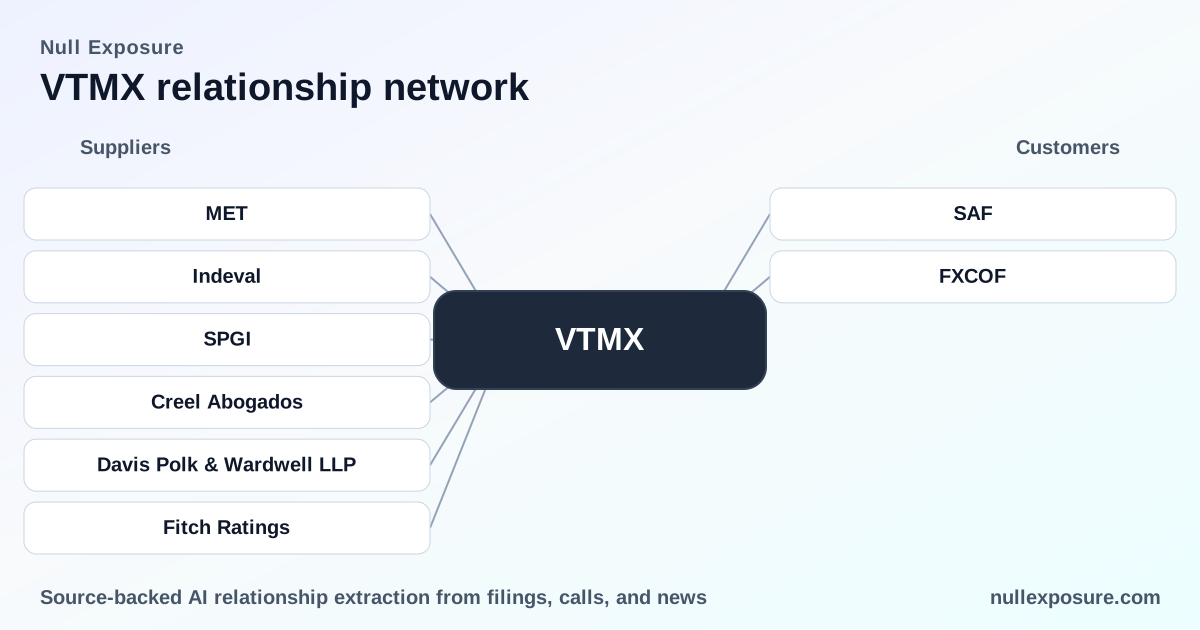
Safran Group (entry 1)
Vesta reported a recent expansion with the Safran Group, a major aerospace supplier based in France, framing the deal as a clear signal of global manufacturers’ continued commitment to Mexico. According to the Q4 2025 earnings call (vtmx-2025q4-earnings-call) on March 7, 2026, management emphasized that the Safran expansion demonstrates cross-border industrial investment into Vesta’s assets.
SAF (duplicate entry)
Management repeated that it had “expanded another operation with the Safran Group out of France,” reinforcing the same development as a strategic win for Mexico-facing industrial logistics. The reference appears in the same Q4 2025 earnings call transcript (vtmx-2025q4-earnings-call) dated March 7, 2026, underscoring the importance Vesta places on that customer expansion.
Foxconn (entry 1)
Vesta noted that Foxconn — a major electronics manufacturing services provider — is an existing client actively expanding its footprint, which strengthens both the portfolio’s demand profile and the strategic importance of Mexican manufacturing hubs. This remark was included in the Q4 2025 earnings call (vtmx-2025q4-earnings-call) on March 7, 2026, and indicates follow-on leasing activity from technology supply-chain tenants.
FXCOF (duplicate entry)
Management again identified Foxconn in the earnings call narrative, highlighting that “existing clients, including Foxconn, are actively expanding their footprint,” a repetition that signals the company views this as a material and recurring source of leasing demand. The comment is recorded in the Q4 2025 earnings call (vtmx-2025q4-earnings-call) on March 7, 2026.
What these customer references imply for investors
The earnings call references combine into a coherent commercial picture: Vesta is capturing expansion demand from large, global industrial tenants rather than relying solely on new tenant acquisition. Anchor-tenant expansions have three immediate effects on the investment case:
- They increase near-term leased area and revenue without the same acquisition or tenanting costs as new-market entry.
- They reduce vacancy risk in newly completed developments by converting pipeline space to occupied leases.
- They validate Vesta’s product-market fit for global supply-chain tenants, which supports pricing power and longer-term occupancy.
Constraints and company-level signals
No constraint excerpts were supplied in the materials reviewed for these customer relationships. As a company-level signal, the absence of explicit contracting or regulatory constraints in the provided record suggests that the conversations captured by management were oriented around growth and tenant activity rather than operational friction. Investors should still evaluate external controls (permitting, infrastructure bottlenecks, macro trade policy) outside these remarks, since the earnings call highlights demand more than supply-side limitations.
Investment implications and risks to monitor
- Upside: Continued expansions from global manufacturers and OEMs underpin rental growth and de-risk development pipelines. Tenant-led expansion is a direct lever on revenue visibility.
- Concentration risk: Large customers like Foxconn and Safran provide scale but create revenue concentration; a meaningful contraction by any single anchor tenant would have outsized effects on occupancy and cash flow.
- Market sensitivity: Demand for industrial space tracks broader trade flows and nearshoring dynamics; sustained capital inflows from multinational clients are the primary growth engine.
- Execution risk: Development execution and leasing cadence determine whether expansion announcements convert into stabilized income on schedule.
Bottom line for operators and buy-side analysts
The Q4 2025 commentary confirms that Vesta is successfully converting multinational manufacturing demand into portfolio expansions. Management’s repeated references to Safran and Foxconn are not casual name-drops — they are operational evidence that Vesta’s properties meet the requirements of large-scale industrial tenants and that those tenants are expanding within Mexico. For operators, that validates pipeline assumptions; for investors, it supports an earnings narrative driven by tenant expansion rather than speculative leasing.
For continuing coverage and detailed customer-centric intelligence on Vesta, visit https://nullexposure.com/.