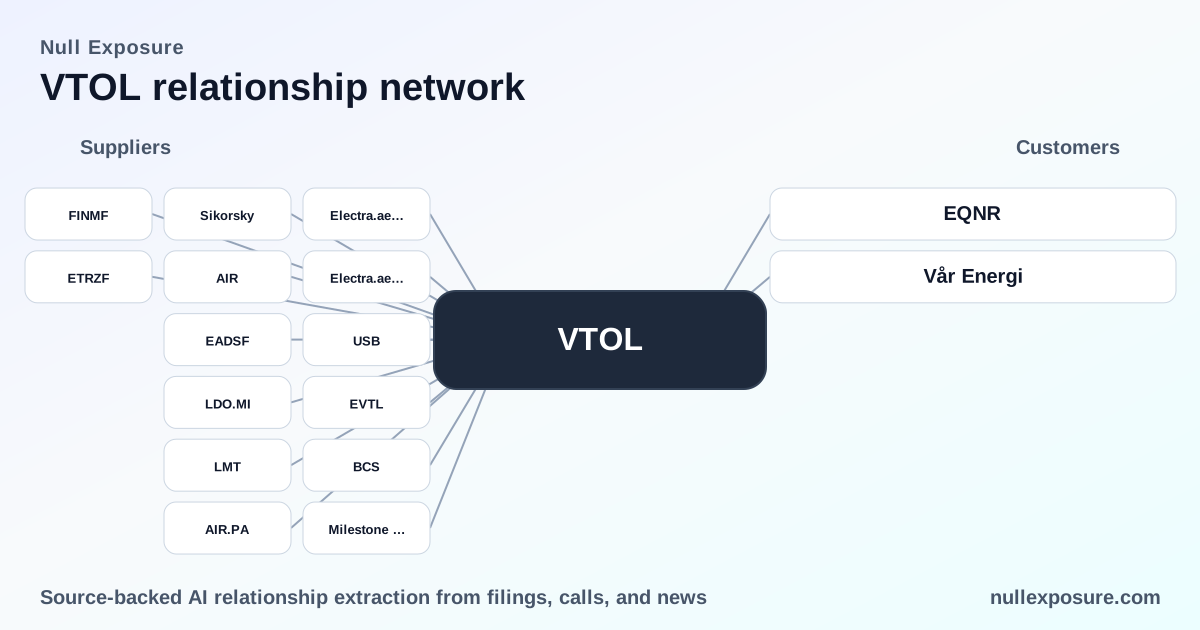
Bristow Group (VTOL): Customer Relationships and What They Mean for Revenue Quality
Bristow Group operates a global aviation services platform that monetizes through long-duration government search-and-rescue (SAR) contracts, multi-year offshore energy transportation contracts, and a mix of ad-hoc and subscription-style fleet arrangements. The company sells crew and aircraft capacity to large energy majors and government agencies, capturing margins through operating scale, specialized SAR capabilities, and geographic reach. For investors, the core question is whether contract structure, customer concentration and the Government Services ramp will translate into durable cash flow expansion and improved margin profile.
Explore the full offering and signals at https://nullexposure.com/.
How Bristow actually gets paid — contract posture and revenue drivers
Bristow’s operating model combines two distinct monetization patterns that shape cash flow predictability:
- Long-term, high-visibility government contracts that deliver stable cash flows. Company disclosures note multiple 10-year awards (including UK and Irish SAR contracts), which drive a high-quality, long-duration backlog and underwrite capital allocation to fleet and trained personnel.
- Shorter-term offshore energy contracts typically structured between one and five years, frequently with options for early termination; these deliver higher cyclicality tied to exploration and production activity but preserve close ties to large energy customers.
Company filings through 2024 show Offshore Energy Services accounted for ~68% of revenues and Government Services ~23%, which means the business combines cyclical and stable revenue streams in a single platform. Bristow contracts the majority of helicopters through master service agreements, subscription arrangements and dry-leases, which creates a hybrid of fixed-recurring and utilization-sensitive revenue. The firm’s global footprint—operations across six continents and 46 bases—supports diversification but also creates exposure to multiple regulatory and operating regimes.
What the public coverage says about named customers
Below are every relationship referenced in the available public coverage; each entry includes a plain-English summary and the cited source.
EQNR (listed as EQNR in coverage) — FY2026
According to MarketScreener coverage in March 2026, Equinor and Vår Energi hired Bristow for helicopter transportation operations in the Barents Sea on February 2, positioning Bristow as a contractor for Arctic offshore logistics over that contract term. (MarketScreener, March 10, 2026)
Equinor — FY2026
MarketScreener’s March 2026 report states Equinor is a named customer in Bristow’s Barents Sea helicopter transportation engagement, reflecting Bristow’s role supplying specialized aircraft and crews for high-latitude offshore operations. (MarketScreener, March 10, 2026)
Vår Energi — FY2026
The same March 2026 MarketScreener note lists Vår Energi alongside Equinor as a counterparty for Barents Sea helicopter transportation, indicating multi-customer utilization of Bristow’s Arctic assets under coordinated service arrangements. (MarketScreener, March 10, 2026)
Company-level constraints that shape customer economics
The following operating characteristics are derived from Bristow’s own disclosures and thus represent company-level signals—not attributes of any single customer unless explicitly stated in source text.
- Contract maturity and visibility: Government services contracts are typically long-term (ten years or more) and provide stable, high-credit-quality cash flows; offshore energy contracts run one to five years and are more dependent on customer activity levels.
- Contract mechanics: The company employs master service agreements, subscription-style arrangements and day-to-day contracts; this mix creates a degree of recurring revenue while retaining exposure to utilization cycles.
- Counterparty profile: Customers are a mix of government entities (SAR outsourcing) and large energy enterprises; this results in high credit quality on the government side and concentrated revenue risk among a handful of major energy customers.
- Geographic diversification and operational complexity: Bristow operates in North America, EMEA, APAC and LATAM, with revenue splits demonstrating meaningful exposure to the UK and Norway in particular; global scope reduces single-country risk but increases execution complexity.
- Materiality and concentration: Disclosures show three named customers accounted for roughly 33.3% of revenues, with a clear materiality signal that a small number of counterparties can move overall results.
- Relationship lifecycle: The Government Services segment is currently in a ramping phase in the 2025 transition year as new contracts come online and related operating costs are absorbed before the full earnings power is realized.
What these customer relationships mean for revenue quality and risk
Bristow’s customer mix delivers a blend of resilience and cyclicality. Government SAR contracts provide high-quality, contracted cash flows and justify fleet investments; offshore energy contracts supply scale but expose margins to volatility from rig activity and commodity-driven capex cycles. The presence of master agreements and subscription leasing improves predictability, while the disclosed top-customer concentration creates idiosyncratic revenue risk if a major energy customer reduces activity.
Operational risk is elevated during ramp phases: the company disclosed that 2025 is a transition year for Government Services as it incurs onboarding and capital costs while operations scale into full profitability in 2026. This dynamic pressures near-term margins but supports longer-term margin expansion once government revenues fully ramp.
Geographic and contract diversification lower single-market exposure, but multi-jurisdiction operations increase the importance of execution discipline, local regulatory compliance and crew retention. The Barents Sea engagement with Equinor and Vår Energi is an example of Bristow winning specialized, higher-margin work in demanding environments—work that requires mature safety systems and Arctic-capable assets.
Investor takeaways — what to monitor and when to act
- Monitor government contract cash flow realization and whether 2026 operating results show the expected margin benefit from completed ramp activity. That is the single biggest determinant of earnings quality improvement.
- Track top-customer revenue trends and any concentration reduction; a sustained drop in share from the top three customers would materially alter risk profile.
- Watch fleet utilization and capital allocation: the balance between leasing, dry-leases and owned aircraft will determine capex intensity and free cash flow generation.
- Follow new contract awards in high-demand regions (North Sea, Barents Sea, Brazil) for evidence of pricing leverage and margin resilience.
- Evaluate exposure to offshore industry cycles versus government backlog—offshore activity drives near-term revenue volatility, government contracts underpin long-term valuation support.
Learn more about monitoring counterparty signals at https://nullexposure.com/.
Final verdict for relationship-focused investors
Bristow combines durable, long-term government contracts with large—but cyclical—offshore customer relationships, producing a revenue mix that is attractive to income-oriented investors who value contracted cash flows, while still offering cyclical upside tied to offshore recovery. The company’s near-term profile is defined by a government-segment ramp and top-customer concentration that warrant active monitoring; the Barents Sea engagements cited in March 2026 demonstrate Bristow’s continued ability to secure specialized, high-barrier contracts with major energy players. For investors evaluating customer risk, the balance of long-duration SAR contracts against a concentrated offshore customer base is the defining trade-off.