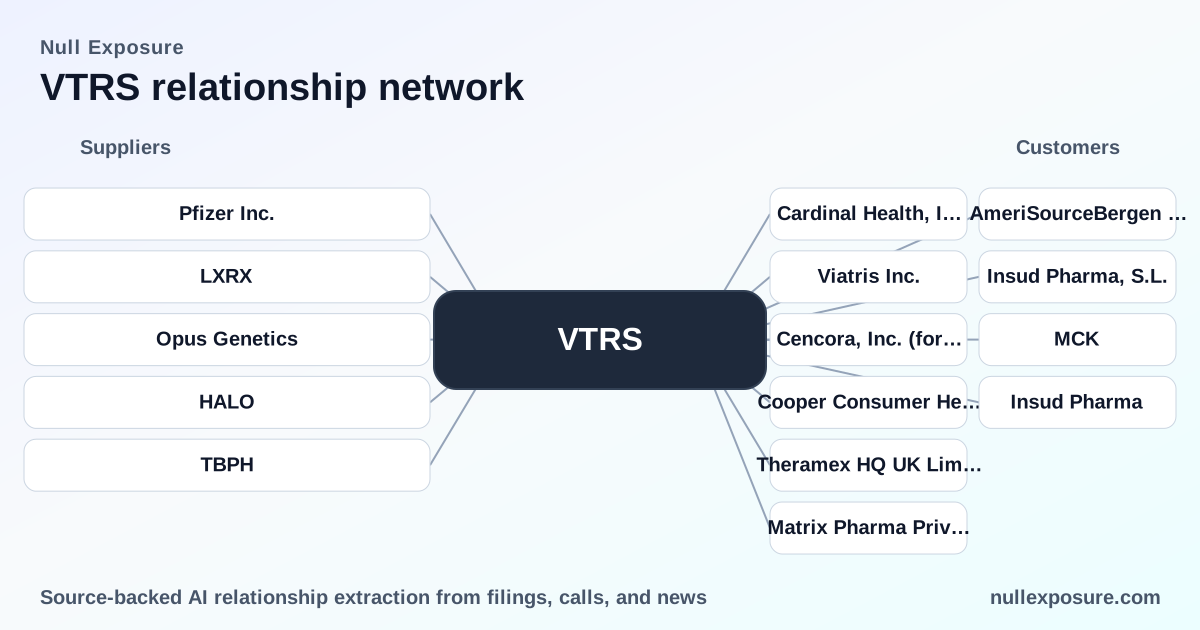
Viatris (VTRS): Customer Relationships, Concentration, and Commercial Footprint
Viatris operates as a global manufacturer and marketer of branded and generic pharmaceuticals, monetizing through large-scale product sales to wholesalers, retail chains, hospitals, payers and governments, supplemented by manufacturing and transition services tied to divestitures and commercial partnerships. Revenue derives from a concentrated set of very large distributors and targeted co-promotion agreements, while monetization also includes multi-year manufacturing and supply contracts and short-term transition services related to business divestitures. For a data-driven lens on counterparties and risk, explore more at https://nullexposure.com/.
What investors need to know up front
Viatris runs a dual commercial model: high-volume, low-margin product sales through a handful of very large distribution partners alongside contracted manufacturing and commercial services linked to portfolio reshaping. That structure produces meaningful customer concentration (a few wholesalers represent double-digit percentages of consolidated net sales) and predictable service revenues tied to divestiture transition periods. The company reported approximately $14.3 billion in trailing revenues and EBITDA of about $3.96 billion, underpinning a stable base even as it shifts toward specialty and divestiture-driven cash generation.
How Viatris structures customer contracts and services
Viatris discloses two contract time horizons in connection with divestitures and third-party manufacturing: transition services generally up to 12 months, and manufacturing and supply agreements that range from one to ten years, depending on product and geography. The company sells into governments, payers and individual patient channels globally, but relies heavily on a small number of very large wholesalers and retail chains for distribution — a dynamic that concentrates commercial risk while enabling scale economics.
Every named customer and counterpart in Viatris’s public filings and related reporting
Below I cover each relationship named in the available results with a concise, plain-English description and the cited disclosure.
-
Cardinal Health, Inc.
Viatris discloses Cardinal Health among its largest customers, reporting it represented about 5% of consolidated net sales in the periods shown in the company’s customer concentration table. This disclosure is from Viatris’s FY2024 Form 10‑K. -
Pfizer Inc. (manufacturing and supply relationship referenced in Viatris filings)
Viatris documents a Manufacturing and Supply Agreement dated November 16, 2020, identifying Pfizer as the manufacturer and Viatris as the customer for specified products under that contract. The agreement is cited directly in Viatris’s FY2024 10‑K. -
Cencora, Inc. (formerly AmerisourceBergen Corporation)
Cencora is reported as a major customer, listed at roughly 12% of consolidated net sales in the most recent customer table disclosed in the FY2024 10‑K, reflecting continued reliance on large national distributors. -
Cooper Consumer Health
Viatris completed the divestiture of its Over‑the‑Counter (OTC) business to Cooper Consumer Health in July 2024, and entered transition and supply service arrangements tied to that transaction as described in the FY2024 10‑K; subsequent coverage summarized those divestitures and proceeds in sector research in early 2026. -
Theramex HQ UK Limited
Viatris sold certain rights to women’s healthcare products (for example, Duphaston and Femoston in specified countries) to Theramex, with the transfer and related transition arrangements disclosed in the FY2024 10‑K. -
Matrix Pharma Private Limited
In June 2024 Viatris completed the divestiture of its API business in India to Matrix Pharma Private Limited, a transaction described in its FY2024 10‑K which included accompanying transition and manufacturing arrangements. -
AmeriSourceBergen Corporation
The FY2024 10‑K lists AmerisourceBergen among the largest customers in Viatris’s customer concentration disclosures; this entity is also referenced in earlier public customer tables and filings. -
Insud Pharma, S.L.
Viatris completed the divestiture of its women’s healthcare business (primarily oral and injectable contraceptives) to Insud Pharma in March 2024, a transaction disclosed in the FY2024 10‑K and reiterated in subsequent research coverage of Viatris’s portfolio exits. -
McKesson Corporation (ticker: MCK)
McKesson is a top distributor for Viatris and is reported as contributing roughly 10% of consolidated net sales in 2024 (11% in 2023) per Viatris’s FY2024 10‑K customer concentration table — a clear signal of distribution concentration risk. -
Theravance Biopharma (TBPH)
Viatris and Theravance Biopharma have a co‑promotion arrangement for YUPELRI (revefenacin) in the U.S., leveraging Viatris’s commercial footprint and Theravance’s product, as noted in a PR Newswire release and related disclosures about their joint sales infrastructure. -
IRD / Ocuphire‑related commercialization
Following acquisitions (Famy Life Sciences and Oyster Point Pharma), Viatris participated in commercialization activities tied to RYZUMVI (phentolamine), originally developed or partnered with Ocuphire; regulatory approvals and commercial launches in 2023–2024 and press coverage describe Viatris’s commercial involvement in those products.
Business model constraints and what they imply for investors
-
Contracting posture: both short-term and long-term — Viatris explicitly provides transition services up to 12 months and executes manufacturing and supply contracts from one to ten years, creating a mix of recurring and time‑limited revenue streams that smooth divestiture impacts. This is a company-level disclosure from the FY2024 filings.
-
Concentration and counterparty scale: material and concentrated — A significant portion of revenues flows through a small number of very large wholesalers and retail chains, which drives scale but concentrates counterparty risk; this is substantiated in Viatris’s customer concentration disclosures.
-
Counterparty diversity and criticality: global, institutional and governmental buyers — Viatris serves governments, payers, hospitals and individual patients across more than 165 countries, so commercial relationships are globally distributed but remain dependent on institutional distribution partners.
-
Relationship roles: seller, distributor and service provider — Viatris is both a seller of finished medicines and a service provider for transition, billing and commercial continuity (for example, services provided to Biocon Biologics during transition), which diversifies revenue sources beyond product sales.
-
Lifecycle stage of relationships: active and winding down — Several post‑divestiture arrangements are time‑limited; Viatris disclosed that Biocon Biologics had substantially exited transition services with Viatris as of December 31, 2023, reflecting a winding‑down profile for certain contractually limited services.
Investment takeaways and next steps
-
Key investment thesis: Viatris converts a broad manufacturing footprint and distribution reach into concentrated but stable revenues from large wholesalers and co‑promotional partners, while extracting cash through strategic divestitures and time‑limited services. The company trades with attractive forward multiples relative to its profitability and generates meaningful EBITDA to fund transformation.
-
Primary risks: customer concentration, the finite length of transition agreements, and execution of manufacturing contracts in competitive global markets.
For a deeper table‑level and relationship extraction view, visit https://nullexposure.com/ for detailed contract and counterparty analytics.