Ventyx Biosciences (VTYX) — The Lilly Exit and What It Reveals About Commercial Risk
Ventyx Biosciences operates as a clinical-stage immunology biotech developing NLRP3 inhibitors; its primary path to monetization has been value creation through clinical progress and strategic transactions rather than product revenues. The company’s business model centers on advancing a differentiated therapeutic candidate to clinical inflection points and realizing value via licensing, partnerships, or an outright sale—a strategy that concluded with Eli Lilly’s agreement to acquire Ventyx for approximately $1.2 billion in early 2026. For investors evaluating VTYX customer relationships, the transaction catalog and accompanying press/regulatory notices provide the clearest lens on counterparties, negotiating posture, and residual commercial obligations.
Visit our homepage for more coverage and screening tools: https://nullexposure.com/
Transaction in plain English: Lilly buys a clinical-stage asset for strategic scale
Eli Lilly agreed to acquire Ventyx in an all-cash deal valued at roughly $1.2 billion ($14.00 per share), reflecting Lilly’s objective to expand its immunology pipeline around NLRP3-targeting therapeutics for inflammatory disorders. This acquisition converts Ventyx’s development-led value proposition into an immediate liquidity event for shareholders and transfers clinical and commercial risk to a large pharmaceutical incumbent.
The media and regulatory trail — every listed mention, one-by-one
Below are the source-level mentions captured in the record; each entry includes a concise, plain-English summary and the cited source.
- A PR Newswire investor alert (first seen Mar 10, 2026) reported that law firm Kahn Swick & Foti is investigating the adequacy of price and process in the proposed sale to Eli Lilly. Source: PR Newswire, March 2026.
- The same PR Newswire item was also indexed under the symbol LLY; it reiterates the KSF investigation into the sale process. Source: PR Newswire, March 2026.
- MedCityNews reported that Lilly is building immunology capacity through a $1.2 billion acquisition of Ventyx, which advances NLRP3-targeted candidates for inflammation indications. Source: MedCityNews, January 2026.
- That MedCityNews mention was also indexed under the symbol LLY; it emphasizes Lilly’s strategic rationale to broaden immunology prospects. Source: MedCityNews, January 2026.
- Pharmaphorum covered Lilly’s $14-per-share offer, noting the deal valuation and the negotiating posture. Source: Pharmaphorum, January 2026.
- The Pharmaphorum item appears again under the LLY tag, repeating the $14-per-share valuation detail. Source: Pharmaphorum, January 2026.
- MLex reported the proposed acquisition, stating the companies announced Lilly would buy Ventyx in a deal worth approximately $1.2 billion. Source: MLex, January 2026.
- The same MLex article was reindexed under the LLY tag, reaffirming the announced valuation and transaction terms. Source: MLex, January 2026.
- An MLex follow-up recorded that the US Federal Trade Commission issued an early termination of the waiting period, effectively clearing the transaction in the US. Source: MLex (FTC notice), March 2026.
- That FTC clearance note was also included under the LLY tag, confirming regulatory approval progression in the US. Source: MLex (FTC notice), March 2026.
- The San Diego Business Journal reported that Ventyx entered a definitive agreement for an all-cash buy of about $1.2 billion by Lilly. Source: San Diego Business Journal, January 2026.
- The SDJB item was reindexed under LLY, again noting the definitive agreement and cash consideration. Source: San Diego Business Journal, January 2026.
- A TradingView item relaying a Reuters shareholder notice summarized the sale terms: $14 per share for an approximate aggregate equity value of $1.2 billion. Source: Reuters via TradingView, January 2026.
- That Reuters/TradingView notice also reappeared under LLY, reiterating the per-share and aggregate valuation. Source: Reuters via TradingView, January 2026.
- Markets FinancialContent published a market-minute analysis noting Lilly’s definitive agreement to acquire Ventyx for approximately $1.2 billion and framed the deal as bridging weight-loss and chronic inflammation adjacencies. Source: Markets FinancialContent, January 2026.
- The Markets FinancialContent item was also indexed under LLY, repeating the announced acquisition price and strategic characterization. Source: Markets FinancialContent, January 2026.
- A duplicate TradingView/Reuters entry in the index again summarized the $14-per-share all-cash transaction equal to about $1.2 billion. Source: Reuters via TradingView, January 2026.
- One final Markets FinancialContent duplicate reiterates Lilly’s definitive agreement and the approximately $1.2 billion consideration. Source: Markets FinancialContent, January 2026.
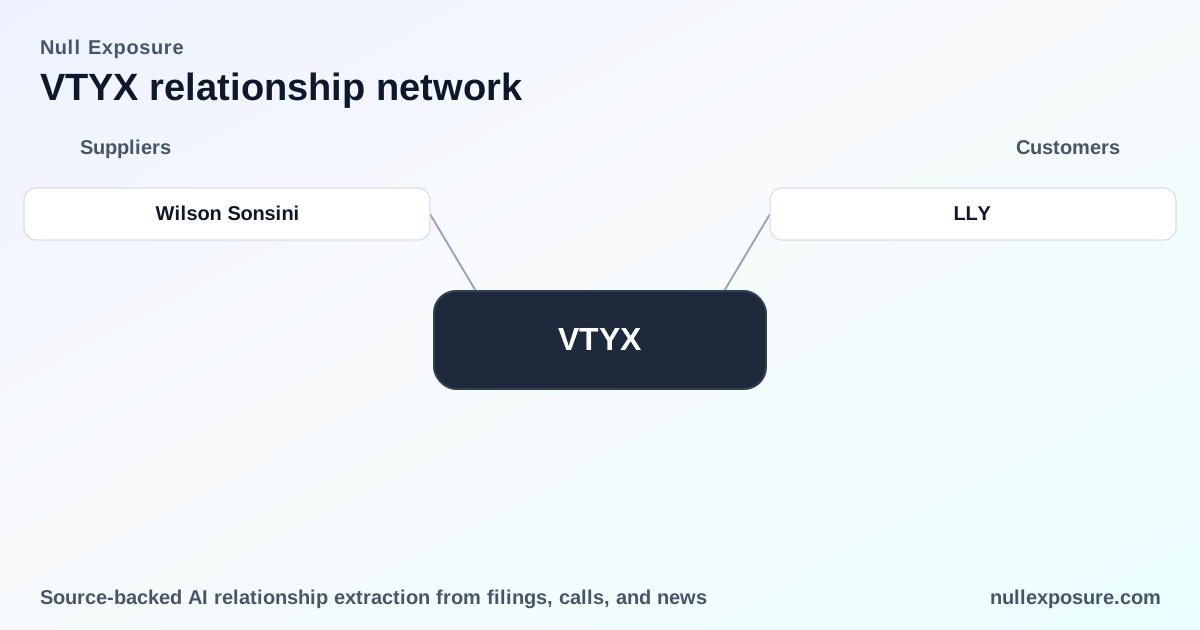
Collectively these entries document a single, well‑covered counterparty: Eli Lilly (LLY), and the principal commercial event is the definitive acquisition at $14 per share / ~$1.2 billion.
What these relationships reveal about Ventyx’s operating model and commercial constraints
The coverage and the company’s disclosures create several company-level signals about how Ventyx operated and the commercial profile investors should assess:
- Contracting posture — partner/exit-focused. Ventyx executed a development-to-exit model: the firm prioritized advancing a lead candidate to a value-inflection point attractive to a large pharma acquirer rather than building a standalone commercial infrastructure. This implies limited direct commercial contracts with payors or distributors prior to acquisition and greater reliance on partnership/M&A timing for value realization.
- Concentration — single counterparty outcome. The public record is dominated by a single counterparty outcome (Eli Lilly), indicating concentration risk in strategic realization: much of shareholder value hinged on one acquirer-led transaction rather than diversified commercialization channels.
- Criticality — clinical-stage asset as the product. For customers in the broad sense (partners, acquirers, later payors), Ventyx’s criticality derived from its clinical data and intellectual property rather than recurring revenue streams, making the company strategically critical to an acquirer’s pipeline expansion but not critical to multiple commercial customers pre-exit.
- Maturity — development-stage with limited commercial footprint. Mentions of distributors and wholesalers in company materials suggest planning for commercial distribution, but those arrangements were prospective rather than mature; the firm’s primary revenue event was transaction completion, not product sales.
- Market and reimbursement exposure — government and global considerations. Company-level excerpts reference government programs like Medicare/Medicaid and the need for global reimbursement strategies; this signals that post-approval commercialization would require broad payer engagement and international market access planning, which was a responsibility Lilly assumed via the acquisition.
Investment implications and risk checklist
- Exit monetization dominated returns. Ventyx exemplifies a biotech where investor returns are realized through an M&A event; that outcome concentrates governance and process risk on transaction execution and perceived deal fairness (as reflected in separate investor investigations reported in the press).
- Regulatory friction was limited. The FTC’s early termination of the Hart-Scott-Rodino waiting period signals no material antitrust barrier in the US, reducing one common source of transaction uncertainty.
- Reimbursement complexity transfers to buyer. Since Ventyx had not reached commercialization, reimbursement and distribution risk now rest with Eli Lilly, including negotiations with government payors and global market access execution.
For a deeper view on how counterparty and transaction signals affect portfolio exposure to event-driven biotechs, see more analysis at https://nullexposure.com/.
Bottom line
Ventyx’s customer landscape was transactional rather than commercial. The company’s value was concentrated in a single strategic relationship that converted clinical progress into cash via Eli Lilly’s acquisition. Investors and operators evaluating similar targets should prioritize: governance and process clarity during sale negotiations, regulatory pathway risk, and the buyer’s capability to execute global reimbursement and distribution — factors that determine the ultimate economic realization of a development-stage biotech.