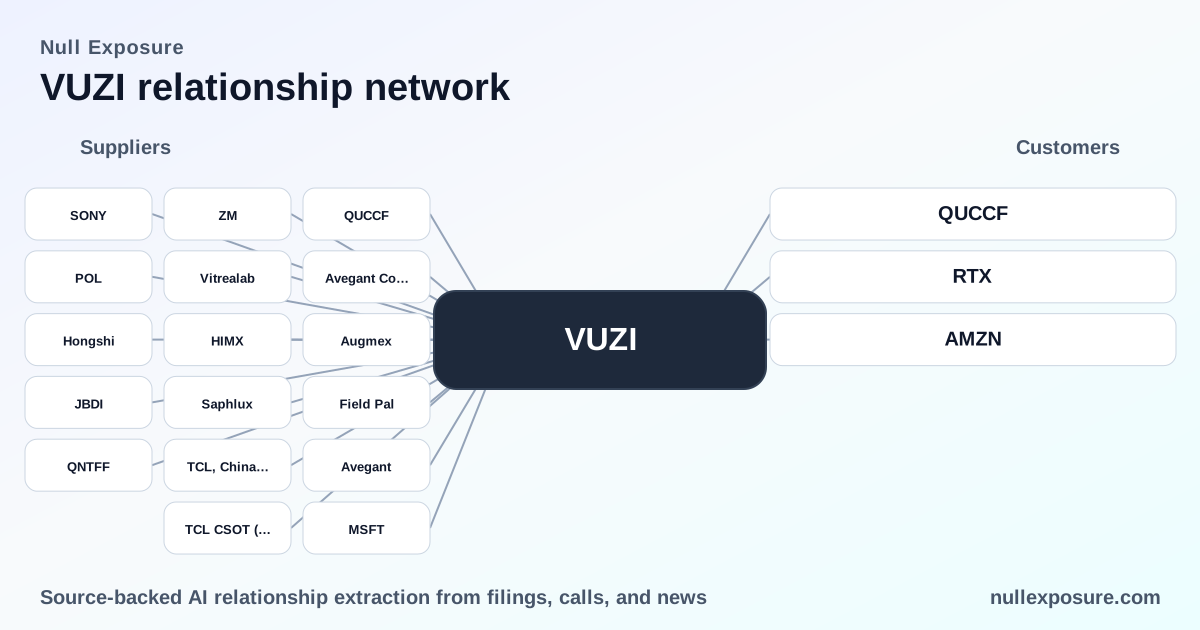
Vuzix customer relationships and what they mean for investors
Vuzix designs and manufactures AI-powered smart glasses and proprietary waveguide optics, monetizing through direct hardware sales (enterprise and OEM), customer-funded engineering and development contracts, reseller arrangements, and follow-on production orders for defense and logistics customers. Revenue today is a mix of short-term cancellable orders and longer-term, firm fixed‑price development programs that shift value into multi-year production opportunities. For deeper signals and sourcing, visit https://nullexposure.com/.
How Vuzix contracts, sells and concentrates revenue — the operational constraints that matter
Vuzix runs a hybrid commercial model that combines commodity-like hardware sales with bespoke OEM and defense development work. Two contract postures coexist: most purchase orders are cancellable or reschedulable with limited penalties, while the company also books firm fixed‑price development contracts on a percentage‑of‑completion basis, recognizing revenue as engineering work progresses. This structure produces lumpy revenue and shifts risk between short-cycle product sales and longer-term project milestones.
Geography and customer concentration are meaningful. Vuzix reports heavy North American revenue weight alongside sales in Japan and Europe, and company disclosures show very high receivable concentration (one customer represented 76% of accounts receivable at Dec. 31, 2024) — a material counterparty risk for investors. The business is vertically integrated: Vuzix manufactures waveguide optics in a dedicated cleanroom at its New York facility and also sells software and ecosystem services through VARs and internal teams, creating both hardware and software revenue streams.
Relationship maturity is mixed: many defense and OEM engagements are still in pilot or early production, with the company indicating projects that are transitioning from R&D to production. Vuzix classifies some backlog information as immaterial today, but the pipeline includes active performance obligations tied to 2025–2026 revenue recognition. These elements combine into a profile of high concentration, selective criticality, production ramp potential, and asymmetric downside from cancellable orders.
Named counterparties and what each relationship actually delivers
Below I run through every customer relationship mentioned in the source results and summarize the commercial substance and provenance.
Amazon — enterprise logistics OEM engagement
Amazon is an active enterprise OEM customer using Vuzix smart glasses for “see‑what‑I‑see” reliability and maintenance use cases and is listed among multiple OEM contracts the company highlighted in earnings commentary. According to an InsiderMonkey transcript of Vuzix’s Q3 2025 earnings call and the Q4 2025 call transcript reported by The Globe and Mail, Amazon has expanded deployments and is an active engineering and production client (FY2025–FY2026).
Quanta Computer — strategic investment and waveguide supply partnership
Quanta made an initial $10 million strategic investment to support a long‑term waveguide design and supply partnership with Vuzix, positioning Quanta as a manufacturing and design partner for integrated optics. This relationship was disclosed in an earnings call transcript summarized by InsiderMonkey (FY2025).
Collins Aerospace (RTX) — defense OEM development and early production orders
Vuzix has an extended development program with Collins Aerospace to design a waveguide‑based display engine for military head‑mounted systems; the collaboration has moved into production orders, giving Vuzix a defense OEM proof‑point. Engineering.com and multiple earnings call summaries note completed design work and the start of production shipments to Collins Aerospace (FY2025–FY2026).
AcuraFlow — six‑figure follow‑on orders and North American rollouts
AcuraFlow, described in press coverage as an industrial AI and automation solutions provider, has placed six‑figure follow‑on orders for Vuzix M400 smart glasses, expanding deployments across North America and representing a meaningful customer for Vuzix’s enterprise hardware business. This was reported in PR Newswire, Investing.com and multiple financial news outlets in late April 2026 (FY2026).
Movora — reseller agreement to enter the veterinary medical market
Vuzix signed a reseller agreement with Movora to distribute M400 smart glasses‑based remote support kits to veterinary professionals in North America; the deal includes an initial stocking order and positions Vuzix in a new vertical via a value‑added distribution partner. The agreement and initial orders were announced on PR Newswire and covered by veterinary trade press (April 2026).
Himax Technologies (HIMX) — microdisplay pairing with Vuzix waveguides
Himax’s HX7319FL LCoS microdisplay has been reported to pair with Vuzix waveguide technology in product design work, indicating component‑level supplier relationships and ecosystem integration for next‑generation AR displays. This pairing was noted in product coverage on Simply Wall St (FY2026).
What these relationships imply for revenue quality and risk
- Concentration and counterparty risk are significant. The single large receivable concentration disclosed for 2024 underscores the importance of customer retention and timing of payments.
- Defense and OEM programs are a growth lever but early-stage. Collins Aerospace and Quanta represent pipeline entries into higher‑margin, multi‑year production programs; the company reports production orders but much of the value depends on successful scaling.
- Commercial deployments provide recurring hardware demand. Amazon and AcuraFlow represent operational customers buying repeat hardware units and follow‑on orders. The Movora reseller deal is a diversification play into a new vertical with lower absolute dollar size but potential distribution leverage.
- Contracting posture creates revenue volatility. The coexistence of cancellable POs and long‑term fixed‑price engagements means quarters can swing between modest product sales and concentrated, milestone‑based contract revenue.
Investment takeaway — where value and risk concentrate
Vuzix is executing an OEM/OEM+defense dual strategy: pursue enterprise and retail deployments (Amazon, AcuraFlow) while converting R&D and defense pilots (Collins Aerospace, Quanta) into production programs that carry higher revenue visibility. Key upside is conversion of pilot programs to volume procurement and ongoing OEM orders; key downside is high customer concentration and cancellable order exposure. Investors should watch production cadence with Collins and Quanta, follow‑on order frequency from Amazon/AcuraFlow, and the cash collection profile tied to the large receivable noted in 2024 filings.
If you want a concise summary of these customer signals and the disclosure evidence that supports them, find the integrated view at https://nullexposure.com/.
Bold actions for diligence: verify the timing and contractual terms for the Collins Aerospace production orders, the structure of Quanta’s strategic investment, and receivable aging for the single large customer that dominated AR receivables in 2024. These items determine whether Vuzix’s pipeline converts into predictable, scaled revenue or stays lumpy and dependent on a small set of counterparties.