VVOS: Revenue through appliance sales, licensing and payer-enabled clinical channels
Vivos Therapeutics (VVOS) monetizes a blended model: direct sales of oral appliances and guides, licensing the right-to-sell and training to dental partners, and recurring services including practice management / billing subscriptions and managed clinic services. Investors should value VVOS as a mixed hardware-plus-services growth company whose revenue combines point-in-time product sales with recurring enrollment and billing streams tied to long-lived VIP relationships and expanding payer coverage.
For a broader look at how we source and structure these relationship signals, visit the Null Exposure homepage: https://nullexposure.com/
What drives the economics: clear revenue levers and contract posture
VVOS sells physical products at shipment (a spot revenue element) while simultaneously monetizing the Vivos Method as a licensed right-to-sell and a set of services. Evidence from company filings describes product revenue recognized at shipment and the licensing-like “right to sell” recognized over customer life; the company also runs monthly subscription services (BIS / AireO2 practice management and billing). These design choices create a predictable two-part revenue stream: immediate cash from appliances plus recurring revenue from subscriptions and service fees, with unearned revenue on the balance sheet indicating a material contract liability tied to future service performance.
- Contracting posture: a mixture of spot product sales, subscription-based software/billing, and multi-year recognition for VIP program rights that are amortized over estimated customer lives (company filings describe recognition over 14–27 months depending on cohort).
- Customer concentration and geography: primary revenue concentration is North America, with active sales in U.S. and Canada and limited presence in Australia and selective activity in Europe and Asia.
- Criticality and maturity: unearned revenue is a meaningful balance-sheet liability, implying contractual performance obligations and repeatable service delivery; VIPs that complete training typically remain active for multiple years, indicating mature customer relationships.
- Segmentation: revenue is split across hardware (appliances) and services (training, practice support, billing/subscriptions) with VIP enrollment fees cited at material price points (the Premier VIP enrollment is reported around $23,200).
Mid-article signal check — want the raw relationship summaries?
Access full relationship intelligence at Null Exposure: https://nullexposure.com/
Customer and partner relationships investors should track
Below are every relationship surfaced in public filings and trade press; each entry includes a concise investor-oriented summary and the relevant source.
-
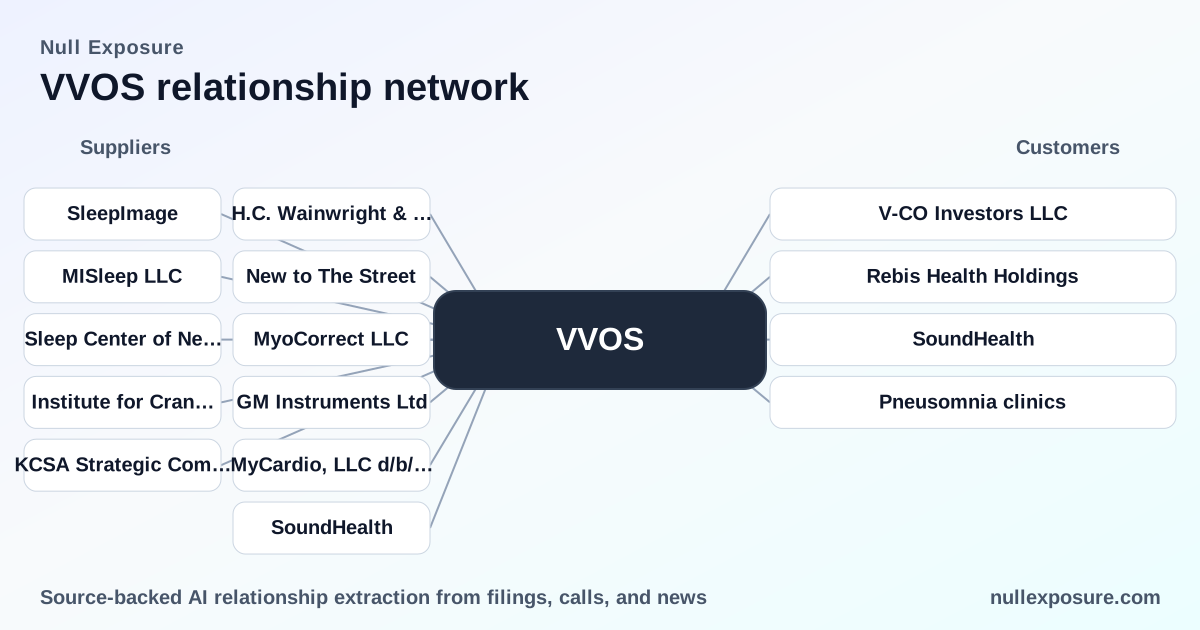
V‑CO Investors LLC — VVOS executed a securities purchase agreement with V‑CO Investors LLC on June 10, 2024, signaling a financing or investor arrangement disclosed in the FY2024 10‑K filing. (According to VVOS’s FY2024 10‑K, filed Dec. 31, 2024.)
-
Humana — Practices supported by VVOS’s management services report that they have achieved in‑network status with Humana in Nevada, expanding reimbursement access for VVOS‑supported clinical channels. (Sleep Review and GlobeNewswire coverage, March–May 2026.)
-
UnitedHealthcare — VVOS‑supported physician practices in Nevada report in‑network acceptance by UnitedHealthcare, which enhances claims-based revenue potential for appliance and service delivery. (Sleep Review / GlobeNewswire reporting, March–May 2026.)
-
Anthem — VVOS’s Nevada-supported practices list Anthem among payers granting in‑network status, an important commercial insurer for regional patient access. (Sleep Review / GlobeNewswire reporting, March–May 2026.)
-
Cigna — In‑network status with Cigna has been reported for VVOS‑supported practices in Nevada, reinforcing payer coverage breadth across commercial insurers. (Sleep Review / GlobeNewswire reporting, March–May 2026.)
-
Aetna — Aetna is named among payers that have placed VVOS‑supported practices in‑network in Nevada, which supports reimbursement pathways for appliance care. (GlobeNewswire coverage, March 2026.)
-
Molina — VVOS‑supported Nevada practices report Molina in‑network status, adding Medicaid and managed‑care pathways to the company’s coverage footprint. (GlobeNewswire / Sleep Review, March–May 2026.)
-
Wellcare — Wellcare is listed among the payers granting in‑network status to VVOS‑backed practices in Nevada, expanding access in government‑oriented plans. (GlobeNewswire / Sleep Review, March–May 2026.)
-
UMR — UMR appears in the payer list for VVOS‑supported practices, increasing support from third‑party administrators for claim submissions. (Sleep Review / GlobeNewswire reporting, March–May 2026.)
-
Intermountain Health — Intermountain Health appears among payers recognizing VVOS‑supported practices in Nevada as in‑network, widening institutional acceptance. (GlobeNewswire / Sleep Review, March–May 2026.)
-
Select Health — Select Health is reported as an in‑network payer for VVOS‑supported clinics in Nevada, further broadening payer mix. (Sleep Review / GlobeNewswire coverage, March–May 2026.)
-
Health Plan of Nevada (HPN) — Local Medicaid and commercial plans such as Health Plan of Nevada and HPN Medicaid are listed among in‑network payers for VVOS‑supported practices in Nevada, strengthening local reimbursement. (GlobeNewswire / Sleep Review, March–May 2026.)
-
CareSource — CareSource is named in the payer roster for VVOS‑supported Nevada practices, expanding managed care connectivity. (Sleep Review / GlobeNewswire, March–May 2026.)
-
HPN Medicaid — State Medicaid participation via HPN Medicaid is reported for VVOS‑supported clinics in Nevada, signaling access to Medicaid populations. (GlobeNewswire reporting, March 2026.)
-
SilverSummit — SilverSummit is reported in the payer list for VVOS‑supported Nevada clinics, adding regional managed‑care coverage. (Sleep Review reporting, May 2026.)
-
Prominence — Prominence is included among payers listing VVOS‑supported practices as in‑network in Nevada, supporting commercial access. (Sleep Review / GlobeNewswire reporting, March–May 2026.)
-
Medicare — Medicare coverage is specifically cited for VVOS‑supported practices in Nevada, a crucial driver of volume and standardized reimbursement. (Sleep Review / GlobeNewswire, March–May 2026.)
-
TRICARE — TRICARE is listed among payers recognizing VVOS‑supported practices, offering access to military beneficiaries in relevant markets. (Sleep Review reporting, May 2026.)
-
USDOL (workers’ compensation) — Worker’s compensation coverage via USDOL is noted among reimbursement pathways for VVOS‑supported services, opening occupational-health channels. (GlobeNewswire / Sleep Review, March–May 2026.)
-
Pneusomnia clinics — The company’s network model includes collaboration between Vivos‑trained dentist offices and Pneusomnia clinics, highlighting multidisciplinary referral flows. (Sleep Review article referencing the Vivos network, FY2021 context.)
-
MISleep Solutions, LLC — VVOS established an Auburn Hills center through an agreement with MISleep Solutions, LLC, demonstrating the company’s strategy to launch affiliated sleep centers through local partners. (Sleep Review coverage of the Michigan center, FY2025.)
-
Rebis Health Holdings — Rebis Health receives a share of patient payments collected by VVOS dental providers in designated locations under a revenue‑sharing/management model, indicating JV‑style monetization of clinical operations. (Sleep Review / partner reporting, March 2026.)
-
SoundHealth — VVOS will utilize SoundHealth’s CT‑accurate facial scanning and voice biomarker technology to improve screening and monitoring, signaling integration of third‑party clinical tech into VVOS care pathways. (Intellectia.ai news reporting on warrant exercise and partnership, March 2026.)
Bottom line for investors
VVOS combines a high‑margin, point‑in‑time appliance business with recurring subscription and managed‑service revenue and is actively widening reimbursement via in‑network agreements across major commercial and government payers in targeted markets. Key risk / monitor points: the mix of spot versus recurring revenue, the material unearned revenue liability, and execution of payer onboarding at scale.
For a deeper examination of these relationship signals and what they mean for valuation and risk, visit Null Exposure: https://nullexposure.com/