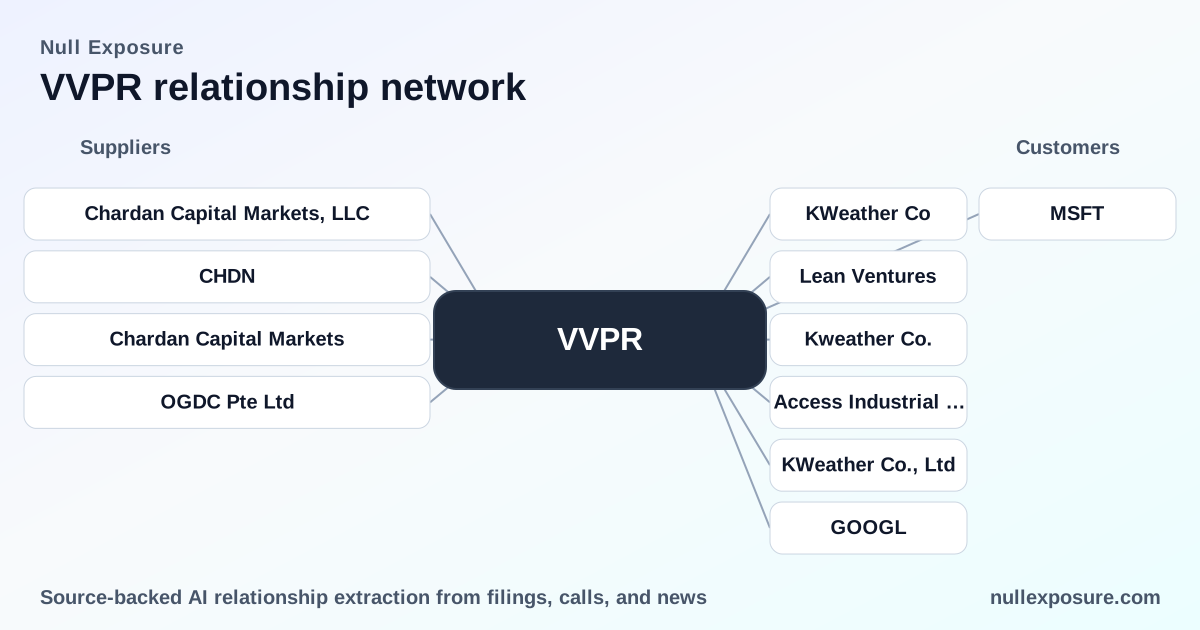
VivoPower (VVPR) — Customer relationships that shape an AI‑infrastructure.Provider story
VivoPower International (NASDAQ: VVPR) builds, owns and leases powered land and sovereign-aware data center infrastructure for AI compute customers, and supplements that core leasing model with product sales (Tembo electric utility vehicle kits) and active portfolio management of non‑core digital assets. Revenue comes from long‑duration tenancy and project delivery to hyperscalers, governments and specialist cloud providers, while balance‑sheet moves — notably the strategic transfer of Ripple Labs shares — reshape financial exposure and liquidity. For a compact relationship risk scorecard and ongoing monitoring, see Null Exposure: https://nullexposure.com/
Executive snapshot — what matters to investors
VivoPower’s near‑term valuation drivers are clear: tenant composition (hyperscalers and sovereign customers), strategic partnerships that accelerate market entry, and active portfolio management that reduces non‑core volatility. These dynamics create both upside (securing large, creditworthy tenants and sovereign contracts) and downside (tenant concentration and execution risk on data center builds). Key takeaways:
- Hyperscaler tenancy is explicit: VivoPower cites Microsoft and Google as tenant types, underscoring reliance on large cloud customers for recurring revenue (Proactive Investors, Mar 2026).
- Strategic equity and asset swaps are part of liquidity management: VivoPower converted part of its digital‑asset holdings into an equity stake and cash equivalents via transactions with KWeather and Lean Ventures (Company press release, Feb 2026).
- Product revenue diversification via Tembo E‑LV kits provides non‑recurring but near‑term commercial cash flows through distributors such as Access Industrial Mining in Canada (IM‑Mining, Feb 2024).
If you want ongoing flags and relationship-level detail, Null Exposure’s portal tracks these counterparties and announcements in real time: https://nullexposure.com/
Detailed relationship map — counterparties that matter right now
KWeather Co., Ltd — strategic acquiror of Ripple economic rights and equity partner
VivoPower completed an agreement that transferred the economic rights to part of its Ripple Labs holdings to KWeather, while taking a 20% stake in KWeather valued at approximately $4.3 million, positioning the transaction as a strategic exit from digital‑asset exposure without realized losses (VivoPower press release, Feb 5, 2026; GlobeNewswire and Proactive Investors coverage, Feb–Mar 2026).
Lean Ventures — purchaser of the remaining Ripple share balance under partnership terms
The remainder of VivoPower’s Ripple Labs shares are slated for acquisition by Lean Ventures under the definitive partnership announced in December 2025, completing VivoPower’s strategic divestiture of its digital‑asset treasury (VivoPower news release, Feb 2026; Proactive Investors and Cryptopolitan coverage, Mar 2026).
Access Industrial Mining Inc — commercial distributor for Tembo product deliveries
Tembo (a VivoPower subsidiary) has initiated deliveries of next‑generation Electric Utility Vehicle (EUV) conversion kits to Access Industrial Mining Inc, which serves as Tembo’s exclusive Canadian distributor and therefore represents a source of product revenue and go‑to‑market scale in mining and industrial electrification (IM‑Mining report, Feb 2024).
Google (GOOGL) — cited tenant class (hyperscaler)
VivoPower identifies hyperscalers such as Google among potential tenants for its sovereign and AI‑compute facilities, signalling that Google stands as a target or current tenant category that supports recurring lease economics and scale deployment (Proactive Investors interview/report, Mar 2026).
Microsoft (MSFT) — cited tenant class (hyperscaler)
Microsoft is likewise named by VivoPower as a representative hyperscaler tenant, indicating exposure to major cloud players whose tenancy underpins predictable utilization and revenue for built facilities (Proactive Investors, Mar 2026).
How these relationships translate into operating and business‑model signals
VivoPower’s public relationship activity produces a coherent set of company‑level characteristics investors should price into any valuation model:
-
Contracting posture: VivoPower operates primarily as an infrastructure landlord and project developer, negotiating long‑dated tenancy and sovereign contracts rather than short-term spot sales. The company’s language around “tenants” and sovereign facilities signals emphasis on contractual stability and credit‑worthy counterparties (Proactive Investors, Mar 2026).
-
Concentration and counterparty mix: The explicit naming of hyperscalers (Microsoft, Google) signals potential concentration toward a small number of large tenants; this concentration increases revenue visibility but also elevates tenant‑specific risk if sourcing or negotiation dynamics shift.
-
Criticality of services: AI‑compute campus and sovereign data center infrastructure are strategically critical to customers; that criticality supports pricing power and long useful lives for assets, but it also raises execution and capital intensity requirements during buildouts.
-
Maturity and portfolio management: The company’s B‑Corp positioning and the recent strategic exit from digital assets (trading Ripple holdings for equity and economic rights) reflect an active balance‑sheet management approach and a move away from volatile holdings toward industry‑aligned partnerships and cash/liquidity preservation (VivoPower press release, Feb 2026).
-
Commercial diversification: Product sales via Tembo and distribution agreements (Access Industrial Mining) provide complementary, project‑level cash flow that de‑correlates some revenue from pure tenancy cycles.
Risk and opportunity implications for investors
-
Opportunity: Securing hyperscaler or sovereign tenants can generate long‑duration, high‑margin cash flows and accelerate scale across jurisdictions where sovereign partnerships create entry barriers for competitors. The KWeather and Lean Ventures transactions convert an illiquid crypto exposure into equity and partnership value that can be redeployed into core infrastructure activities (Company release, Feb 2026).
-
Risk: Tenant concentration and the capital‑intensive nature of data center rollouts create funding and execution risk; investors should monitor tenant contract lengths, creditworthiness, and the pace at which Tembo product revenue ramps relative to capex outlays.
-
Balance‑sheet signal: The digital‑asset exit reduces market volatility on the balance sheet and introduces minority equity stakes in counterparties (KWeather), which changes the shape — but not necessarily the liquidity — of non‑core holdings (GlobeNewswire, Feb 2026).
Bottom line — how to think about VVPR exposure
VivoPower is positioned as an infrastructure landlord for the AI era with active portfolio reshaping to concentrate on predictable leasing revenues and sovereignly sensitive deployments. Investor focus should be on tenant composition, contract tenor, execution on data‑center rollouts, and how accretive the KWeather/Lean Ventures transactions prove versus foregone crypto upside. For a relationship‑level risk dashboard that tracks updates to these counterparties, visit Null Exposure: https://nullexposure.com/