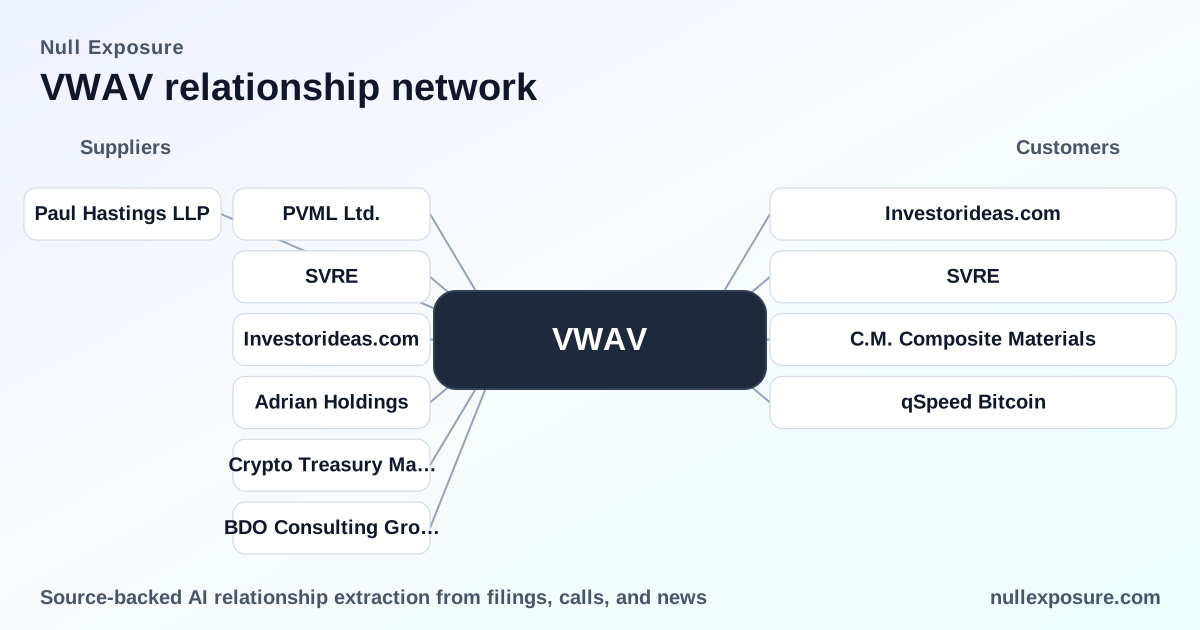
VisionWave (VWAV) — Customer relationships that convert IP into near‑term commercial revenue
VisionWave builds AI-driven RF and sensing systems for defense, homeland security and industrial inspection and monetizes through a mix of direct product sales, technology licensing, and paid Statements of Work with strategic partners. Recent announcements show a shift from pilot programs toward paid commercial execution, licensing agreements and targeted government engagement—an operational stance that turns intellectual property into partner‑driven revenue streams. For a concise map of partners and what each relationship delivers, see more at https://nullexposure.com/.
What investors need to know about how VisionWave makes money
VisionWave’s commercial model is straightforward: sell systems where possible, license core RF sensing and analytics where scale requires partners, and sign SOWs for bespoke platform work. That model produces a mix of small‑ticket pilot revenue and lumpy, higher‑value contracts as third‑party integrators and governments adopt the technology.
Operationally this implies several company‑level characteristics:
- Contracting posture: The company combines product sales with licensing and third‑party SOWs—a hybrid model that reduces capital intensity at scale by outsourcing deployment through partners and licensees.
- Customer concentration & geography: The business targets governments and allied defense contractors globally, with explicit emphasis on North America and APAC as growth regions; early revenue is U.S.‑centred while future mix anticipates non‑U.S. sources.
- Criticality vs. maturity: Relationships are often strategic (licensing, co‑development) but remain early stage—many engagements are pilots or limited SOWs rather than broad production contracts.
- Revenue cadence: Expect episodic revenue spikes from SOWs and government milestones rather than steady recurring streams while commercialization progresses.
For direct updates and structured investor coverage, visit https://nullexposure.com/.
Who VisionWave is working with (relationship-by-relationship)
Below are plain‑English summaries of every partner and customer relationship surfaced in public reporting and press coverage, with source references.
SVRE (SaverOne)
VisionWave granted SaverOne a non‑exclusive global license for RF sensing and analytics to support RF‑based defense and homeland‑security use, and positioned SaverOne as the core operating platform for specified RF defense applications. Source: Yahoo Finance press release summarizing the SaverOne collaboration (Mar 10, 2026) — https://finance.yahoo.com/news/visionwave-holdings-saverone-announce-execution-133000867.html.
SaverOne 2014 Ltd.
As part of the SaverOne collaboration, SaverOne 2014 Ltd. received a full license to use VisionWave’s defense product IP as the initial stage of an operating partnership; that license is paired with a strategic investment and operational integration plan. Source: Bitget reporting on the SaverOne licensing and platform role (Mar–May 2026) — https://www.bitget.com/amp/news/detail/12560605252906.
SVRE (multiple reports)
Multiple outlets repeat the SaverOne licensing and investment details: SaverOne is positioned to commercialize VisionWave RF tech through a platform license and capital commitment, reinforcing the company’s channel/licensing strategy. Source: InvestorIdeas and QuiverQuant reporting on the SaverOne deal and investment activity (Mar–May 2026) — https://www.investorideas.com/CO/VWAV/news/2026/01262-ai-defense-stock-visionwave-saverone-rf-platform-vwav-svre.asp and https://www.quiverquant.com/news/SaverOne+Completes+$2.75+Million+Initial+Investment+in+Strategic+Collaboration+with+VisionWave+Holdings+to+Expand+RF+Technology+into+Defense+Markets.
National Oil Company of Liberia
VisionWave entered a Letter of Engagement with the National Oil Company of Liberia for offshore petroleum Blocks LB‑4 and LB‑5, positioning its sensing and AI capabilities as a novel way to approach subsurface exploration and offering an exclusive eight‑month pathway toward a Production Sharing Contract. Source: GlobeNewswire corporate release (Mar 24, 2026) — https://www.globenewswire.com/news-release/2026/03/24/3261343/0/en/Defence-AI-Meets-Offshore-Energy-VisionWave-Secures-Exclusive-Pathway-to-Two-Liberia-Basin-Petroleum-Blocks.html.
National Oil Company of Liberia (NOCAL) — follow‑up coverage
Independent press summarized the engagement as part of VisionWave’s strategy to treat offshore exploration as an intelligence and sensing challenge, reinforcing the company’s push into adjacent commercial markets beyond defense. Source: AI Magazine/GlobeNewswire summary of the research initiative and NOCAL Letter of Engagement (May 2026) — https://aimagazine.com/globenewswire/3263801.
InvestorIdeas.com
InvestorIdeas disclosed that VisionWave is a paid featured defense company on its platform, a relationship that is commercial/marketing in nature rather than a customer supply contract. This is a material disclosure for investor audiences because it signals paid promotional activity in the public record. Source: InvestorIdeas press notices and disclaimer language (Feb–May 2026) — https://markets.financialcontent.com/stocks/article/abnewswire-2026-2-17-ai-defense-stock-visionwave-holdings-inc-nasdaq-vwav-transitions-from-acquisition-to-paid-commercial-execution-for-quantumspeed-with-10-million-statement-of-work and https://www.investorideas.com/CO/VWAV/news/2026/04091-visionwave-vwav-double-digit-gains.asp.
Versatilidad
VisionWave announced a signed purchase order from Versatilidad, a Mexican company contracted by a state government, to deploy drone‑based surveillance systems at World Cup matches with the intent to scale to broader state and national use—an example of near‑term domestic government work via local integrators. Source: Bitget reporting on the Versatilidad purchase order for drone surveillance (May 4, 2026) — https://www.bitget.com/news/detail/12560605343709.
qSpeed Bitcoin
VisionWave executed a $10.0 million Statement of Work with qSpeed Bitcoin to develop and deploy a custom Bitcoin mining acceleration and orchestration platform (qSpeed‑Mine), representing a sizable commercial SOW outside the core defense remit. Source: TradingView coverage of the $10M SOW with qSpeed Bitcoin (Mar 10, 2026) — https://www.tradingview.com/news/tradingview:c6f54525e2892:0-visionwave-inks-10-million-sow-with-qspeed-bitcoin-to-build-mining-acceleration-platform/.
C.M. Composite Materials
VisionWave entered a promissory note arrangement for a $500,000 advance with C.M. Composite Materials, indicating short‑term working capital or supplier financing activity tied to manufacturing or materials procurement. Source: TradingView report on the promissory note (Mar 10, 2026) — https://www.tradingview.com/news/tradingview:4b381728140e0:0-visionwave-holdings-signs-promissory-note-with-c-m-composite-materials/.
How these relationships color the risk/reward profile
- Positive: License deals (SaverOne/SVRE) and the $10M qSpeed SOW are concrete commercialization steps that convert IP into revenue opportunities and validate third‑party willingness to pay for customization or platform access.
- Watch points: The business is still in early commercial maturity—revenue to date is limited and pilot‑heavy. Government engagement has long sales cycles and export‑control complexity. Marketing relationships (InvestorIdeas) should be treated as disclosure events, not revenue signals.
- Balance: If VisionWave converts licensing commitments into recurring royalties and executes larger government or industry SOWs, the revenue trajectory can shift materially from pilot to production.
Bottom line for investors
VisionWave is executing a pragmatic hybrid go‑to‑market: product pilots, licensing for scale, and high‑value SOWs for bespoke systems. That mix reduces capital outlay while creating episodic revenue opportunities, but investors should price in program risk, export and government procurement timelines, and the early stage of many relationships. For ongoing monitoring and deeper relationship mapping, visit https://nullexposure.com/.
If you need a tailored brief that prioritizes partner risk or quantifies potential revenue pathways from these relationships, I can prepare a focused follow‑up.