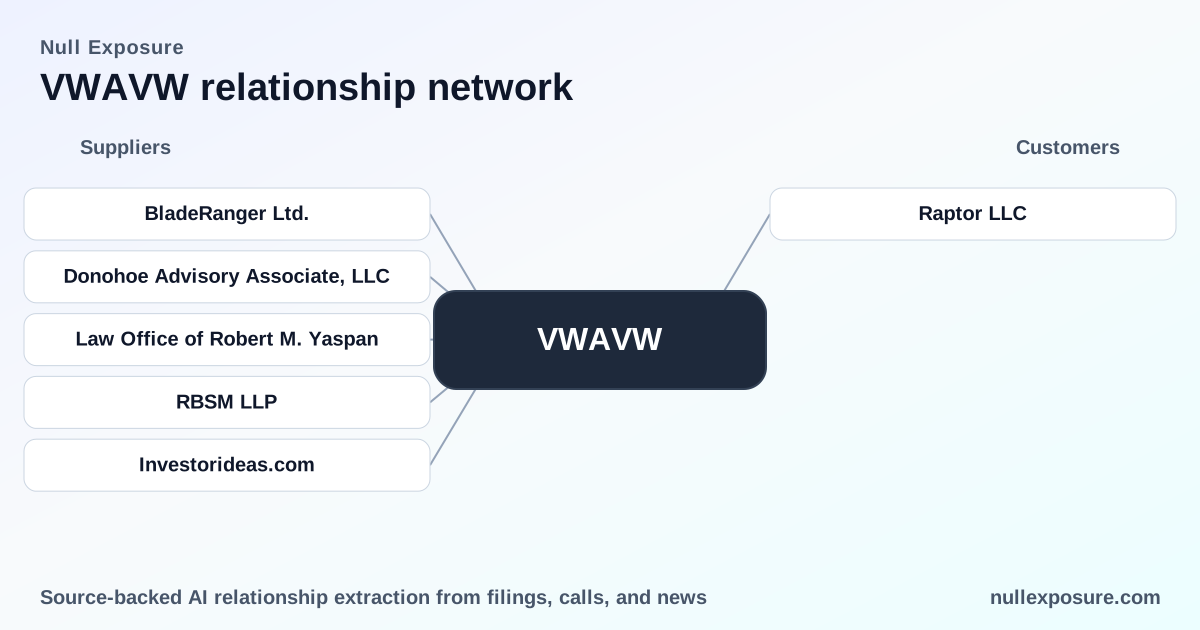
VisionWave customer relationships: Raptor LLC and the commercial signals investors should price
VisionWave Holdings develops AI-driven autonomous defense systems across air, ground and sea domains and monetizes through a mix of direct hardware sales and technology licensing to defense contractors and governments, plus strategic alliances and joint ventures for scale. Contracts today reflect a pre-commercial posture: pilot programs and prepaid, single‑obligation orders dominate revenue recognition, while management positions international expansion—particularly India—as the next revenue frontier. For a consolidated view of these relationship signals, see NullExposure’s research hub: https://nullexposure.com/.
Deal spotlight — Raptor LLC was appointed exclusive sales agent for TFLM shares
On May 22, 2025 VisionWave executed an addendum appointing Raptor LLC as exclusive sales agent for 280,534 TFLM shares, a change documented in the company’s FY2025 Form 10‑K. This appointment is recorded as an amendment to an existing agreement and is disclosed in the FY2025 annual filing. According to VisionWave’s FY2025 Form 10‑K, the addendum formalizes the exclusivity for this block of shares (FY2025 10‑K, filed February 2026).
Why the Raptor appointment matters to operators and investors
The designation of an exclusive sales agent for a quantified block of shares signals a deliberate decision to outsource distribution for that instrument, concentrating commercial access through a single intermediary. This structure accelerates market access but creates execution and counterparty concentration risk if the agent is the primary distribution channel for a material tranche.
All customer relationships disclosed (concise coverage)
- Raptor LLC — VisionWave executed an addendum on May 22, 2025 appointing Raptor LLC as exclusive sales agent for 280,534 TFLM shares, as disclosed in the FY2025 Form 10‑K. (VisionWave FY2025 Form 10‑K, disclosure dated FY2025.)
This list reflects all customer relationship entries in the company’s FY2025 customer disclosures.
Commercial and contracting posture investors must internalize
VisionWave’s public disclosures present a mixed commercial model that combines elements of licensing, spot shipments, and pilot-stage engagements. These are company-level signals drawn from the FY2025 filing:
- Licensing and seller roles are core revenue channels. The company explicitly states it generates revenue through product sales and technology licensing to defense contractors and governments, and through strategic co‑development partnerships (FY2025 disclosures).
- Spot contracts with full prepayment are in effect for certain orders. Some agreements contain a single performance obligation with full customer prepayment at a fixed price prior to shipment, indicating strong cash collection but restricted revenue recognition until transfer of control.
- Government customers are a material counterparty type. The filing references direct engagements with government procurement programs, including the Indian Ministry of Defense, indicating programmatic sales that carry procurement cycles and regulatory conditions.
- Revenue today is pilot‑centric and regionally mixed. The company reports that in 2025, 100% of limited revenue came from U.S.-based pilots, while management projects up to 60% of future revenue from non‑U.S. sources, particularly India—a deliberate international growth vector.
- Product focus is hardware and defense platforms. Descriptions emphasize counter‑UAS systems, tactical drones, radar and sensor fusion subsystems and unmanned platforms, highlighting a capital‑goods, hardware‑heavy revenue mix.
These characteristics together create a working model where cash collection is front‑loaded for spot orders, commercialization depends on converting pilots to production, and international expansion will require export‑control and procurement compliance.
Risk and concentration considerations that change valuation math
- Concentration of distribution through agents is notable. The Raptor appointment highlights dependency on third‑party intermediaries to execute sales of certain instruments; investors should treat agent performance as a direct commercial risk.
- Pilot-to-production conversion is the single largest operational lever. With limited revenue to date and a pilot posture, growth depends on converting trials into recurring, multi‑year contracts with governments and prime contractors.
- Export controls and government procurement cycles will govern timing. The company discloses export‑control compliance obligations and anticipates Asia (India) as a large near‑term market, making regulatory clearance and foreign procurement relationships critical.
- Prepayment spot contracts reduce receivable risk but limit upside on payment terms. Full prepayment prior to shipment protects working capital but reduces pricing and contract leverage on follow‑on sales; revenue recognition is still tied to transfer of control and live testing completion.
Key takeaway: VisionWave’s current commercial footprint is low‑volume and pilot‑heavy, with execution risk concentrated in agent distribution and government procurement pathways.
What to watch next — actionable signals for investors and operators
- Track any amendments to the Raptor appointment or additional agent agreements that expand the sales channel beyond this single block; agent concentration will materially affect go‑to‑market scalability.
- Monitor pilot outcomes and contract conversion language in future filings; the timing and structure of production contracts (multi‑year, recurring, licensing vs. one‑off hardware) will determine revenue predictability.
- Watch export‑control disclosures and any MoD program awards in India and the Middle East; these will validate management’s growth case for non‑U.S. revenue.
- Evaluate cash flow dynamics tied to prepaid spot contracts—positive short‑term cash is real, but valuation should reflect the effort and time required to convert pilots into repeatable revenue.
For a centralized feed of these relationship signals and to integrate them into investment workflows, visit NullExposure: https://nullexposure.com/.
Bottom line
VisionWave is a defense‑hardware specialist operating from a pilot and precommercial base, monetizing through a hybrid of licensing and hardware sales with prepaid spot orders and actively positioning for international defense contracts. The Raptor LLC exclusive sales‑agent appointment is a tactical distribution play with outsized operational consequences given the company’s current scale. Investors should value the business on the conversion rate from pilots to production contracts, export control execution, and the stability of appointed sales intermediaries.