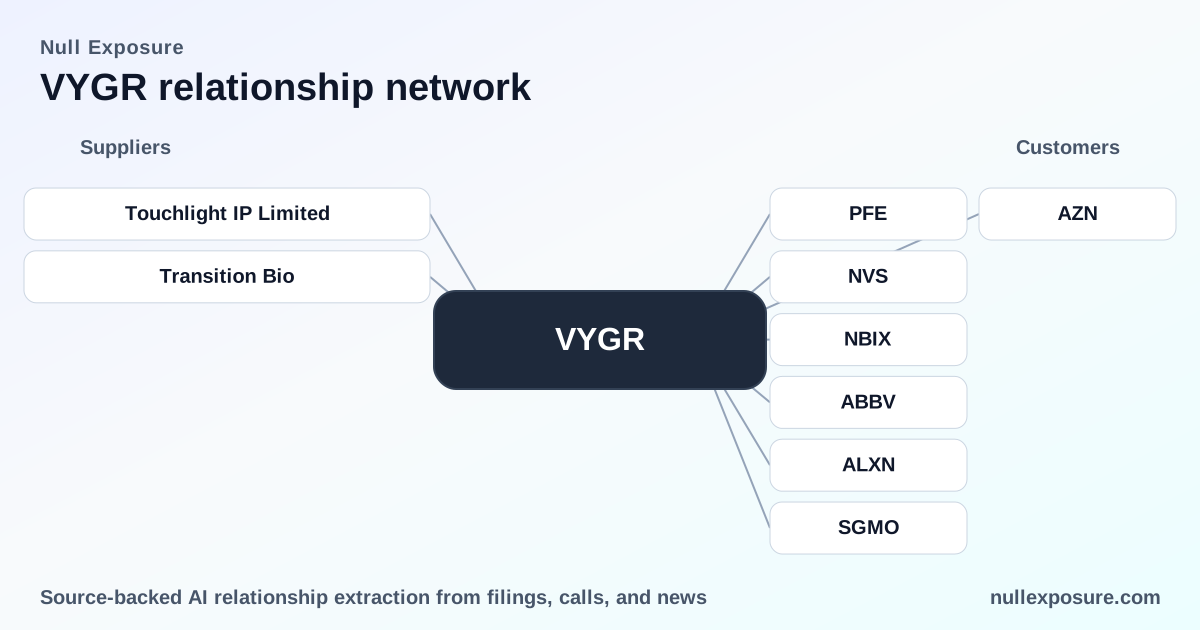
Voyager Therapeutics: a partnership-driven commercialization engine for gene therapy capsids and programs
Voyager Therapeutics operates as a clinical-stage gene therapy developer that monetizes intellectual property and program advancement through collaborations, capsid licensing and milestone-triggered payments. Rather than a traditional product-sales model, Voyager extracts value by licensing capsids from its TRACER discovery platform, entering development collaborations with major pharma, and recognizing collaboration revenue and milestone fees as partners advance programs into preclinical and clinical phases.
If you evaluate counterparty exposure or revenue stability for VYGR, start with the partnership map: a small number of large pharma partners supply the majority of near-term non-dilutive funding and absorb development cost risk. For a deeper look at the partner footprint, see our research hub at https://nullexposure.com/ — the deal map matters more than therapy headlines.
Partnerships drive cash, not finished products
Voyager’s balance sheet and revenue profile reflect a contracting posture that prioritizes license and collaboration economics over internal late-stage commercialization. The company recognizes fees and milestones when partners take defined development steps and often shifts preclinical development costs to collaborators under joint committee governance. That structure reduces Voyager’s cash burn volatility but concentrates its revenue realization on partner execution.
Key investor implications of this model:
- Concentration risk — a handful of large partners supply the bulk of material revenue and funding.
- Milestone dependency — recognizable revenue is lumpy and tied to discrete preclinical/clinical triggers.
- Asset leverage — Voyager’s value is highly correlated with the utility of its TRACER capsids and the strategic will of licensees to advance programs.
Explore the complete partnership data and alerts at https://nullexposure.com/ to track milestone timing and counterparty execution in real time.
Relationship map — what every partner contributes (complete coverage)
Below are every counterparty referenced in public reporting and press coverage in our collection, with a concise plain-English summary of the commercial relationship and the source cited.
Novartis (NVS / Novartis Pharma AG / Novartis AG)
Voyager maintains an extensive collaboration and capsid-license relationship with Novartis that includes upfront payments and a multibillion-dollar milestone framework; Novartis also agreed to cover preclinical costs for certain partnered programs under joint steering committee-approved workplans. According to BioSpace reporting, Novartis paid a $100 million upfront fee and committed up to $1.2 billion in milestones (coverage noting programs announced January 2024), and ClinicalTrialsArena cited a January 2024 collaboration described as worth $1.3 billion. GlobeNewswire filings and Voyager financial releases also state that Novartis assumes responsibility for specific preclinical development costs under the existing collaboration agreements (reported in Q4 2024 and Q3/Q4 2025 releases).
Sources: BioSpace (deal reporting, referenced FY2025 coverage), ClinicalTrialsArena (Jan 2024 deal coverage), Voyager press releases on GlobeNewswire (FY2025/FY2026 investor filings).
Neurocrine Biosciences (NBIX / Neurocrine)
Neurocrine is a strategic development partner that has advanced multiple Voyager-originated programs and triggered a $3 million milestone payment to Voyager when it initiated a preclinical toxicology study for a fourth development candidate in Q4 2025; contract language also places responsibility for agreed preclinical costs with Neurocrine for certain programs. Voyager’s earnings and investor releases report the $3 million milestone and describe Neurocrine-funded preclinical work under joint committees.
Sources: Voyager press releases on GlobeNewswire (Q3 and Q4 2025 financial results) and TradingView summaries of the Q4 2025 report; FriedreichsAtaxiaNews coverage of the potential milestone pipeline (FY2025).
Pfizer (PFE / Pfizer Inc)
Pfizer executed a license option agreement with Voyager to evaluate and potentially license TRACER-selected capsids for CNS and cardiac gene-therapy programs; press coverage and Voyager filings describe Pfizer’s right to evaluate capsids and exercise options to license them for specific transgenes. Reporting in DrugDiscoveryTrends and GlobeNewswire (Voyager press release archive) documents the license option relationship initially announced in 2021 and referenced again in market commentary.
Sources: DrugDiscoveryTrends (news report, Mar 10, 2026) and Voyager’s 2021 GlobeNewswire press release announcing the Pfizer license-option agreement (FY2021).
Alexion (ALXN)
Alexion is listed among Voyager’s strategic collaborators supporting specific gene-therapy programs; Voyager’s investor presentations and earnings commentary cite Alexion alongside Novartis and Neurocrine as contributors to the partnered portfolio. TradingView coverage of Voyager’s SEC reporting summarizes these strategic collaborations and the role Alexion plays in advancing partnered programs.
Sources: Voyager earnings call excerpts (Q3 2024) and TradingView summary of Voyager SEC filings (FY2025).
AstraZeneca Rare Disease (AZN / AstraZeneca Rare Disease)
AstraZeneca Rare Disease appears on Voyager’s partner list for certain TRACER-enabled programs, positioning AstraZeneca as a collaborator on rare neurologic targets. Voyager’s press communications announcing capsid licensing activity identify AstraZeneca Rare Disease among the current partner cohort.
Source: Voyager press release on GlobeNewswire announcing the TRACER-enabled partnered portfolio expansion (FY2024).
Sangamo Therapeutics (SGMO / Sangamo Therapeutics, Inc.)
Sangamo is named as a collaborator in Voyager’s partnered portfolio for advancing gene therapy programs; public filings and press releases include Sangamo among co-development partners leveraging Voyager’s capsid assets. The GlobeNewswire 2024 licensing announcement lists Sangamo as one of the partners.
Source: Voyager press release on GlobeNewswire (FY2024).
AbbVie (ABBV)
AbbVie had an Alzheimer’s disease collaboration with Voyager that was later terminated in August 2020; market reporting references the severance of that agreement as part of Voyager’s earlier partnership history. BioSpace reported on the AbbVie relationship termination in retrospective coverage of Voyager’s partnership activity.
Source: BioSpace coverage referencing the AbbVie agreement termination (historical, FY2021 reporting).
What this partnership map implies for investors
- Concentration of counterparty funding is material. A small set of large pharma partners—Novartis, Neurocrine, Pfizer and Alexion—account for the majority of partnership-driven revenue and preclinical cost coverage in public filings. That concentration turns partner program progress into the primary driver of near-term revenue recognition.
- Revenue is milestone-lumpy and execution-dependent. Voyager recognizes collaboration revenue and milestone payments when partners advance specified development activities; the Q4 2025 $3 million Neurocrine milestone is a recent example of that pattern.
- Contracting posture reduces cash risk but raises dependency risk. By shifting preclinical costs to collaborators and licensing capsids, Voyager lowers its standalone cash burn but becomes dependent on partners’ development decisions and strategic prioritization.
- Strategic asset: TRACER capsids. The capsid-licensing model creates recurring monetization pathways—upfront fees, option exercises, and milestone streams—if partners elect to exercise options and advance programs.
Bottom line and action points
Voyager is not a traditional product company; it is an IP- and collaboration-driven engine whose valuation and near-term cash flows are tethered to partner choices and milestone timing. For operators and investors focused on counterparty risk, prioritize monitoring: (1) milestone schedules and steering-committee deliverables for Novartis and Neurocrine, (2) option exercise windows for Pfizer and other capsid licensees, and (3) public disclosures that convert program advancement into bookable revenue.
For ongoing monitoring of Voyager’s partner-triggered revenue and to receive alerts when milestones are recognized or licenses are exercised, visit our research hub at https://nullexposure.com/ — the partner timeline is the single most predictive input for VYGR revenue realization.