VYNE Therapeutics: Royalty-driven revenue from a single partner — what investors should know
VYNE Therapeutics operates as a small dermatology-focused pharmaceutical company that monetizes primarily through licensing and royalty arrangements rather than commercial product sales. The company retains intellectual property and development capabilities while generating recurring, though currently immaterial, cash inflows from royalties—most notably tied to LEO Pharma’s commercialization of Finacea® foam. For investors, VYNE is a royalty-backed, early-stage revenue story with concentrated counterparty exposure and limited near-term topline diversification. Learn more at https://nullexposure.com/.
A concise operating thesis
- VYNE’s current revenue base is dominated by royalty income from LEO Pharma; operating losses and negative margins reflect ongoing R&D and small scale.
- Concentration risk is high: royalty receipts are small in absolute terms but represent the bulk of reported revenue; credit risk is described as immaterial by management.
- The company’s strategic posture is to monetize legacy assets (licensing/sales of franchises) while selectively advancing pipeline assets in dermatology and autoimmune areas.
How VYNE makes money and why it matters VYNE’s economics come from two complementary playbooks: (1) out-license rights to established products (creating low-effort, recurring royalty streams), and (2) internal development of new therapeutics that require capital and time. The royalty pathway provides near-term, low-capex revenue but anchors the company to counterparties’ commercial execution. The development pathway offers upside but keeps VYNE loss-making for the foreseeable term given current EBITDA and operating margins.
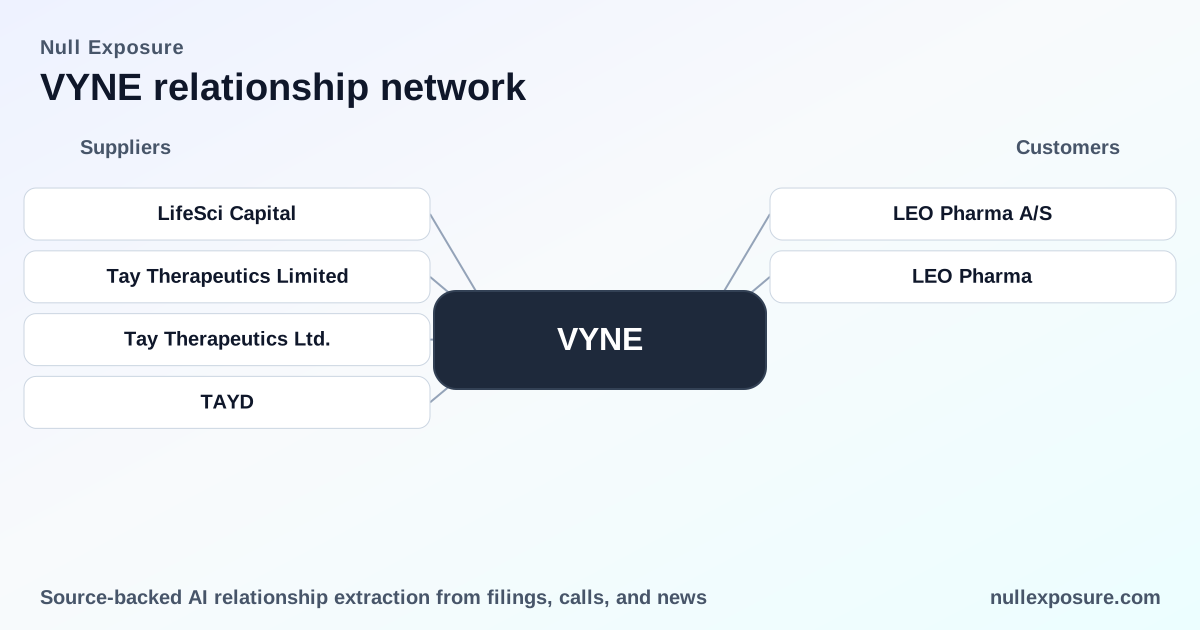
Customer relationships: what the record shows Below I cover every customer-related item surfaced in the available results. Each entry is short, factual, and tied to its source.
LEO Pharma A/S — Q3 2025 press release (GlobeNewswire)
VYNE reported $0.2 million in revenue for the three months ended September 30, 2025, of which the company stated that revenue consisted of royalty income from the licensing agreement with LEO Pharma A/S for Finacea® foam. According to VYNE’s Q3 2025 financial results (GlobeNewswire, Nov 6, 2025), these royalties are an ongoing but modest contribution to reported revenues.
LEO Pharma — TradingView summary of SEC filing (FY2026 reference)
VYNE’s FY2026 reporting consolidated total revenues of $0.6 million, described explicitly as royalty revenue generated under the company’s agreement with LEO Pharma, confirming that LEO remains the principal revenue source for the fiscal year (TradingView summarizing the company’s SEC 10-K, filed in the FY2026 reporting period).
LEO Pharma A/S — Market commentary (PredictStreet / FinancialContent, Dec 2025)
Market commentary noted a year-over-year increase in quarterly royalty receipts—VYNE reported $0.169 million in Q3 2025, up from $0.121 million in Q3 2024—and explicitly tied that growth to royalty income from LEO Pharma’s commercialization of Finacea® foam (PredictStreet/FinancialContent, Dec 17, 2025). This underscores modest but positive revenue momentum linked to the same counterparty.
Constraints and company-level signals that shape the relationship picture
- Geographic concentration: Management reports that all revenues are generated in the U.S., which signals single-market exposure for current cash inflows rather than international diversification.
- Materiality and credit posture: VYNE states that existing royalty receivables relate to one customer but are immaterial and do not present a credit risk, indicating management views counterparty payment risk as low in dollar terms.
- Portfolio actions: Company disclosures indicate prior asset transactions—specifically, VYNE sold its MST franchise to Journey under an Asset Purchase Agreement dated January 12, 2022—showing VYNE’s willingness to monetize non-core assets to fund operations and focus on higher-priority programs.
What these signals mean for investors
- Concentration risk is the dominant governance issue. Revenue is concentrated in a single counterparty (LEO), so any deterioration in that relationship would reverberate immediately through VYNE’s top line. Even though management labels receivables as immaterial, the strategic dependence on royalties reduces revenue optionality.
- Low absolute revenues compress near-term valuation upside. Reported revenues in hundreds of thousands of dollars and a negative operating margin mean investor returns hinge on either meaningful commercialization of VYNE’s pipeline or favorable licensing outcomes.
- Contracting posture is cautious and capital-efficient. VYNE’s historical sale of the MST franchise and the continued use of licensing for Finacea® foam indicate a preference for non-capex monetization of assets, which preserves capital but limits upside capture if products scale materially.
Risk factors emerging from the customer set
- Single-counterparty concentration: LEO’s commercial performance directly affects VYNE’s revenue trajectory.
- Limited revenue scale: even with year-over-year royalty growth, amounts remain immaterial in the context of operating losses.
- Geographic focus: U.S.-only revenue generation increases sensitivity to a single regulatory and commercial environment.
Investor takeaways and next steps
- VYNE is a royalty-and-license play with development optionality. Evaluate the company by tracking LEO’s ongoing commercial performance for Finacea® foam and management’s ability to convert pipeline programs into additional licensing or higher-margin sales.
- Monitor receivables and counterparties: while management calls receivables immaterial, any shift in the payment profile or expansion to new royalty partners would materially change VYNE’s risk profile and upside. For ongoing monitoring and deeper relationship analytics, visit https://nullexposure.com/.
Conclusion VYNE’s customer landscape today is straightforward: a single, recurring but small royalty stream from LEO Pharma underpins reported revenues, while the company pursues asset sales and development programs to change that profile. Investors should treat VYNE as a high-concentration, early-stage biotech with limited current cash inflows and upside tied to licensing success or meaningful pipeline progress. For more detailed counterparty mapping and portfolio-level exposure analysis, see our coverage at https://nullexposure.com/.