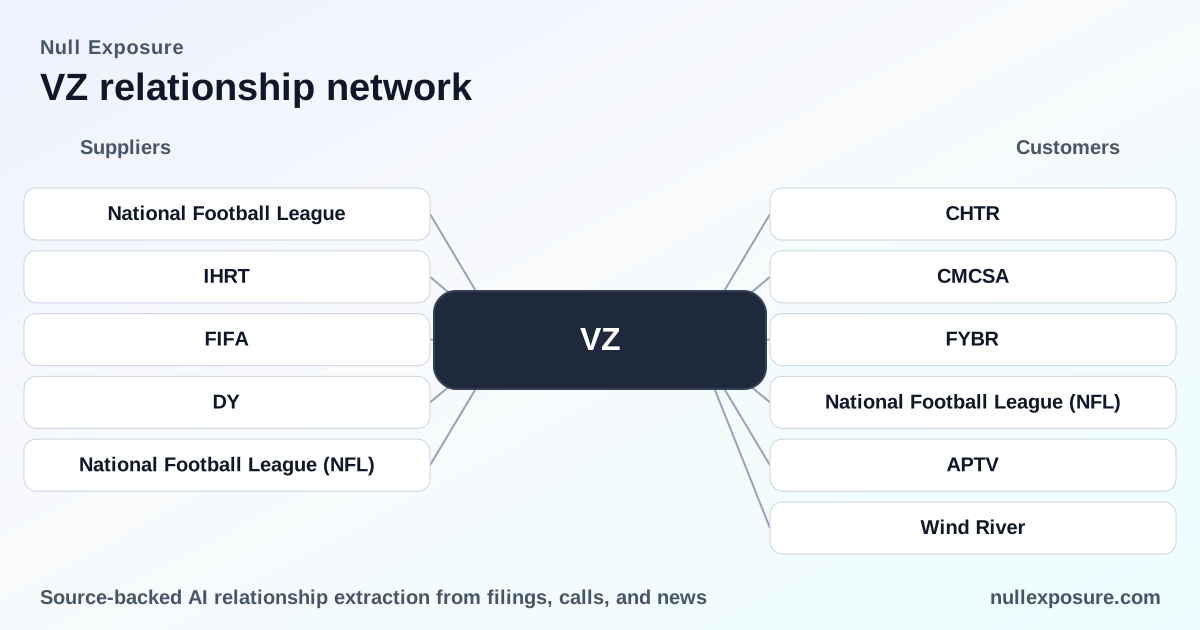
Verizon (VZ) — an investor’s map of customer relationships and commercial posture
Verizon monetizes a broad communications platform by selling subscription-based wireless and wireline services, wholesale network access to MVNOs and carriers, enterprise connectivity and managed services, and value-added offerings such as edge compute and advertising platforms. Revenue is driven by recurring consumer postpaid contracts, wholesale MVNO arrangements, and enterprise/government engagements supported by Verizon’s 5G, fiber and edge infrastructure. For a concise vendor and customer intelligence briefing, visit https://nullexposure.com/.
How Verizon structures customer-facing commerce (what matters to investors)
Verizon’s operating model combines high-margin recurring service revenue with wholesale and partner-driven distribution. The company contracts primarily on subscription terms for consumer and telematics services, with usage-based elements where overages apply; large-enterprise and public sector work are sold as managed services and connectivity. Company disclosures underline that no single customer contributed more than 10% of revenue, signalling low revenue concentration but wide counterparty breadth. Expect relationships to be operationally critical (network access, MVNO routing, enterprise connectivity) and generally mature—many are ongoing MVNO and wholesale arrangements rather than short-term pilots.
Key operational signals:
- Subscription-heavy billing with month-to-month and device-payment variants drives predictability.
- Wholesale/reseller roles (MVNOs, distributors, system integrators) scale reach without direct retail cost.
- Geographic focus on North America, with selected global enterprise engagements.
- Materiality signal: immaterial single-customer concentration, reducing single-client revenue risk.
Customer relationships — the recent mentions investors should track
Below I catalogue each relationship flagged in the source set. Each item is a plain-English take with a direct source reference.
-
Charter (CHTR) — strategic mobile reselling agreement. Charter confirmed a structural, strategic mobile reselling agreement with Verizon for current and future services during its Q4 2025 earnings call (2025Q4). (Charter earnings call, 2025Q4)
-
Aptiv (APTV) — connected-driving and V2X demonstration on Verizon 5G. Aptiv’s MWC Barcelona showcase used Verizon’s 5G network, MEC and connected-driving platform to demonstrate low-latency V2X sensor sharing for safety-critical functions (FY2026 media coverage). (StockTitan / MWC coverage, March 2026)
-
Staples (SPLS) — in-store tech services partnership. Staples began full-service eye care centers via Stanton Optical and partnered with Verizon to expand tech services in stores, per news coverage on store strategy in 2025–2026. (The Sun, March 2026)
-
Vertical Bridge — tower acquisition from Verizon. Vertical Bridge completed a $3.3bn acquisition of more than 6,000 towers from Verizon last year, indicating Verizon’s monetization of passive tower assets (FY2026 coverage). (DatacenterDynamics, May 2026)
-
Comcast (CMCSV / CMCSA / CCZ) — modernized MVNO partnership and Xfinity Mobile carriage. Comcast reported adding mobile subscribers through a deal that uses Verizon’s network and announced a modernized MVNO relationship with Verizon supporting profitable wireless growth (Comcast/CMCSA/Q4 2025 and FY2025 coverage). (BroadbandBreakfast, March 2026; Comcast/CCZ/CMCSA earnings calls, 2025Q4)
-
Frontier (FYBR / Frontier) — competitive reference in Verizon call. In Verizon’s Q4 2025 commentary, Frontier was referenced as a competitive peer with high churn and pricing challenges; this is a competitive mention rather than a customer contract. (Verizon Q4 2025 earnings call)
-
NFL — major sponsorship and 5G naming rights. Verizon’s 2021 sponsorship of the NFL, valued at more than $1 billion, positioned Verizon as the league’s official 5G network; Verizon is reviewing sponsorship portfolio costs as part of corporate expense management (FY2026 reporting). (Finviz report, March 2026)
-
Aptiv (APTV) — additional media coverage of V2X use of Verizon platform. Multiple outlets reiterated Aptiv’s demonstration leveraging Verizon’s connected-driving platform at MWC, reinforcing the automotive/edge strategy linkages (FY2026 coverage). (SimplyWall.St / StockTitan, March 2026)
-
Xfinity Mobile reference (CCZ) — network plus Wi‑Fi model. Analysts and press describe Xfinity Mobile as a wireless offering that “rides” on Verizon’s network supplemented by Comcast’s Wi‑Fi footprint. (Ad-hoc News / March 2026)
-
BuzzFeed (BZFD) — ad platform access from Verizon Media (historical). BuzzFeed’s strategic moves included tapping Verizon Media’s ad platform to reach cross-channel audiences; this is a historical FY2020 relationship showing Verizon’s advertising reach. (BuzzFeed press coverage, FY2020)
-
NAPCO / NSSC — security communicators supporting Verizon connectivity. NAPCO’s StarLink®5G multi-carrier communicators include support for Verizon’s network, enabling nationwide alarm reporting and dealer service revenue opportunities (FY2026 investor meeting notes). (Intellectia.ai, May 2026)
-
Comcast group earnings references (CCZ, CMCSA) — reaffirmation of MVNO modernization. Comcast and related filings (CCZ/CMCSA) repeated that their MVNO arrangements with Verizon have been modernized to support growth. (Comcast/CMCSA Q4 2025 earnings calls)
-
Charter and Comcast (mentioned on Verizon call) — renewed MVNO relationships. Verizon’s Q4 2025 earnings call explicitly cited renewed MVNO relationships with Comcast and Charter as part of its wholesale strategy. (Verizon Q4 2025 earnings call)
-
FIFA World Cup 2026 — event infrastructure deployment. Verizon is deploying advanced 5G and fiber for FIFA World Cup 2026 venues and surrounding communities, reflecting event-based infrastructure delivery (FY2026 coverage). (MarketBeat alert, May 2026)
-
FirstNet — expanded 5G network slicing for frontline users. Verizon expanded 5G network slicing capabilities for FirstNet to support frontline agencies and public safety use cases (FY2026 reporting). (MarketBeat alert, May 2026)
-
Wind River — partner in V2X demonstrations using Verizon’s platform. Wind River collaborated with Aptiv in showcasing network V2X sensor-sharing leveraging Verizon’s connected-driving platform at industry events (FY2026 coverage). (SimplyWall.St, March 2026)
-
Aptiv SEC/form coverage — repeated mentions of Verizon platform use. SEC and media filings reiterated Aptiv’s use of Verizon’s connected-driving technology in demonstrations (FY2026 filings/coverage). (StockTitan / SEC reporting, March 2026)
-
Charter filing (LBRDK 10-K) — Charter operates as MVNO using Verizon network and Wi‑Fi/CBRS. Charter’s FY2025 10‑K specifically notes that Charter provides mobile service as an MVNO using Verizon’s network alongside Spectrum Wi‑Fi and CBRS. (Charter 2025 10‑K)
-
ASTS — Verizon purchase orders for network equipment. AST LLC disclosed that Verizon submitted purchase orders for network equipment to support planned commercial service, indicating an equipment-supplier relationship (ASTS 2024 10‑K). (ASTS 2024 10‑K)
(If you’d like a consolidated, investor-ready matrix of these relationships with dates and source links, Null Exposure provides that mapping at https://nullexposure.com/.)
What these relationships reveal about Verizon’s commercial posture
- Distribution-first, asset-light for certain footprints. The tower sale to Vertical Bridge demonstrates Verizon is monetizing passive infrastructure where strategic, while MVNO wholesale agreements extend reach without incremental retail CAPEX.
- Wholesale MVNOs are strategic growth channels. Renewed, modernized MVNO agreements with Comcast and Charter show Verizon balances direct retail with partner-led subscriber growth.
- Enterprise and public-sector criticality. Work for FirstNet and major events such as FIFA 2026 highlights the mission-critical nature of some contracts and the operational premium attached to network-slicing and edge services.
- Revenue profile is recurring and diversified. Subscription billing and wholesale contracts create predictable cashflows; single-customer immateriality reduces concentration risk.
- Risks to monitor: sponsorship and marketing cost rationalization (NFL review), ongoing competition from lower-price competitors (Frontier commentary), and the long-term economics of asset sales versus retained network ownership.
Bottom line for investors
Verizon runs a subscription-first, wholesale-augmented communications platform with diversified customer relationships spanning MVNO partners, enterprise/government customers, event infrastructure deals and technology partners leveraging Verizon’s 5G and edge stack. The company’s commercial posture reduces single-customer concentration while capturing recurring revenue, but watch sponsorship spend and the strategic trade-offs of tower monetization.
For a structured, exportable view of the vendor relationships and to track updates in real time, see https://nullexposure.com/.