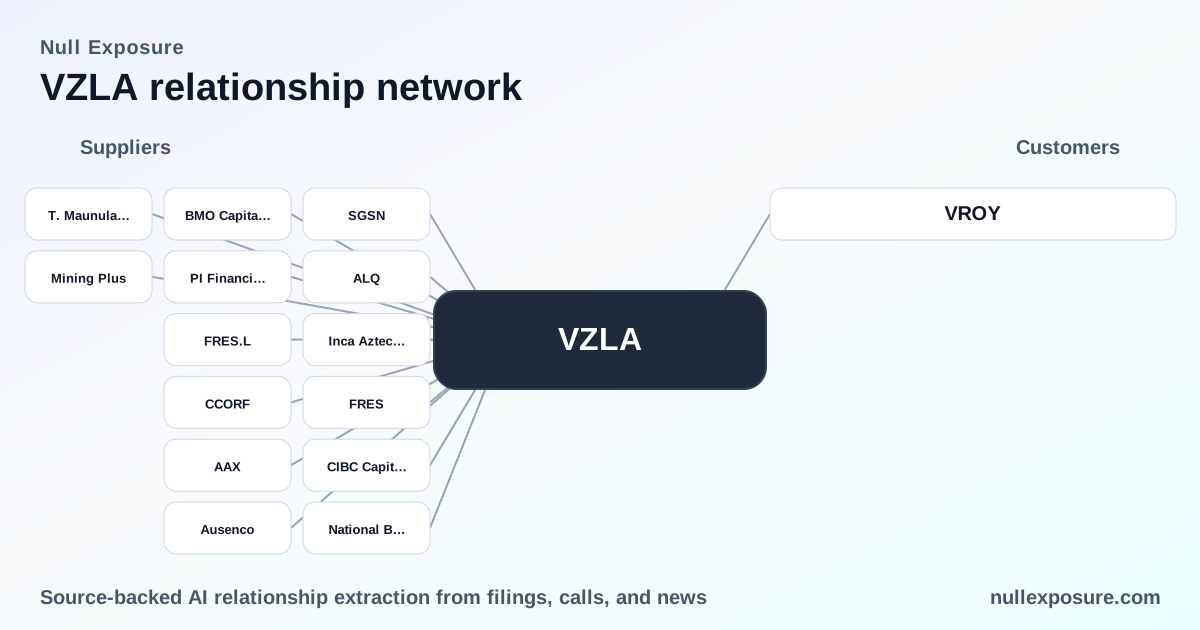
Vizsla Resources (VZLA) — Customer relationships and what they mean for investors
Vizsla Silver Corporation (ticker: VZLA) is a development-stage precious metals company centered on the 100%‑owned Panuco silver‑gold project in Mexico. The company currently monetizes through capital markets and partner financing while it advances the project toward production; long‑term value will be delivered by metal sales once the mine is commissioned, but near-term investor returns hinge on financing, royalty arrangements, and the contractual rights of counterparties.
For a structured view of counterparty exposures and relationship signals, visit https://nullexposure.com/.
One clear counterparty: a royalty relationship that reduces future upside
Investors evaluating Vizsla’s customer/contract landscape will find a single, material relationship documented in public reporting: a royalty interest held by Vizsla Royalties Corp (VROY). This relationship is not a buyer‑of‑product arrangement today — it’s a claim on future production proceeds.
-
Vizsla Royalties Corp (VROY) — A Resource World article dated March 10, 2026 reports that Vizsla Royalties holds, indirectly, a net smelter royalty on any potential future mineral production from Vizsla’s 100%‑owned Panuco project, creating a pre‑existing cashflow priority on future metal sales. (Resource World, March 10, 2026: https://resourceworld.com/vizsla-silver-arranges-65-million-bought-deal-financing/)
-
Vizsla Royalties (duplicate listing) — The dataset contains a second, identical mention of the same royalty: the company reiterates that Vizsla Royalties holds an indirect net smelter royalty on Panuco’s potential future production, reinforcing that this counterparty exposure is present in market reporting. (Resource World, March 10, 2026: https://resourceworld.com/vizsla-silver-arranges-65-million-bought-deal-financing/)
Key takeaway: the documented external claim is a royalty interest, not a commercial off‑taker contract; that structure preserves operational control for Vizsla but permanently allocates a slice of future revenue to the royalty holder.
Why a royalty relationship matters for valuation and cashflow modeling
A net smelter royalty (NSR) is a structural claim that takes a percentage of metal value at smelter settlement. For a development‑stage miner like Vizsla:
-
Contracting posture: the NSR is a long‑lived, non‑operational liability that survives financing rounds and reduces project gross revenues at the point of sale. This changes the effective price deck investors should use in discounted cash flow scenarios.
-
Concentration: only one external counterparty is documented in the customer/claim set, which is a concentrated source of permanent revenue claim; concentration simplifies modeling but also creates a single point where negotiated terms materially affect project economics.
-
Criticality: the NSR is materially critical to future cashflow capture — it does not affect near‑term operations today (since there is no reported production revenue), but it will be a recurring cash outflow once production starts.
-
Maturity: Vizsla is pre‑revenue (RevenueTTM = 0) and therefore the NSR’s financial impact is contingent on development timelines; the royalty’s existence is a mature contractual commitment even as the company itself remains in a development phase.
Use these characteristics to adjust price forecasts, tax and royalty overlays, and break‑even analysis for Panuco when progressing to production.
Financial and market context that shapes counterparty risk
Vizsla’s public financial snapshot provides the context in which the royalty sits:
-
Market capitalization stands at approximately $1.174 billion with pre‑production economics (RevenueTTM = $0, EBITDA negative) as of the latest quarter ended 2026‑01‑31. These figures underline the company’s dependence on external capital and contractual financing activity until cashflow from mining begins.
-
Institutional ownership is substantial (64.11%), indicating professional investor interest and potential for orderly capital raises, while insider ownership (~4.24%) signals modest insider alignment with shareholders.
-
Analysts show a consensus target of $6.56, with three buy ratings; this represents market expectations that project value will be realized despite existing royalty encumbrances.
In sum, the royalty is priced into valuation implicitly, but the financial snapshot emphasizes that capital markets and contract structures — not product sales — drive near‑term value realization.
Practical implications for investors and operators
For investors and operators underwriting VZLA’s path to production, the royalty relationship and company metrics translate into actionable considerations:
-
Modeling: incorporate an NSR deduction from gross metal prices in all production scenarios; treat the royalty as a fixed percentage claim rather than a discretionary cost.
-
Capital structure: expect additional financings to bridge development; royalty holders do not provide operating capital and will remain a fixed claim on future revenue, so financing rounds should be sized to preserve project economics after royalty payments.
-
Deal dynamics: because the public record shows a single royalty counterparty, future negotiations (buy‑backs, swaps, or secondary royalty issuances) would be high‑impact and high‑visibility to investors.
-
Timing risk: with no current revenue, the royalty heightens the importance of timeline discipline — delays compress the present value of post‑royalty cashflows and increase dilution risk from capital raises.
Bottom line: structural claim, concentrated counterparty, development risk
Vizsla’s public relationship footprint for customers and claims is narrow and specific: a net smelter royalty held by Vizsla Royalties Corp is the principal documented external claim on future production, according to reporting in March 2026. That royalty reduces the upside per ounce and should be treated as a senior, long‑lived contractual claim in valuation models.
For investors wanting a systematic view of corporate counterparty exposures and how they affect cashflow and risk, explore the platform at https://nullexposure.com/ for summarized counterparty profiles and relationship signals.
Bold, transparent assessment of these contractual priorities is essential when valuing development‑stage miners: ownership of a high‑quality deposit is valuable, but contractual claims such as royalties define how much of that value actually reaches shareholders.