Top KingWin Ltd (WAI): Customer relationships and what they signal for investors
Top KingWin Ltd operates as a fintech platform delivering financial trading solutions and digital asset management services, monetizing primarily through platform and service fees, trading commissions, and asset-management mandates that target institutional and retail trading activity. The company runs a technology-forward product set built around AI and big-data analytics, while depending on external capital to fund growth and operations given ongoing operating losses. For investors evaluating customer exposure, the disclosed relationship activity centers on financing counterparties rather than recurring commercial customers, a distinction that changes how revenue concentration and counterparty risk should be assessed. Learn more about our coverage at https://nullexposure.com/.
Quick operating snapshot investors need to know
Top KingWin is a small-cap NASDAQ-listed fintech with a thin public float and negative operating leverage. Publicly reported metrics show Revenue (TTM) of $8.04M and EBITDA of -$24.16M, with EPS materially negative and Price-to-Book at 0.172—indicative of a capital-intensive, loss-making growth posture. The company is incorporated with an address in Guangzhou, China, and trades on a U.S. exchange, which creates a cross-jurisdictional oversight profile investors must factor into counterparty and regulatory assessments.
Key balance and market signals:
- Market cap: $5.47M; Shares outstanding: 2.2984M.
- Profitability: Net losses (Diluted EPS -28.26) and negative margins.
- Ownership: Insiders ~4.0%; institutions effectively negligible at ~0.2%.
These facts together denote high financing dependency, small public liquidity, and elevated governance scrutiny as primary structural risks to monitor.
What the documented relationship activity reveals
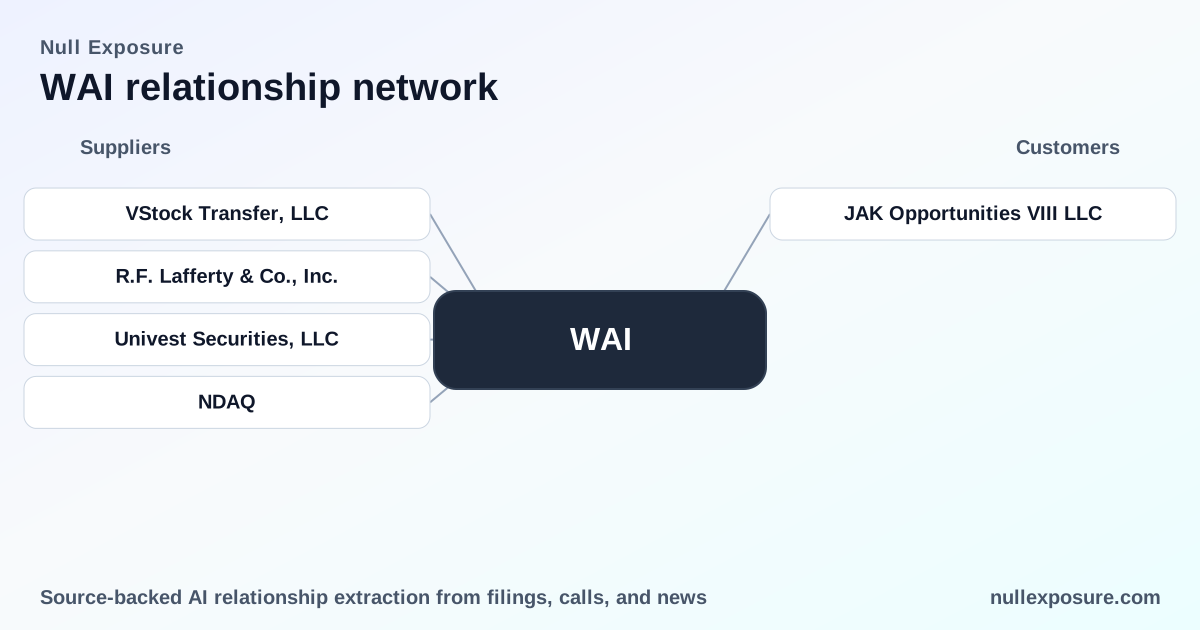
There is a single relationship recorded in the customer-scope results: an external purchaser of convertible debt. This interaction is capital provision, not recurring revenue from a commercial customer, and therefore should be treated as financing activity rather than a sign of client concentration in the product or services book. The presence of such transactions signals an operating model that uses bespoke financing arrangements as part of working capital and growth funding.
JAK Opportunities VIII LLC — convertible promissory note (FY2024)
Top KingWin entered a securities purchase agreement to issue a convertible promissory note with a $2,500,000 original principal to JAK Opportunities VIII LLC, convertible into Class A ordinary shares; the transaction closed for gross proceeds of approximately $2.25M, as reported publicly. According to a FinancialContent news release dated November 26, 2024, the offering was structured as a convertible note private placement to JAK Opportunities. (FinancialContent, company announcement, Nov 2024)
How to interpret this relationship for commercial risk and concentration
The disclosed JAK transaction should be interpreted through a financing lens rather than as a customer-win metric. Its characteristics imply:
- Contracting posture: The company actively pursues bespoke financing arrangements (convertible notes) to shore up liquidity, which signals a defensive contracting posture toward capital raising rather than aggressive expansion through customer contracts.
- Concentration: Because the only recorded counterparty in the customer-scope dataset is an investor, customer-revenue concentration cannot be assessed from these records; however, capital concentration risk is visible—large private placements can materially affect capitalization and ownership when executed by a small number of counterparties.
- Criticality: For ongoing operations, these financing relationships are critical—Top KingWin’s negative EBITDA and net losses make access to external capital an operational necessity until profitability is reached.
- Maturity: The nature of convertible notes and private placements indicates a company at an earlier maturity stage, still reliant on episodic capital infusions rather than sustained, profitable operating cash flow.
No contractual constraint excerpts were provided in the available results, so there are no disclosed covenants, lock-ups, or counterparty-specific obligations to analyze from the data set; that absence itself is a company-level signal that material terms are not publicly filed within the customer-scope records available here.
Strategic and risk takeaways for investors and operators
- Financing over customers: The singular recorded relationship is capital provision, which means the primary near-term risk to equity holders is financing dilution and execution risk on future raises rather than a sudden loss of a major commercial account.
- Dilution risk is real: Convertible note structures create a pathway to equity issuance that will dilute existing holders when conversion triggers are met; investors must model potential conversion scenarios against the small share base.
- Liquidity and governance constraints: Small market capitalization and minimal institutional ownership increase volatility and reduce the margin for adverse developments; governance and transparency will matter disproportionally to valuation recovery.
- Watch for revenue validation: The company reports modest revenues but negative operating cash flow and EBITDA; sustainable monetization through recurring commercial customers remains the key catalyst required to reduce dependence on private placements.
What to watch next (practical monitoring checklist)
- Announcements of additional private placements or debt instruments that replicate the JAK structure.
- Any filings or disclosures that reveal convertible note terms, conversion prices, and covenant triggers (these will determine dilution and creditor protections).
- Quarterly operating results showing progress toward positive operating margins and cash flow from customers rather than financing.
- Changes in ownership—particularly any increase in institutional holders or secondary market activity that would improve liquidity.
For a deeper, structured review of counterparty exposure and contractual risk across public disclosures, see our home page for investor briefing tools: https://nullexposure.com/.
Bottom line
Top KingWin’s public relationship footprint in the customer-scope results is dominated by a single convertible note financing from JAK Opportunities VIII LLC rather than evidence of broad commercial customer traction. That financing activity is critical to operations today, creates meaningful dilution risk, and signals a firm still in capital dependency mode rather than self-sustaining commercial maturity. Investors should prioritize tracking future financing events, conversion terms, and the company’s progress in converting technology and service offerings into repeatable, margin-bearing revenue streams.