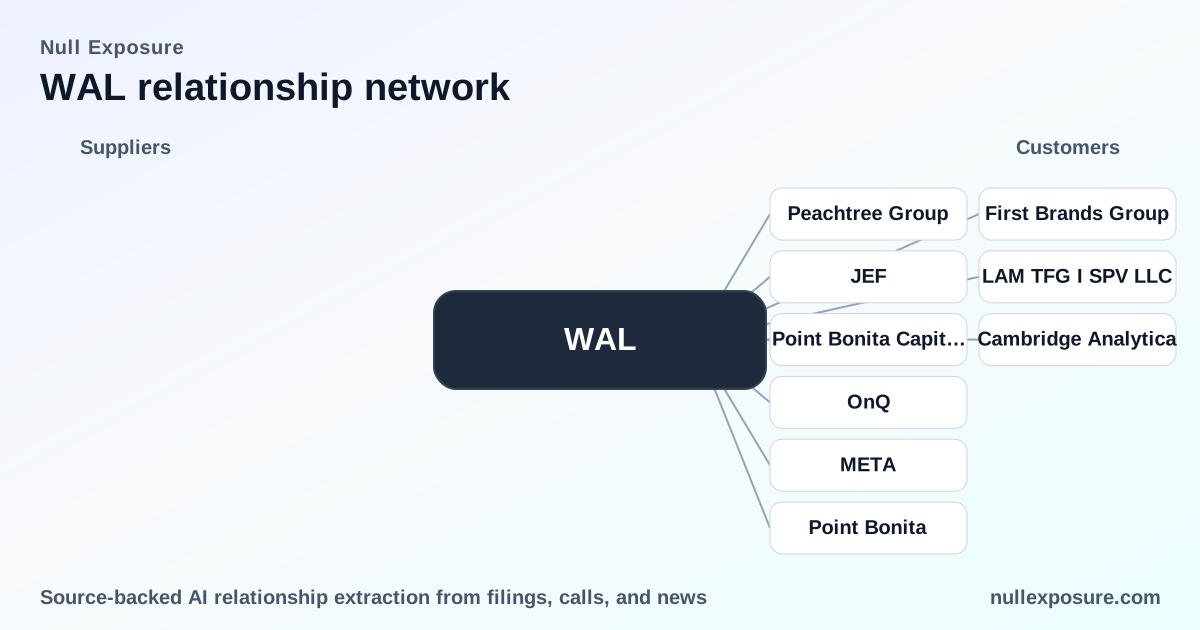
Western Alliance (WAL): Customer relationships that move the credit needle
Western Alliance Bancorporation operates as a regional commercial bank focused on commercial lending, treasury management, mortgage banking and specialized payment services, monetizing through net interest income, loan origination and sales, servicing fees, and customized treasury fees. Its business model combines deposit funding with targeted commercial credit and fee businesses (including digital payments and mortgage servicing), producing a mix of interest and non‑interest revenue that drives ROE and margin expansion. For a concise intelligence package and source consolidation, see https://nullexposure.com/.
How to read WAL’s customer flows: concentration, tenor and role
Western Alliance runs a diversified commercial banking platform with clear operational characteristics. Credit relationships skew toward short‑term and value‑add real estate lending and asset-based facilities, reflecting a contracting posture that often uses bridge or warehouse structures. Counterparties range from individual and small‑business borrowers to mid‑market and institutional sponsors, and the balance of activity sits inside WAL’s core geographic footprint of Arizona, California and Nevada. The company has stated it is not dependent on any single counterparty for material revenue, and it both sells loans and services retained portfolios, signaling a hybrid seller/service‑provider operating model. These factors combined make the loan book operationally active but not single‑counterparty concentrated; the primary risks to watch are credit migration and the cost of heightened regulatory/compliance activity.
For a deeper view of these relationship signals, visit https://nullexposure.com/ (company overview and aggregated news links).
Relationship roll‑call: what the press and filings named
Below is a concise, source‑linked summary of every counterparty named in recent coverage. Each entry is a plain‑English snapshot investors can use when mapping WAL’s credit and client footprint.
Peachtree Group
Western Alliance provided a $50 million warehouse funding facility to expand Peachtree Group’s equipment finance business, supporting national origination of equipment loans. According to MonitorDaily and HotelManagement (Mar 2026), the facility is structured as warehouse funding to scale the equipment‑finance division.
Jefferies Financial Group / JEF / Jefferies
WAL filed a $126.4 million loan lawsuit after payments under a forbearance stopped; Jefferies strongly refuted the claims. Financial coverage and investor notes documented the dispute and public pushback from Jefferies (Finviz; Intellectia.ai, Mar 2026).
Point Bonita Capital / Point Bonita
WAL has a loan to Point Bonita (a Jefferies subsidiary) that continues to pay down at an accelerated pace, per company commentary on borrower performance (InsiderMonkey, Mar 2026).
Cantor Group Five / Cantor Group 5
WAL recorded a $26 million charge‑off related to the Cantor Group Five loan during the quarter, reflecting a complex and potentially prolonged resolution process (StockStory / InsiderMonkey Q1 2026 earnings call coverage).
Leucadia Asset Management
Western Alliance announced the full charge‑off of a $126.4 million loan to Leucadia Asset Management, recognized in quarterly disclosures as a significant credit loss (StockStory Q1 2026).
Lucadia Asset Management
Company earnings commentary repeated that WAL fully charged off the remaining $126.4 million balance tied to a fund of Lucadia Asset Management, underscoring a major write‑off in the period (InsiderMonkey Q1 2026).
OnQ
WAL extended a $7.5 million asset‑based line of credit plus treasury services to OnQ to support growth; the facility is a working‑capital ABL rather than long‑term term debt (BusinessWire / FinancialContent, Feb 2026).
AEYE (AudioEye)
AEYE completed a debt refinancing with Western Alliance in early 2025 that management said reduced interest expense and improved flexibility — a typical mid‑market refinancing use case for WAL (InsiderMonkey; Yahoo Finance Q4 2025 commentary).
Facebook / META (Juris banking)
WAL’s Juris banking group processed over $17 million in digital payments tied to the Facebook/Cambridge Analytica settlement, illustrating WAL’s niche payments role servicing class‑action flows (InsiderMonkey Q4 2025).
First Brands Group
Coverage links the $126.4 million commercial loan write‑off to a forbearance tied to bankrupt auto supplier First Brands Group, and WAL disclosed legal action amid non‑payment (SimplyWall.st, Mar 2026).
Bark, Inc. (BARK)
Bark extended or maintained a long‑standing line of credit with Western Alliance, showing WAL’s engagement with growth‑stage consumer internet customers (MarketScreener, Nov prior year reference).
CPI Aerostructures (CVU)
CPI Aerostructures announced two credit facilities totaling $20 million with Western Alliance, reflecting a typical credit relationship for smaller industrial issuers (Investing.com / SEC filing note, FY2025).
Mission Housing Development Corporation
WAL provided $78 million financing for low‑income housing in San Francisco’s Mission District, demonstrating activity in community development and construction financing (ConnectCRE, Apr 2026).
Mission Economic Development Agency
WAL partnered with local development and community groups on the Mission District financing and participated in public‑facing groundbreakings as the lender (ConnectCRE, Apr 2026).
LAM TFG I SPV LLC
Jefferies clarified loans to LAM TFG I SPV LLC were non‑recourse and not guaranteed by Jefferies, per company statements in investor materials (Intellectia.ai, Mar 2026).
Marvel (MRVL) — Mission project reference
Western Alliance provided $77.9 million for a mission‑area real estate project linked to a developer referenced in analyst notes, showing continued sizeable CRE commitments (MarketScreener, Apr 2026).
AmeriHome
Management cited margin improvement driven by increased retail recapture volume at AmeriHome, indicating WAL’s mortgage banking and servicing channels are contributing to margin dynamics (InsiderMonkey Q1 2026).
Cambridge Analytica
WAL’s Juris banking processed digital payments associated with the Cambridge Analytica litigation settlement, illustrating WAL’s role in specialized payments for high‑profile legal settlements (InsiderMonkey Q4 2025).
What investors should watch next
- Credit volatility and legal outcomes: the $126.4m and $26m charge‑offs and the Jefferies lawsuit are immediate credit and reputational risks; monitor court developments and recoveries.
- Earnings mix: fee businesses (Juris/digital payments, mortgage servicing, ABLs) are important diversifiers to net interest margin pressure but are operationally intensive.
- Geographic concentration: CRE exposure centered in AZ/CA/NV amplifies regional cyclical risk; WAL’s disclosures show an intentional regional focus.
- Counterparty breadth: WAL’s client base spans individuals to large sponsors and the bank acts as both lender and service provider, which supports revenue resilience but requires active credit governance.
Bottom line: Western Alliance runs a commercially active, fee‑augmented bank with meaningful mid‑market and CRE exposure; recent large charge‑offs and an adversarial legal posture with a major financial counterparty elevate near‑term risk while its specialized payment and mortgage franchises provide offsetting fee revenue. For an aggregated feed of these customer relationships and continuous monitoring, visit https://nullexposure.com/.