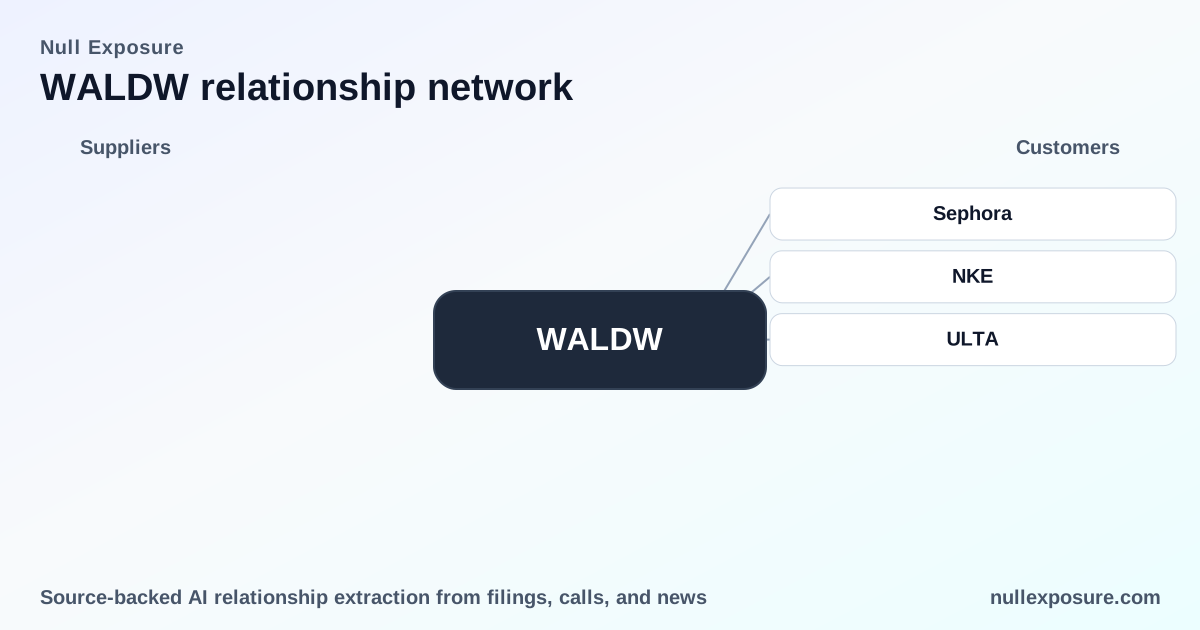
WALDW Customer Relationships: Retail partnerships drive near-term revenue while concentration creates execution risk
Waldencast Acquisition Corp operates as an acquirer and operator of consumer brands; its revenue model is driven by post‑business‑combination ownership of consumer-facing labels that monetize through a mix of direct e‑commerce and large retail partner distribution. Recent commentary ties the company's brand (Milk Makeup) to three major retail relationships—Sephora, Ulta and a brand collaboration with Nike—that materially determine revenue cadence and channel mix. For investors, the key read is simple: growth will be driven by retail rollouts and co‑brand activations, while downside concentrates around execution and partner reliance. Learn more at https://nullexposure.com/.
The earnings call paints a go‑to‑market centered on retail launches and collaborations
Waldencast’s 2025 Q1 earnings call explicitly referenced digital and wholesale channels as the engines for near‑term sales. The company cited significant online sales tied to a prior product launch and highlighted two major retail rollouts and one strategic brand partnership that broaden consumer reach. That combination—direct e‑commerce momentum plus large retail placements and a high‑profile partnership—drives top‑line visibility but also concentrates execution risk in a few counterparties.
Call‑level relationship log — every mention from the filing
Below are the relationships recorded in the company’s 2025 Q1 call transcript, each followed by a concise, plain‑English takeaway and the source reference.
- Sephora — Waldencast reported significant online sales through MilkMakeup.com and Sephora’s online storefront tied to last year’s Jelly product launch, which complicates year‑over‑year digital comparisons going forward. According to the company’s 2025 Q1 earnings call (transcript dated March 7, 2026), the Jelly launch drove meaningful prior‑period online results.
- Nike (company name listed as Nike) — Management announced a partnership between Milk Makeup and the Nike brand to broaden the brand and community, indicating a strategic co‑branding or partnership effort beyond traditional retail channels. The 2025 Q1 earnings call referenced this collaboration (March 7, 2026).
- NKE (Nike, ticker referenced in call metadata) — The call text is also recorded under the ticker NKE in the call materials, confirming the corporate identity of the partner named in the announcement. This entry mirrors the Nike mention in the same 2025 Q1 call (March 7, 2026).
- ULTA (Ulta Beauty, ticker referenced) — Waldencast said the brand launched into Ulta with sales beginning in late February, signalling a recent wholesale expansion into Ulta’s distribution network. This insertion into Ulta’s assortment was disclosed on the company’s 2025 Q1 earnings call (transcript dated March 7, 2026).
- Ulta Beauty — The transcript also refers to the retailer by its full name, Ulta Beauty, and repeats that sales at Ulta commenced in late February; the duplicate reference underscores the operational significance the company assigns to this retail entry. See the 2025 Q1 earnings call (March 7, 2026).
Company‑level constraints and what they signal about WALDW’s operating posture
Two constraints extracted from company filings provide useful company‑level context:
- Buyer posture (high confidence): Filing language tied to the IPO and private placement (units and warrants sold at set prices) registers Waldencast in a transactional capital‑markets posture typical of acquisition vehicles. This is a company‑level signal that the entity has historically relied on sponsor capital and capital markets transactions to establish its balance sheet and fund business combinations, rather than organic contract commitments.
- Prospect / early maturity signal (moderate confidence): Separate filing language indicates the company historically described itself as having been organized to search for a business combination and that it did not expect operating revenues until after completing a combination. This speaks to transitional maturity—the firm has a short operating history under its current structure, and some commercial programs remain in early rollout phases.
Together these constraints imply an operating model that is transactionally contracted, concentrated on a small set of large partners, and commercially immature—a combination that increases execution sensitivity during retail rollouts and co‑brand activations.
What this means for investors: upside drivers and concentrated risk
The call narrative creates a clear investment map:
-
Upside drivers
- The Nike collaboration functions as a halo partnership that can expand brand awareness and justify premium pricing or limited‑edition product drops. That type of partnership accelerates customer acquisition beyond standard retail placements.
- Entry into Ulta, coupled with ongoing Sephora online strength, diversifies retail touchpoints across two of the largest beauty retail channels in the U.S., improving omnichannel reach.
-
Concentration and execution risks
- Channel concentration: A material share of near‑term revenue is routed through a small set of large retail partners; any distribution delays, promotional missteps, or inventory issues at these partners will have outsized impact on reported sales and comps.
- Comparability risk: Management explicitly warned that last year’s Jelly launch produced outsized online sales, complicating year‑over‑year comparisons—investors should expect volatile quarterly comps while new SKUs and retail placements normalize.
- Maturity risk: The company’s SPAC heritage and filing language that described limited historical operations place the business in a scaling phase; execution benchmarks tied to retail rollouts are the primary proof points to watch.
Practical monitoring checklist for the next two quarters
- Track sequential sales at Sephora and Ulta and the cadence of online vs. wholesale revenue; weekly sell‑through and reorder signals at major retailers will be leading indicators.
- Watch product cadence and inventory availability for the Nike collaboration—timing and exclusivity terms will determine uplift.
- Monitor management commentary for changes to promotional intensity; aggressive discounting at key retail partners will compress margins and signal demand weakness.
Explore deeper customer linkage analysis and historical call transcripts at https://nullexposure.com/.
Bottom line
The 2025 Q1 call frames Waldencast’s revenue story as retail‑distribution driven, amplified by a strategic co‑brand partnership with Nike and supported by online strength at Sephora. These are clear commercial levers for growth, but the company’s capital‑markets origins and concentrated partner set create execution and comparability risk that investors must monitor closely through retail sell‑through data and the next several quarters of partner‑level performance.