Washington Trust Bancorp (WASH) — Customer Relationships and What They Tell Investors
Washington Trust Bancorp is a regional New England bank that monetizes a conservative franchise through net interest margin on commercial and consumer lending, fee income from wealth-management and trust services, and mortgage origination and servicing activities. Washington Trust operates primarily as a lender and service provider in Rhode Island, Massachusetts and Connecticut, converting local deposit funding into secured real-estate and small-business credit and recurring wealth-management fees. For a quick company-level reference, visit https://nullexposure.com/.
Why customers matter to the investment case
Washington Trust’s customer footprint is a direct window into its underwriting posture and franchise durability. The bank’s relationships are concentrated in southern New England and skew toward real-estate collateralized lending and small-business deposit clientele, which supports stable deposit funding but also creates regional credit concentration. Washington Trust combines balance-sheet lending with origination-and-sale activity in mortgages and provides fiduciary services, so earnings are driven by interest margin plus recurring trust and fee income.
Company-level signals investors should carry forward
- Geographic concentration: Washington Trust operates through offices in Rhode Island, Connecticut and Massachusetts; loans and collateral are materially concentrated in southern New England. This localization is a structural feature of the business that reduces diversification but strengthens local customer franchise and deposit stickiness (company disclosures).
- Counterparty mix: The bank explicitly serves individuals, commercial customers, non-profits and municipal clients, indicating a diversified product set across retail, commercial and fiduciary lines (company disclosures).
- Role breadth: The firm acts as lender, mortgage originator (and sometimes seller or originating agent), and service provider where revenues can be reported on a gross basis when Washington Trust is principal. That operational mix drives both interest income volatility and fee-income stability.
- Materiality: Historical disclosures describe repurchase demands as insignificant, signalling customer-level litigation or repurchase risk is immaterial to core capital metrics.
- Segment focus: Management emphasizes commercial and residential lending plus wealth-management and trust services as primary segments; these are the engine for recurring revenue and the source of mortgage-related representations and warranties.
Customer relationships on the record
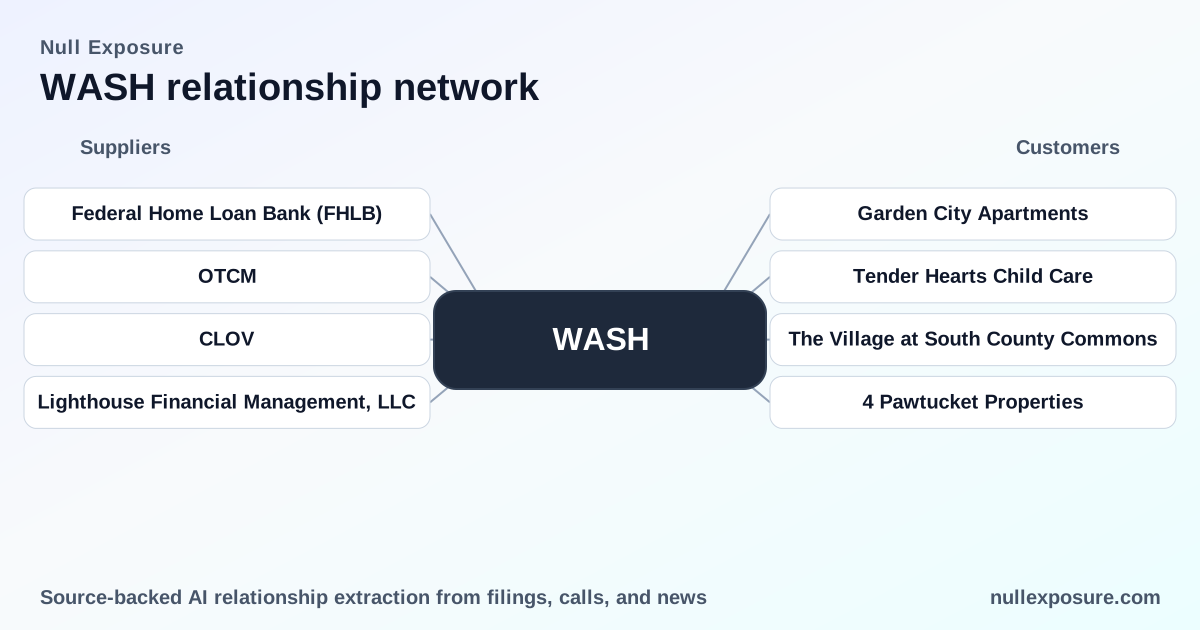
Below are every customer relationship found in public local reporting and the precise source for each.
Garden City Apartments — commercial real-estate financing
Washington Trust provided a $5.25 million financing to Garden City Apartments in October 2013, reflecting the bank’s role as a regional real-estate lender to apartment owners. Reported by GoLocalProv (transaction headline dated 10-08-2013; referenced in local coverage). Source: GoLocalProv article.
Tender Hearts Child Care — small-business credit
Washington Trust extended a $1.4 million loan to Tender Hearts Child Care in December 2012, illustrating the bank’s exposure to small-business lending for community services. Reported by GoLocalProv (transaction headline dated 12-05-2012; referenced in local coverage). Source: GoLocalProv article.
The Village at South County Commons — large retail/commercial financing
Washington Trust financed The Village at South County Commons with a $25 million facility in November 2015, a clear example of the bank’s capacity to underwrite sizeable retail-anchored commercial real-estate deals in its core markets. Reported by GoLocalProv (transaction headline dated 11-03-2015; referenced in local coverage). Source: GoLocalProv article.
4 Pawtucket Properties — mid-size property financing
Washington Trust provided $2.17 million in financing to 4 Pawtucket Properties in October 2015, another illustration of portfolio-level lending to regional property owners. Reported by GoLocalProv (transaction headline dated 10-28-2015; referenced in local coverage). Source: GoLocalProv article.
Brews Bros — retail depositor and small-business customer
A local news account notes Brews Bros’ owner as a Washington Trust account holder and describes bank employees as regular customers since the coffee shop’s opening during the pandemic, showing the bank’s relationship depth with small retail and consumer clients. Reported by The Spokesman-Review (April 15, 2026 local coverage of downtown investment and tenant relationships). Source: The Spokesman-Review article.
For additional context on these relationship types and how they map to credit and fee profiles, see https://nullexposure.com/.
What these relationships imply for underwriting and operations
The public record on customer transactions underscores a loan book dominated by real-estate collateralized commercial and residential credits, supplemented by small-business loans and deposit relationships. That combination produces the following operational characteristics:
- Concentration risk: The geographic and sector concentration in southern New England elevates exposure to local economic cycles, particularly retail and multifamily real estate prices.
- Contracting posture: Washington Trust originates loans for its own balance sheet and acts as agent/originator for third parties in mortgage transactions, creating contractual representation-and-warranty obligations on sold loans.
- Revenue mix and maturity: Mortgage originations and real-estate financings are episodic and can produce either interest income or gain-on-sale/fee income; trust and wealth-management services provide more predictable recurring fees.
- Counterparty diversity: Serving individuals, non-profits and municipal customers reduces single-segment dependency and supports stable deposit funding.
Risk factors investors should monitor
- Local CRE/multifamily downside: A significant portion of the loan portfolio is collateralized by New England real estate; stress in regional property markets would have outsized credit impact.
- Mortgage repurchase exposure: While repurchase demands have been described as insignificant historically, Washington Trust’s role as originator and seller creates ongoing representations that require monitoring in servicing and loan sale disclosure practices.
- Growth dynamics: Quarterly revenue traction has shown pressure (quarterly revenue growth year-over-year listed at -7%), so investors should watch loan growth, deposit trends and fee income composition.
- Valuation and returns: The bank trades at a Price-to-Book near 1.11 with a trailing P/E ~11.65 and a Return on Equity around 9.9%, placing it in a value-oriented, modest-return profile relative to larger regional peers (company filings and market data).
Bottom line for investors and operators
Washington Trust’s customer evidence reinforces a classic community-bank model: deep local relationships, real-estate-backed lending and fee-bearing wealth services. That model produces stable deposit funding and predictable fee income, but it concentrates credit risk geographically and by collateral type. Investors should value the franchise for its funding advantage and fee diversification, while underwriting downside scenarios tied to New England real-estate cycles and mortgage servicing/repurchase exposures.
If you evaluate regional banking relationships as part of credit or investment due diligence, Washington Trust is a textbook case where local market share, underwriting discipline on CRE and mortgage sale policies determine both upside and downside. For more structured insights and comparable relationship mapping, visit https://nullexposure.com/.