Energous (WATT): Customer Relationships and Commercial Trajectory
Energous develops at-a-distance wireless charging systems and monetizes through sales of PowerBridge transmitters, integrated receiver solutions, and connected software for enterprise deployments; revenue is driven by a small set of commercial contracts and channel availability that enable faster procurement for large customers. Investors should view WATT as a technology commercialization story where revenue volatility is driven by a handful of large customers, evolving channel strategy, and an ongoing transition from early adopters to top-tier enterprise buyers. For a consolidated view of counterparty exposure and relationship signals, visit https://nullexposure.com/.
Quick commercial thesis
Energous converts engineered wireless-power intellectual property into box sales (transmitters and receivers) and support software, then distributes through direct commercial agreements and channel listings that accelerate enterprise procurement. Revenue is concentrated, growth is stepwise and lumpy, and strategic progress is measured by large-customer wins and channel qualifications rather than recurring subscription metrics.
How the company actually sells and gets paid
Energous sells hardware transmitters and integrated receiver modules to enterprise customers and distributes software alongside those units. The company accelerates adoption by providing evaluation kits for prospects and by qualifying its products for established procurement channels to reduce friction for large buyers. Monetization is transactional and order-driven, with margin and cash flow profiles tied to discrete shipments and accounts receivable from a small number of counterparties.
Customer relationships: what the public record documents
Below I cover every relationship found in the public results for WATT; each entry includes a concise commercial description and the supporting source.
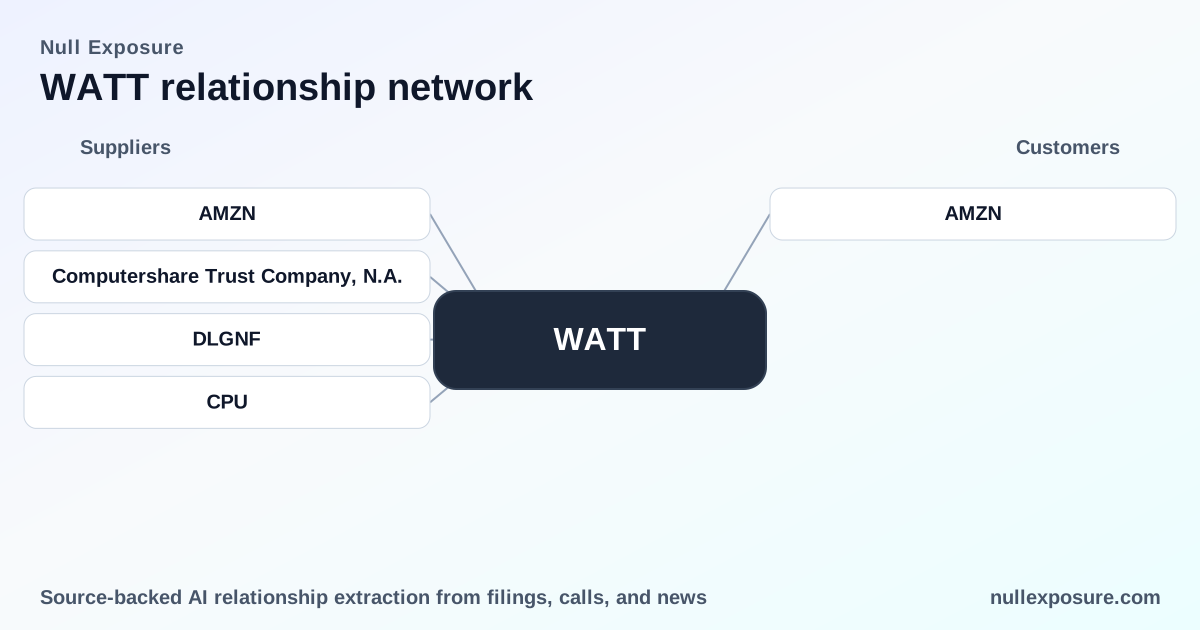
Amazon Marketplace (customer listing)
Energous’ hardware and software solutions are now qualified and available through the Amazon Marketplace, which streamlines procurement and enables enterprise customers to order approved wireless-power solutions through a familiar channel. According to a Sahm Capital press release (January 13, 2026), the marketplace qualification is positioned as a commercialization milestone to simplify deployment for enterprise buyers.
AMZN (inferred symbol — same marketplace qualification)
The same Sahm Capital notice lists AMZN as the inferred symbol tied to marketplace availability; this represents the marketplace channel rather than a traditional strategic partnership with Amazon as a bespoke enterprise customer. Sahm Capital’s release (FY2026 commentary) states that Energous solutions are “qualified and available through the Amazon Marketplace,” highlighting distribution reach rather than a named large-account procurement contract.
Operating constraints and what they signal for investors
Energous’ public disclosures and reporting context expose a set of structural characteristics that drive both opportunity and risk. These are company-level signals unless a constraint excerpt explicitly names a counterparty.
- Concentration and counterparty criticality. Energous reports that its top two customers represented approximately 76% of revenue in 2024 and that two customers accounted for a very large share of accounts receivable by year-end 2024 (excerpts show concentrations up to 99% of AR in certain disclosures). This concentration imposes earnings volatility and tail-risk; individual order timing or payment issues will move operating results materially.
- Large-enterprise traction alongside early-adopter origins. The company documents a transition from smaller, nimble early adopters to engaging larger, top-tier customers capable of mass deployment. Evidence includes statements that a Fortune 10 retailer initial order drove a meaningful portion of 2024 PowerBridge transmitter revenues—this signals validation at scale even as overall revenue remains small.
- Geographic concentration. All long-lived assets are located in the United States and substantially all revenue is U.S.-based, concentrating country risk but simplifying go-to-market and logistics for now.
- Maturity of commercial relationships. Relationship-stage signals are mixed: Energous has active shipments since Q4 2021 for commercial IoT deployments while simultaneously offering evaluation kits to prospects, indicating a business that is commercially active but still in market-expansion and qualification phases.
- Contracting posture and channel strategy. The marketplace qualification (Amazon) and the use of evaluation kits indicate a dual contracting approach: direct commercial orders for strategic customers plus channel listings to reduce procurement friction for a broader set of enterprise buyers.
- Single-segment focus. The company reports revenue from a single operating segment—wireless charging system solutions—which concentrates product development and go-to-market risk.
What this means for valuation and downside risk
The structural facts produce a clear risk/reward profile for investors:
- Upside: Validation from a Fortune 10 retailer and marketplace qualification are concrete commercialization milestones that can convert R&D into repeatable order streams; a successful pivot to mass enterprise buyers would justify multiple expansion if revenue scales.
- Downside: Extreme customer concentration and receivables concentration create high cash-flow volatility and counterparty credit risk; a delayed or canceled large order would materially compress revenue and working capital metrics.
Investors should price WATT with a scenario-based approach: one where large-customer orders sustain stepwise revenue growth and a second where concentration persists and keeps multiples constrained.
Practical monitoring checklist for investors and operators
Track these items quarterly to adjudicate the thesis:
- Bookings and backlog disclosure, with named customers where available.
- Accounts receivable concentration and days sales outstanding to monitor collection risk.
- Additional channel qualifications beyond Amazon or expansion into non-U.S. procurement channels.
- Evidence of product mix diversification or recurring revenue streams.
For a deeper, structured view of WATT’s customer exposures and counterparties, see the service summary at https://nullexposure.com/ — it aggregates relationship signals and constraint evidence into an investor-ready format.
Bottom line
Energous is a commercialization-stage technology company whose revenue profile is defined by a small number of large, high-impact customers, active channel expansion via Amazon Marketplace, and ongoing prospect activity through evaluation kits. That combination offers asymmetric upside if top customers repeat orders at scale, but the current concentration and U.S.-centric revenue base create pronounced downside risk that demands active monitoring of bookings, receivables, and channel progress.