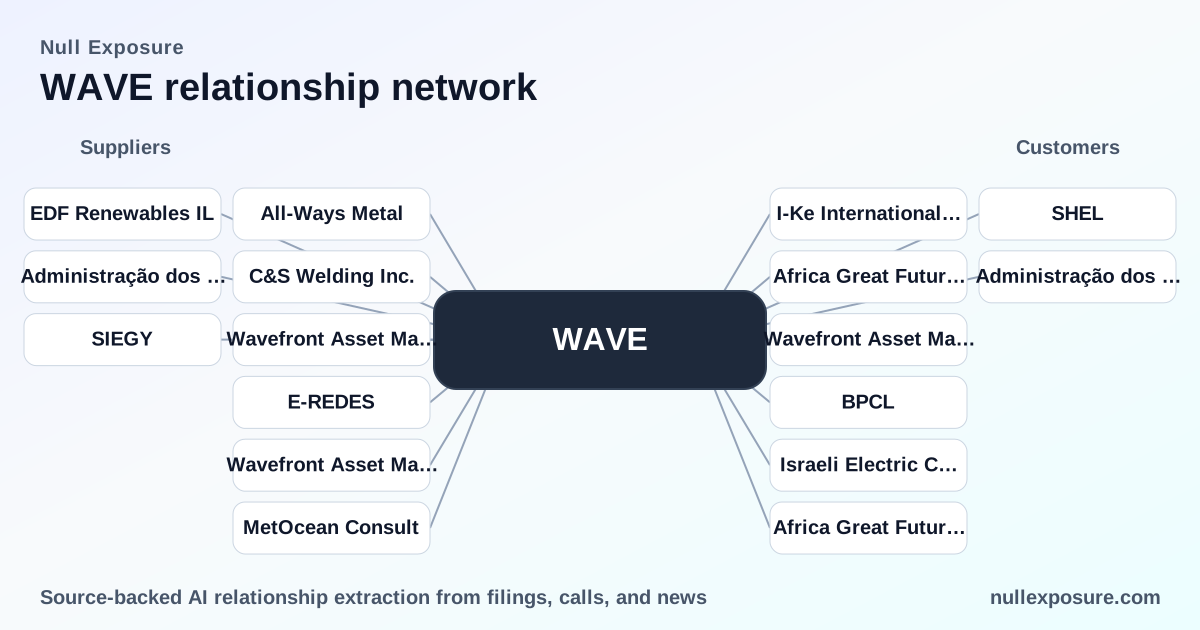
Eco Wave Power (WAVE): customer map and what it means for investors
Eco Wave Power develops onshore wave-energy conversion systems and monetizes through a mix of turnkey equipment sales, project development under concession or PPA structures, and strategic financing/co-investment arrangements that accelerate deployments while limiting direct capital expenditure. The company sells 100 kW–scale units and modular floaters, advances feasibility studies into commercial concessions, and leverages partners and funders to convert pilots into grid‑connected revenue — a capital-light commercial model when compared with incumbent offshore renewables. For a quick route to the primary relationship records, see https://nullexposure.com/.
Why partners matter for WAVE’s business model
Eco Wave Power’s commercial progress depends on three relationship vectors: strategic energy partners (co-investors and offtakers), local industrial manufacturers and port authorities (for scale and permitting), and financial lessors/funders (to enable medium-term leases and project finance). These relationships convert technical pilots into contracted revenue under PPAs or lease arrangements and are therefore the single biggest determinant of short-to-medium term cash flow trajectory for WAVE.
Bold takeaway: WAVE’s path to recurring revenue is partner-driven rather than hardware margins—project wins and finance structures move valuation more than unit sales alone.
Customer relationships and deal map — who WAVE is working with
Below are the relationships captured in public disclosures and press reports. Each entry is a plain-English snapshot with the cited source.
Africa Great Future Development (AGFDL)
Eco Wave Power signed a feasibility study agreement with Africa Great Future Development to evaluate a potential deployment at the Port of Ngqura in South Africa, representing a market-entry push into Africa. This engagement was disclosed in company announcements and referenced in FY2025/FY2026 reporting. (Eco Wave Power press release, FY2025; company reporting, FY2026)
I‑Ke International Ocean Energy (I‑Ke)
WAVE has a local manufacturing and turnkey agreement with I‑Ke in Taiwan, under which I‑Ke will locally produce floaters and procure a 100 kW turnkey unit from Eco Wave Power, supporting faster local deployment and permitting. (Water Power Magazine; FY2026 reporting)
H&R Block (HRB)
A MarketScreener article references H&R Block’s small-business product named “Wave,” but this mention refers to H&R Block’s software offering and is not connected to Eco Wave Power’s renewable-energy business. (MarketScreener news item, FY2026)
KT (Korean Telecom)
A South Korean media item mentioned “Wave” in the context of content services (Wave, Coupang Play and YouTube Premium); this reference is unrelated to Eco Wave Power’s technology and does not indicate a commercial relationship. (MK.co.kr report, FY2025)
Shell International Exploration and Production Inc.
Shell served as a strategic co-investor and pilot partner: Eco Wave Power completed a Port of Los Angeles pilot under a 2024 Pilot Test Agreement and submitted the final project completion report in March 2026, confirming achievement of the pilot objectives. Shell’s involvement includes co-investment and operational collaboration supporting U.S. commercialization efforts. (Company press releases and Newsfile/PR Newswire/Energy Global coverage; FY2026)
Shell Marine Renewable Energy / Shell (SHEL)
Operational collaboration with Shell’s marine renewables arm underpinned the U.S. pilot at the Port of Los Angeles; Eco Wave Power publicly framed this as a joint pilot launch and completion with Shell’s marine renewables business. (Newsfile/Finviz/Barchart coverage; FY2026)
Wavefront Asset Management Ltd
Eco Wave Power signed a letter of intent with Wavefront Asset Management for a funder/lessor model where Wavefront would acquire equipment and lease it to customers under medium-term finance leases, subject to due diligence—an important commercial pathway to convert secured projects into recurring lease revenue. (Energy Global, FY2026)
Bharat Petroleum Corporation Limited (BPCL) / Bharat Petroleum
WAVE signed a memorandum of understanding with Bharat Petroleum to explore wave energy deployment at the Mumbai Oil Terminal; subsequent filings indicate a pending BPCL purchase order for site assessment, marking progress from MOU to early procurement activity. (Company earnings call, 2025Q2; Newsfile press releases, FY2025–FY2026)
Israel Electric Corporation / Israeli Electric Corporation
The EWP‑EDF One project at Jaffa Port is described as Israel’s first grid‑connected wave-energy system and operates under a Power Purchase Agreement (PPA) with the national utility, the Israel Electric Corporation, providing WAVE its first operational PPA‑backed generation. (Newsfile press release and company filings, FY2025–FY2026)
EDF Power Solutions (EDF.PA)
EDF Power Solutions is cited as a co-funder of the EWP‑EDF One Jaffa Port project, signaling that established European utility groups are providing project-level capital support for WAVE’s early grid-connected installations. (Newsfile press release, FY2026)
Administração dos Portos do Douro, Leixões e Viana do Castelo (APDL)
Eco Wave Power holds a 20 MW concession agreement with APDL in Porto, Portugal, and is advancing the first megawatt‑scale installation under that concession, marking the company’s move from kilowatt pilots to megawatt-scale projects. (Company filings and WaterPowerMagazine, FY2026)
What the relationship map reveals about the operating model
- Contracting posture: WAVE operates primarily through project agreements (MOUs, feasibility studies, pilot test agreements, concessions and PPAs) rather than high-volume commodity sales. This is a project-development contracting posture that emphasizes staged risk allocation (study → pilot → PPA/concession).
- Customer concentration and geography: The partner roster is geographically diversified (Israel, Portugal, Taiwan, USA, India, South Africa), reducing single-market concentration risk but relying on a pipeline of successful local conversions.
- Criticality to customers: Early grid‑connected projects with PPAs (Israel) and port concession wins (Portugal) indicate commercial criticality where WAVE’s technology becomes integral to localized renewable generation plans. However, many relationships remain at feasibility or pilot stage, so commercial criticality is currently project‑specific rather than broad-based.
- Commercial maturity: The business is in a transition phase from R&D/pilot to commercial deployments; completion of the Shell‑backed Port of Los Angeles pilot and the APDL concession work represent movement toward repeatable project models, but revenue remains nascent and project-timed.
Investment implications and risk signals
- Upside drivers: Progressing pilots into PPAs and converting concession pipelines (APDL) into construction contracts would materially change revenue visibility; partnerships with Shell, EDF and regional port authorities are high-leverage endorsements that shorten the commercialization curve.
- Key risks: Execution risk on site assessments and purchase orders (e.g., BPCL), financing risk for capex‑heavy project phases (addressed partly by Wavefront LOI), and the timing risk of scaling from kilowatt to megawatt projects remain near-term hurdles. WAVE’s operating model depends on partners for permitting, local manufacturing and capital — a strength for capital efficiency but a dependency for cadence of cash flows.
For a full company‑level coverage and relationship timelines, visit https://nullexposure.com/.
Bottom line for investors
Eco Wave Power has structured a partner-centric route to commercialization: pilots validated with strategic energy majors (Shell), co-funding with utilities (EDF), municipal and port concessions (APDL), and targeted market entries (BPCL, AGFDL, I‑Ke). The company’s monetization is project and partner dependent; the near-term valuation swing will track the conversion of feasibility studies and pilots into PPAs, lease arrangements, and concession-supported construction contracts.