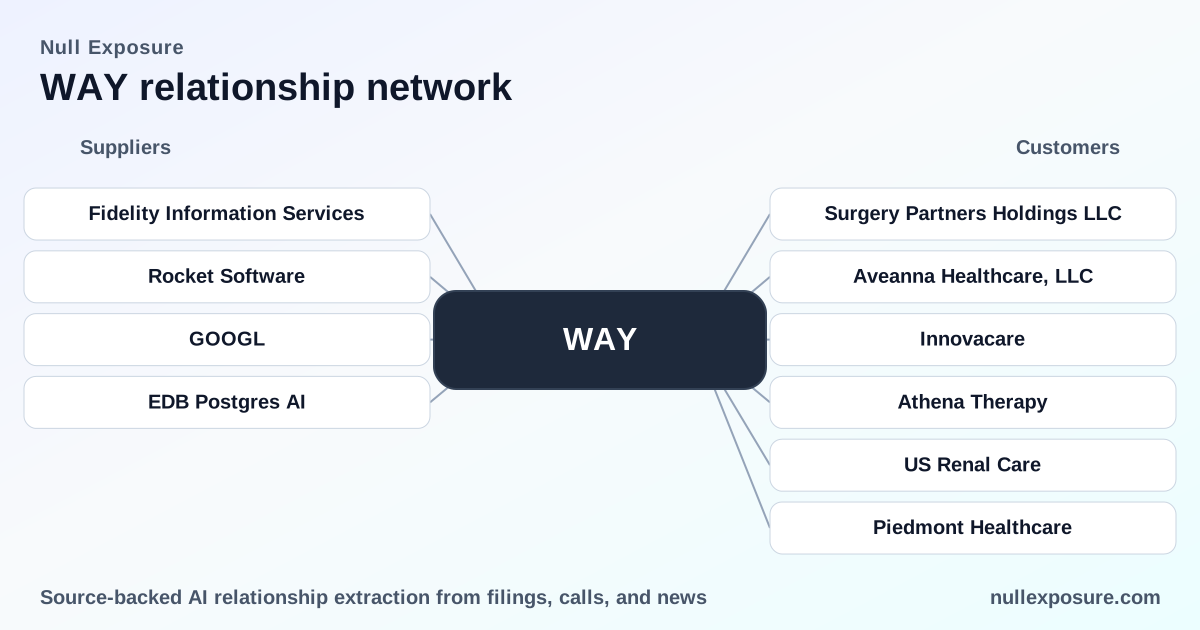
Waystar (WAY): Customer relationships that underpin recurring payments revenue
Waystar operates a mission‑critical cloud platform that simplifies healthcare payments for providers and health systems and monetizes primarily through recurring subscription fees and volume‑based transaction charges tied to payments and claim workflows. Its commercial posture is enterprise‑sales driven, with multi‑year contracts, automatic renewals, and predictable usage fees that together create high revenue visibility and strong retention dynamics—key features for investors assessing cash flow durability.
For a compact view of the coverage and to track additional client signals, see https://nullexposure.com/.
Why customers matter for Waystar’s investment case
Waystar’s core value proposition is operational: it replaces fragmented payments and reconciliation workflows with a single cloud platform that providers use daily. The company’s disclosures make the economics explicit: over 99% of revenue is recurring via subscriptions or predictable volume fees, and the firm recognizes subscription revenue ratably while variable volume fees are recognized as transactions occur. These characteristics produce high margin, predictable top‑line growth when client retention and transaction volumes are stable.
At the same time, Waystar is concentrated geographically and sectorally: the business operates predominantly in the United States and sells into healthcare providers and large health systems. Contract design—two‑ to three‑year terms with automatic one‑year renewals and standard escalators—supports renewal momentum but also establishes a refresh cadence investors should monitor for pricing resets and upsell opportunities.
What the 10‑K and news sources actually list as customers
The following names are all identified in the available disclosures and press coverage. Each entry below is a concise, plain‑English takeaway with source context.
Surgery Partners Holdings LLC
Waystar lists Surgery Partners Holdings LLC among its clients to whom it provides software solutions, indicating enterprise usage in surgical and ambulatory care settings. According to Waystar’s Form 10‑K for FY2024, Surgery Partners is explicitly named as a client. (Waystar 2024 Form 10‑K, FY2024)
Aveanna Healthcare, LLC
Aveanna Healthcare is named in Waystar’s FY2024 10‑K as a client, reflecting penetration into home‑based and post‑acute care providers that generate recurring transaction volumes. (Waystar 2024 Form 10‑K, FY2024)
Innovacare
Innovacare appears on Waystar’s FY2024 client list in the 10‑K, illustrating engagements with managed‑care focused provider organizations where claims and payments complexity drive platform adoption. (Waystar 2024 Form 10‑K, FY2024)
Athena Therapy
Athena Therapy is identified in the FY2024 10‑K as a Waystar customer, signaling usage within specialized therapy and rehabilitation service providers who rely on billing and payment orchestration. (Waystar 2024 Form 10‑K, FY2024)
US Renal Care
US Renal Care is included among named clients in the FY2024 10‑K, showing Waystar’s reach into dialysis and chronic‑care provider segments with steady treatment volumes and recurring revenue characteristics. (Waystar 2024 Form 10‑K, FY2024)
Piedmont Healthcare
Piedmont Healthcare, a Georgia‑based health system, is cited in March 2026 press coverage as a user of Waystar’s AI capabilities across the platform, illustrating both product innovation and a high‑profile system deployment that supports upsell narratives. A March 2026 PR Newswire release and subsequent pickup by market outlets discuss Piedmont’s deployment. (PR Newswire, March 2026; market coverage via Finviz, March 2026)
What these relationships tell investors about Waystar’s operating model
Treat the relationship roster and company disclosures as complementary signals rather than isolated facts. The 10‑K explicitly names multiple enterprise customers (Aveanna, Surgery Partners, Innovacare, Athena Therapy, US Renal Care), which confirms Waystar’s penetration across provider types. Separately, the Piedmont announcement demonstrates product momentum—specifically AI features—that supports upsell and differentiation.
Key operating model takeaways:
- Contracting posture: Waystar’s client deals are predominantly long‑term (two to three years) with automatic one‑year renewals and standard price escalators, which provides renewal visibility and embedded price increases (company 10‑K language).
- Revenue composition: Subscription and usage‑based pricing account for over 99% of revenue, balancing fixed recurring fees with variable transaction fees tied to volume—this lends both stability and scalability.
- Customer profile and criticality: The customer list skews toward large enterprises and health systems, and Waystar positions the platform as mission‑critical for daily payments operations, implying high switching costs once integrated.
- Geographic concentration: Operations and clients are primarily U.S.‑focused, reflecting exposure to U.S. healthcare reimbursement cycles and policy shifts.
- Relationship maturity: High retention is embedded—98% of 2024 revenue was from clients already under contract at the start of the year, indicating a renewing, active client base.
Together, these signals point to a highly recurring, predictable revenue model with enterprise client concentration—a mix that supports valuation corridors for SaaS‑like businesses but requires attention to macro healthcare volumes and contract renewal timing.
Investor implications and risk checklist
Investors should weigh the following implications from Waystar’s customer relationships and contract design:
- Visibility and cash flow: High recurring revenue and long‑term contracts create predictable cash flow and support multiple expansion if growth accelerates.
- Upside from product innovation: Adoption by large systems like Piedmont for AI functions validates product differentiation and creates upsell paths into analytics and automation.
- Concentration and geography risk: Heavy U.S. exposure and client concentration in healthcare settings concentrate revenue sensitivity to U.S. patient volumes, reimbursement changes, and policy.
- Renewal and pricing cycles: Automatic renewals and escalators provide in‑built pricing pressure relief, but major contract renewals with large clients are discrete events that can materially affect near‑term growth if churn or price concessions occur.
- Execution sensitivity: Because Waystar sells enterprise software that integrates into billing and payments workflows, implementation success and customer support quality directly affect retention and expansion.
A quick checklist for further due diligence:
- Monitor renewal timing and any large client choreography in quarterly filings.
- Track reported transaction volumes (revenue drivers) and any public wins or losses among major systems.
- Watch product announcements—particularly AI use cases—that convert platform capability into measurable revenue expansion.
For ongoing signals and relationship monitoring, visit https://nullexposure.com/ for updates.
Conclusion
Waystar’s disclosed customer roster and the company’s contract architecture establish a predictable, subscription‑plus‑usage revenue engine anchored in enterprise healthcare customers. Named clients in the FY2024 10‑K confirm broad provider coverage, and recent press coverage (Piedmont) highlights product traction in AI—both supportive for growth and margin expansion. The principal investor risks are concentrated geography and renewal timing; nevertheless, the combination of long‑term contracts, automatic renewal mechanics, and mission‑critical functionality makes Waystar’s customer base a durable foundation for recurring revenue.