Warner Bros. Discovery (WBD): how the company monetizes customers and where partners matter
Warner Bros. Discovery is a global media and entertainment company that monetizes content through content licensing, distribution fees, advertising sales, and direct-to-consumer (DTC) subscriptions. The business blends long-term licensing and carriage agreements with short-duration advertising and subscription revenue, and supplements growth through strategic minority investments and platform partnerships that extend international distribution. For investors, the revenue mix drives both steady cash flow from distributors and episodic upside from theatrical and streaming hits; this makes partner relationships a core driver of near-term revenue resilience and long-term scale. For more deal-level customer intelligence, see https://nullexposure.com/.
What WBD's customer contracts reveal about the operating model
WBD’s contracts reflect a hybrid posture: a mix of long-term and short-term commitments. Company filings and disclosures show fixed-price or minimum-guarantee distribution deals that extend multi-year (examples through 2031–2032) alongside advertising arrangements that are typically one year or less. Licensing is a central revenue stream: fixed fees for feature films and symbolic IP license arrangements are recognized either at inception or over the license term. The DTC business recognizes subscription fees over the subscription period, and the company reported 116.9 million DTC subscribers as of December 31, 2024, underscoring recurring revenue scale.
- Contracting posture: Combination of long-term distribution/licensing and short-term advertising/subscription contracts supports both revenue predictability and flexibility.
- Concentration and materiality: No single customer accounted for more than 10% of total consolidated revenues (2022–2024), but one customer represented 13% of distribution revenue in 2024, indicating pockets of distributor concentration within distribution revenue.
- Criticality: Relationships with distributors, DTC platforms and strategic regional partners are operationally critical for global reach and local monetization.
- Maturity: The company operates mature revenue streams (licensing, linear distribution) alongside expanding DTC and international distribution footprints (launches across LATAM, EMEA, APAC).
These company-level signals should shape underwriting of counterparties and counterparty concentration risk for investors and operators.
For deeper partner-level analysis and monitoring, visit https://nullexposure.com/.
Relationship rundown: every partner mentioned in public reporting
Below is a concise, source-linked summary for each partner referenced in the collection of documents and news items.
-
Hasbro (HAS) — Hasbro secured the primary toy license for the Harry Potter world tied to an upcoming HBO original Harry Potter series, positioning Hasbro to commercialize a premium global franchise with WBD. Source: Hasbro Q4/FY2025 commentary and Toy Fair announcements (InsiderMonkey, Feb–Mar 2026).
-
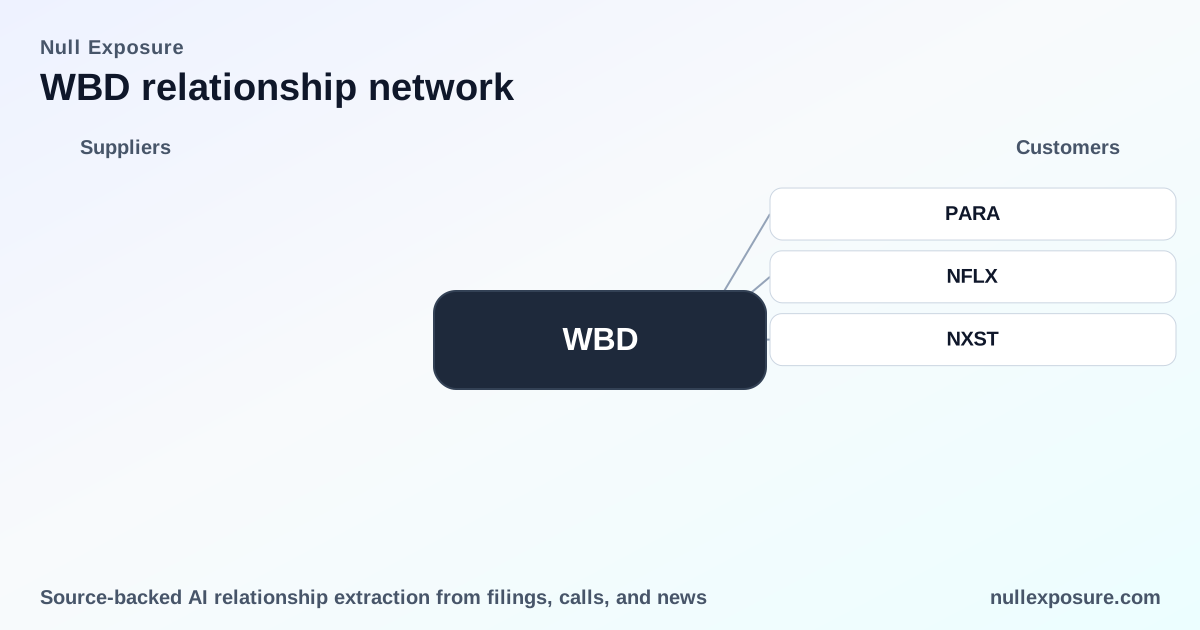
Netflix (NFLX) — Netflix entered and later walked away from an $83 billion agreement to acquire WBD streaming and studio assets; the bidding dynamics pushed competing offers and influenced market moves such as Netflix's buyback program reported in May 2026. Source: reporting on the 2026 bidding process (ComingSoon, Yahoo Finance, May 2026).
-
Paramount Skydance (PARA / PSKY) — Paramount Skydance produced a competing acquisition bid valued near $111 billion for WBD’s studios, HBO and linear networks, driving a high-profile consolidation contest. Source: Fortune coverage of 2026 M&A activity (Mar 2026).
-
Cinemark (CNK) — Cinemark characterized Warner Bros. as a significant studio partner for theatrical exhibition following a record-breaking 2025, signaling ongoing theatrical distribution importance to WBD box-office revenue. Source: Cinemark Q4 2025 earnings call transcript (InsiderMonkey, Mar 2026).
-
Anghami (ANGH) — WBD executed a $57 million minority investment in OSN Streaming Ltd. (Anghami’s majority owner), delivering exclusive HBO and Max Originals to Anghami and accelerating subscriber growth in MENA. Source: Anghami / OSN press releases and reporting on FY2025/H1 2025 results (TipRanks, PR Newswire, Investing.com, Mar–May 2026).
-
OSN Streaming Limited — WBD’s March 2025 minority investment in OSN Streaming Ltd. expanded content partnerships and committed to joint regional original production. Source: PR Newswire and subsequent Anghami reporting (Mar–May 2026).
-
Roku (ROKU) — Roku has deepened content partnerships with Warner Bros. Discovery Global to include hit titles, reinforcing WBD distribution to connected-TV platforms. Source: Roku reporting via Yahoo Finance (May 2026).
-
MNTN (MNTN) — Advertisers on MNTN can launch campaigns across 200+ premium streaming networks that include WBD-owned properties like CNN, indicating WBD’s scale in the programmatic/streaming ad ecosystem. Source: MNTN Q3 2025 call transcript (Investing.com, May 2026).
-
Funko (FNKO) — Funko announced a collaboration with Warner Bros. Discovery Global Consumer Products on a Harry Potter “Pop! Yourself” line, highlighting WBD’s consumer products licensing monetization. Source: Funko press release (Investor.Funko.com, 2024 release referenced in 2026 coverage).
-
IMAX (IMAX) — IMAX attributed record theatrical performance in part to multiple Warner Bros. theatrical releases that were filmed or released in IMAX formats, underlining WBD’s contribution to premium theatrical demand. Source: IMAX commentary and Q2 results coverage (MediaPlayNews, InsiderMonkey, Mar 2026).
-
The CW Network — The CW continues to air series produced by Warner Bros. Television (for example All American), reflecting ongoing content production and licensing relationships despite prior ownership changes. Source: The CW Network programming announcement (Nexstar/The CW press coverage, May 2026).
-
Nexstar (NXST) — WBD sold 75% of its interest in The CW to Nexstar in September 2022, a related-party transaction noted in WBD’s 2024 10‑K. Source: WBD 2024 Form 10‑K (filed Dec 31, 2024).
-
Hershey (HSY) — Hershey and WBD Global Consumer Products announced limited-edition Harry Potter–themed chocolates, a seasonal consumer-products licensing tie-up. Source: SnackandBakery coverage of the Hershey announcement (Mar 2026).
-
JioHotstar — WBD expanded distribution into India with HBO Max landing on JioHotstar, unlocking a major market for premium content distribution. Source: regional coverage of HBO Max India launch (SahmCapital, Apr–May 2026).
-
NetEase (NTES) — NetEase Games lists partnerships with major entertainment brands including Warner Bros., reflecting game development/licensing ties for IP-based titles. Source: NetEase Games program announcements (Dec 2025–Jan 2026 reporting).
-
Mattel (MAT) — Mattel’s licensing activity (e.g., regaining DC Comics toy license) follows the broader market of toy licensing for WBD-owned IP, indicating competitive licensing dynamics. Source: Mattel licensing news (ComicsBeat, Mar 2026).
-
Jakks Pacific (JAKK) — Industry commentary references WBD franchise launches and related licensing opportunities that support third-party toy and merchandise revenue streams, an indirect signal of WBD’s merchandising ecosystem. Source: Jakks Pacific Q1 2026 discussion (Investing.com, May 2026).
Investment implications and risks
- Diversified monetization but selective concentration: WBD’s revenue model blends recurring DTC subscriptions with material distribution license fees; the existence of a single distributor representing 13% of distribution revenue is a concentration risk within an otherwise broad customer base.
- Contract mix reduces volatility: Long-term licensing and minimum-guarantee distribution contracts provide base revenue while short-term advertising and subscription sales capture upside from hit content.
- Strategic investments expand regional reach: The $57 million OSN/Anghami investment exemplifies WBD’s strategy to secure regional exclusives and board influence to accelerate local subscriber growth.
- M&A interest is a valuation driver: The 2026 bidding activity and competing offers from Netflix and Paramount Skydance materially impact strategic optionality and potential valuation outcomes.
Warner Bros. Discovery operates at the intersection of stable distribution economics and high-variance content upside; underwriting should focus on counterparty concentration within distribution revenue, the longevity and renewal cadence of major carriage deals, and the performance of DTC subscriber growth across key international markets. For ongoing monitoring of counterparties and deal-level dynamics, visit https://nullexposure.com/.